
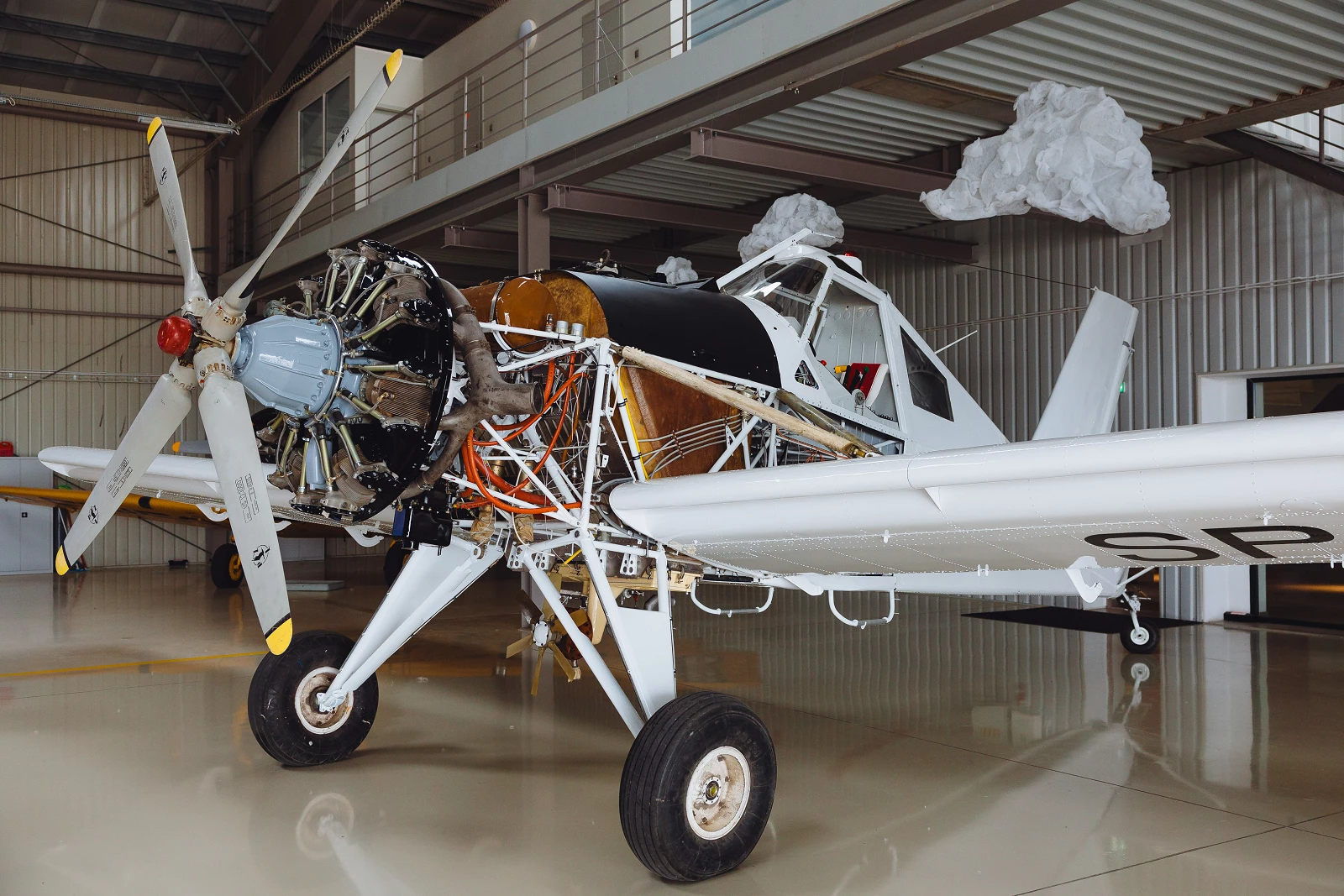
Restoration of the KRUK PZL-106 BR SP-ZCY – Background
The Most Challenging Project of the Polish Sky Monuments Foundation
On May 24, during the company picnic, a panel discussion was held on the restoration of the KRUK PZL-106 BR SP-ZCY to airworthy condition. The discussion, moderated by Piotr Rudzki, featured the following participants:Stanisław Borowski, Managing Director of Aero Club, Member of the Board, and President of the Polish Sky Heritage Foundation, Henryk Wicki, a mechanic and specialist in the restoration of historic aircraft, andKrzysztof Galus, a test and factory pilot involved in agricultural aviation.
Piotr Rudzki: Stanisław. An airplane that wasn't supposed to fly. Why are you restoring planes like this?
Stanisław Borowski: That’s a good question. The Polish Sky Heritage Foundation was established over a dozen years ago. It all started with the TS-8 Bies, which my father, Jan Borowski, and I bought at the Toruń airport, and which we later flew all over Poland. Then came another project: the “Bąk” motor glider. We established the Foundation because we felt that these aircraft are so unique that we wanted to preserve them… The aviation industry here is practically nonexistent, yet as you can see, quite a few of these were produced. We’d like the aircraft that Polish pilots flew—and those that are Polish designs—to continue flying. That’s the idea behind the Foundation.
Piotr Rudzki: How did KRUK end up with you?
Stanisław Borowski: This is a story unlike any other. The aircraft we currently own were acquired by us for the Polish Sky Heritage Foundation. KRUK is the first aircraft donated to the Foundation by a private individual, along with its parts. The restoration was completed fairly quickly. KRUK made its last flight in Sudan. The company that manufactured the engines was acquired by the Canadian firm Pratt & Whitney. They stopped producing and supporting repairs for these engines. Three such aircraft (in the best condition) were selected for conversion to turbine engines. They were shipped to Poland in containers, and after an analysis, PZL (the manufacturer) determined that the conversion was not feasible. The donor, who had been the commander of the aforementioned base in Sudan and a pilot, purchased one of them and donated it to us. We knew the aircraft was in terrible condition, but we took on the challenge nonetheless.
In the past, we restored a Yaka-11 that had been on display at a monument for over 50 years, so this wasn’t our first project of this kind. We had quite a few parts for the KRUK, and Henryk Wicki, who worked as a mechanic, stepped in to help.
Piotr Rudzki: Mr. Henryk, what does that process look like?
Henryk Wicki: When restoring such incomplete aircraft to flying condition, we have to start from scratch. We disassemble whatever we can, and whatever we can’t, we drill open to inspect each part separately. One problem was that this particular aircraft was somewhat incomplete after being dismantled in Africa, and certain parts were missing. However, the Foundation had 1.5 metric tons of parts for the KRUK. As is often the case, some parts are in surplus, while others are completely missing. While I was checking the inventory, a cardboard box containing 40 small windows from the upper part of the cockpit caught my eye—they’re hot-pressed from fairly thick plexiglass. That’s how it all began.
Piotr Rudzki: How does it work? Do you have to be an excellent engineer to tackle topics like this? Were there any particular challenges in this project?
Henryk Wicki: Sort of. Knowledge of the designs of other types is very important here. There are many recurring solutions based on Russian technical designs (units, subassemblies, components)—it’s a recurring pattern.
The size of the plane was a challenge for my small workshop. To get it out, I had to build a transport landing gear. Restoring a plane to flying condition after such a long hiatus is like rebuilding it from scratch—a tedious but rewarding task.
Piotr Rudzki: What stage are we currently at? How much time do we need for KRUK to take off?
Henryk Wicki: We want it to take off at the end of July this year. August is the absolute deadline.
Piotr Rudzki: Stanisław. Will it be possible to watch this test flight? Is it being conducted in complete secrecy?
Stanisław Borowski: Yes, we're planning a media event like this; we're already running a test run of it.
Piotr Rudzki: Mr. Krzysztof, when did you first come across KRUK? What has been your experience with it?
Krzysztof Galus: The first time I flew the Kruk was sometime in 1982 during a solo training flight. The way it worked was that you had to familiarize yourself with the flight manual for that aircraft, listen to the instructor’s advice, and that was it. The instructor would pick up the radio, and then we’d take off (the critical moment). A few maneuvers and then the landing—that was an even more critical moment. The KRUK has a unique design resulting from its intended purpose.
Initially, it was adapted for agricultural aviation. In other models, such as the Gawron, Yak-12, or An-2, the tank was located behind the pilot’s back. In the event of a collision, the tank would be torn loose and could crush the pilot. Here, a different system was developed, namely the following layout: engine, chemical tank, pilot’s cockpit. The tank was located immediately behind the engine (removable from the truss). The tank acts as a shock absorber, and the pilot’s cockpit is at the rear. The cockpit is designed to withstand approximately 40G of G-force. In a situation where the aircraft “flips onto its back,” a pilot who is strapped in has a good chance of survival.
Interestingly, in rear-wheel-drive airplanes like this one, you have to be careful when using the brakes, because the plane tends to tilt toward the engine or roll over onto its back. The KRUK, in versions with the lightweight 7-cylinder “Howler” engine as well as those with a reduction gearbox, has a large anti-rollover angle. You can be more aggressive with braking; if the control stick is pulled all the way back, you can even lock the wheels momentarily on grass, and nothing happens.
Piotr Rudzki: What is a flight like?
Krzysztof Galus: The altitude during granule spreading ranges from about 15 to 20 meters above ground level. The flight altitude for spraying is 1–2 meters. Altitudes considered safe over flat terrain were around 100 meters. So this involved flying below all safe altitudes. A special endorsement on the pilot’s license was required. The KRUK was designed from the outset as a specialized, multi-purpose aircraft—the tanks could be removed and used for other purposes. Attempts were made to use it as a firefighting aircraft, but it was a bit too small for that purpose. In Opole in 1987, it was successful in extinguishing small fires. An interesting fact is that the KRUK initially had a horizontal tailplane, positioned at the top. Loading took place diagonally from the rear, and it was decided that there would be more space either for a crane with a hopper or for a screw conveyor—the so-called “snake”—for feeding fertilizer. It turned out that the truss structure was too weak to withstand the twisting forces, and the tail swayed heavily from side to side. With the first KRUKs, people even said that when you’re flying, don’t look back—you’ll have a heart attack when you see what’s happening. The designers were initially unyielding. It wasn’t until one of the test pilots took the designers to Wilga for a formation flight that they took a much closer look at the issue—and the stabilizer was lowered.
Piotr Rudzki: Mr. Henryk, a quick question. I understand that this model won't have the "flying tail" problem? Will there be any other modifications here?
Henryk Wicki: On this KRUK, we’ve already moved the tailplane downward. In addition, the modifications have given us better monitoring of the engine’s operating parameters. However, the engine is old, so to monitor the parameters of each cylinder, we installed additional sensors for exhaust gas temperature and cylinder head temperature. Of course, this required additional electronics, which were not present on the original KRUK.
Piotr Rudzki: Mr. Krzysztof, what was it like to fly those planes?
Krzysztof Galus: Surprisingly, I had quite a lot of room in the KRUK. My head didn’t bump into anything. You could say that the seat’s contour made it possible to rub your spine raw. Two curves met here—one lordotic, designed by the engineer, meaning a flat molded section covered with thin foam and fabric. On the other hand, an “agro” pilot doesn’t sit leaning against the headrest but sits tensed up. So two curves met here—that of the back and the seat’s contour. After one of the flights, when a mechanic saw that I had blood on my T-shirt, he said, “Wait, this isn’t a modified seat.” And with the help of a hammer, the seat was modified right away :)
Piotr Rudzki: Stanisław, these aren't cheap things. How much money has been invested in this? Is it worth it? Does it pay off?
Stanisław Borowski: It’s definitely worth it, because it’s very rewarding. Is it profitable? Definitely not. We couldn’t sell any of these planes for as much as we’ve invested in them. However, the idea behind the Polish Sky Heritage Foundation is to keep these planes flying.
I am extremely proud that we are wrapping up this project. Just a little more patience, and we'll be able to pop the champagne.
Unpublished photos
As part of the overall project to restore the KRUK PZL-106 BR SP-ZCY to airworthy condition, we should also mention Mr. Wiesław Wasiluk, the donor who donated the “KRUK” to the Polish Sky Heritage Foundation. Furthermore, courtesy of Mr. Wiesław, you can view several unique photos from the beginning of the entire process.
![Image1.jpg [580.75 KB]](https://www.jbi.com.pl/storage/image/core_files/2026/6/17/8642b272508c9b9e7efddabf675cfeeb/jpg/jbinvestments/preview/Obraz1.webp)
![Image2.jpg [897.81 KB]](https://www.jbi.com.pl/storage/image/core_files/2026/6/17/1c69803fc0c5a8cb481c225239139bc8/jpg/jbinvestments/preview/Obraz2.webp)
![Image7.jpg [752.76 KB]](https://www.jbi.com.pl/storage/image/core_files/2026/6/17/b7b381118bf2dea236c9bc9511a56079/jpg/jbinvestments/preview/Obraz7.webp)
![Image8.jpg [192.84 KB]](https://www.jbi.com.pl/storage/image/core_files/2026/6/17/904c1ab6313142fc5720d6152ac4d06e/jpg/jbinvestments/preview/Obraz8.webp)
![Image4.jpg [3.35 MB]](https://www.jbi.com.pl/storage/image/core_files/2026/6/17/10f03f753c39888c7ae37d5e6e42c622/jpg/jbinvestments/preview/Obraz4.webp)
Final Countdown
All that’s left for us to do is wait for the “KRUK” test flights. Below are a few photos of the nearly completed aircraft from the company picnic held on May 24, 2026 (Mr. Henryk Wicki is pictured in the last photo). You can find a full account of the restoration in our news posts. Link to Part I:https://www.jbi.com.pl/aktualnosci/kruk-wraca-do-zycia---rusza-projekt---cz1-,240
Photos: JB Investments archives—all rights reserved


