
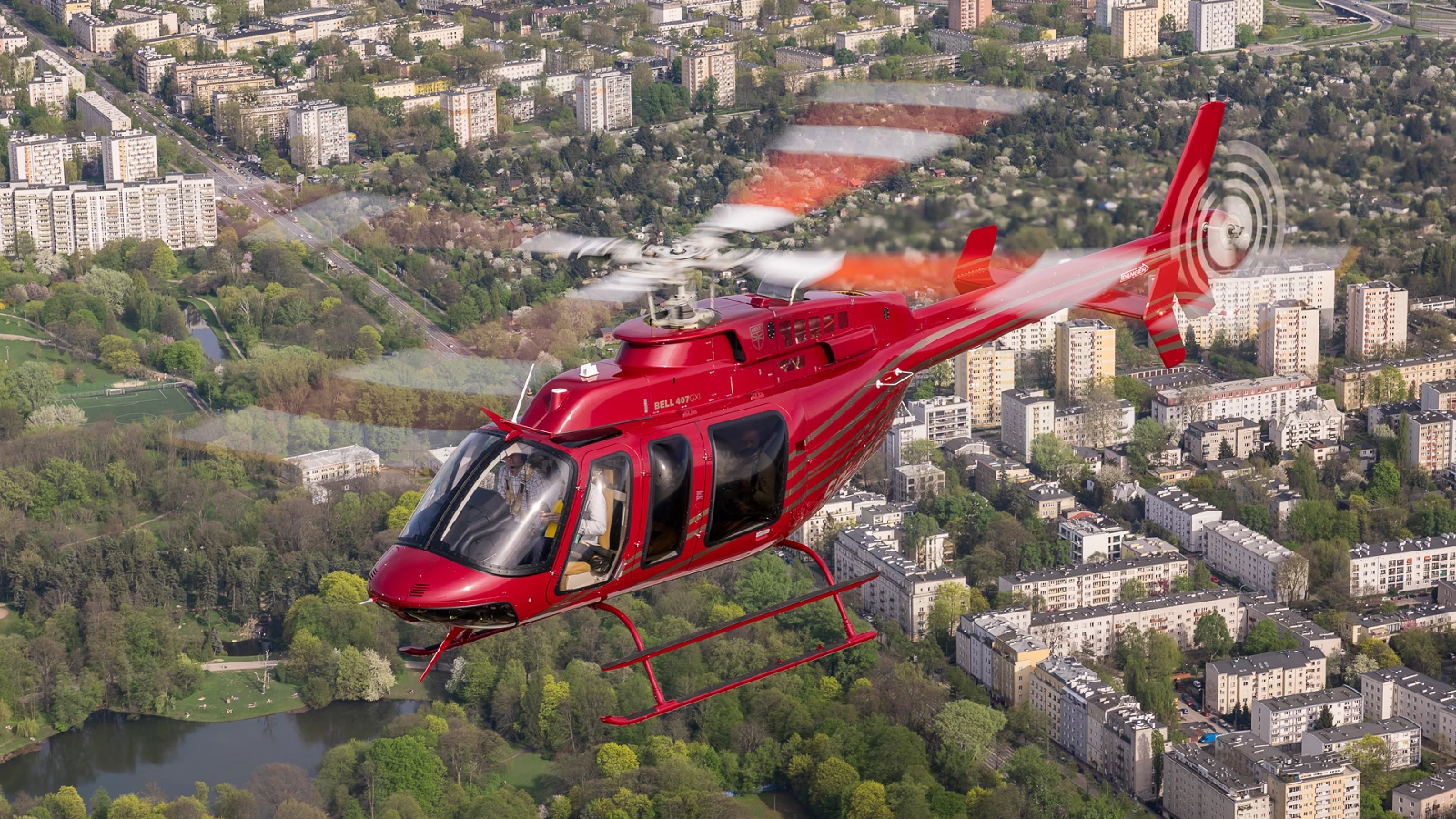
The Versatile Bell 407 GXi

Bell 407 GXI
The Bell 407 GXi for a Wide Range of Applications
The Bell 407GXi is a helicopter that is becoming increasingly popular in many sectors—including private aviation, government aviation, and even the military. In the springtime, Filip Modrzejewski takes us on a flight in the passenger version, which features a unique cherry-red color.
Spring is the perfect time to fly—temperatures aren’t too high yet and there isn’t much turbulence; the weather keeps getting better as the days grow longer, and the cities and forests are starting to turn greener and greener. So it’s no wonder that more and more people are taking to the skies during this time, which is why we teamed up with JB AeroClub to take a closer look at one of the newest helicopters registered in Poland—the Bell 407GXi.
On one of those warm afternoon days, I arrive at the airport in Konstancin, where I greet the pilot who will be flying the cherry-red Bell today—a pilot whose experience includes many other aircraft, both in the past and on a daily basis. The helicopter is already waiting in the hangar, ready for the customer to take delivery, and before that happens, we have the opportunity to take a closer look at it—it’s definitely a larger helicopter and can carry up to 6 passengers on board.
In the cockpit
Two pilots standing next to a helicopter—it goes without saying that the first thing we do is look at the cockpit. The experience is definitely different from that in an airplane—the cockpit is more centered and even shifted slightly to the right, since the pilot sits on the right (instead of on the left, as in an airplane). The two screens in the center are part of the G1000H-NXi system, along with a backup airspeed indicator and altimeter above them. Within the system itself, there aren’t too many differences compared to the airplane version, aside from the fact that the PFD screen is located on the right. The helicopter version also lacks an autopilot panel integrated into the G1000; instead, it’s located underneath on the center console.
The audio panel, of course, has built-in Bluetooth, allowing passengers to make phone calls while on the ground or play music from a phone or tablet. The throttle lever includes all the controls needed to start the engine, and the overhead panel controls the electrical systems, lighting, and cabin cooling system. I have to admit that the cockpit is very ergonomically designed, and the brand-new control stick and throttle, along with the new seats, make flying this helicopter very comfortable from the pilot’s perspective—the pilot confirms this, and I can see in his eyes a desire to take off as soon as possible.
The Bell 407GXi was not certified for IFR flights until 2019, and this equipment is available as an optional extra. The equipment required for such flights includes, among other things, an additional generator and an additional pilot’s tube, a larger onboard electrical power supply, a 3-axis autopilot (another option is a 2-axis autopilot), and a radio altimeter, which displays the helicopter’s altitude above ground with very high precision. The cockpit then features two additional switches for changing the pressure source or the generator operating mode. The owner of SP-API opted for the VFR-only version—this remains a very popular variant of this model, as single-engine helicopters certified for IFR flights are a less common solution and also require additional pilot training.
![B407_SPAPI_20240409_2411.jpg [1.42 MB]](https://www.jbi.com.pl/storage/image/core_files/2026/8/26/8fd65091d56f47da6c3f8f421c3c0bb2/jpg/jbinvestments/preview/B407_SPAPI_20240409_2411.webp)
On board
We close the front door and move to the rear of the helicopter—the first difference is the heavily tinted windows in the passenger compartment and the “protruding” windows. Incidentally, over 90% of the rear door consists of a window. This provides much greater flight comfort and space for passengers, as well as improved visibility thanks to the use of a special type of glass. The view outside is truly impressive.
In the rear, there are four seats arranged in a “club” configuration (2 + 2 facing each other), with comfortable armrests featuring drink holders between the seats. The seats are much wider than those in smaller helicopters or general aviation (GA) aircraft, and having tested them in person, I must admit that the comfort level is truly high. Each passenger has their own powered headphone jack (one plug instead of two, as in most aircraft), and there’s also a control panel for cabin heating and cooling on the center console. The rear of the helicopter features a spacious luggage compartment for additional suitcases or other items.
Flying in a helicopter—whether as a pilot or a passenger—has this “advantage” over airplanes: we can land almost anywhere! All it takes is a small open area, and we can operate from that location without needing a dedicated runway or airport. This makes it very easy and convenient to travel, for example, between home and the office or to various work meetings or private events, which ultimately saves a lot of time.
![B407_SPAPI_20240409_2558.jpg [1.34 MB]](https://www.jbi.com.pl/storage/image/core_files/2026/8/26/7435b7b1608433e1a7a985d1596f454a/jpg/jbinvestments/preview/B407_SPAPI_20240409_2558.webp)
In All Its Glory
We take the helicopter outside—where you can truly appreciate the color of this model. It’s not a bright red, but it’s not quite burgundy either; the term “cherry” fits it perfectly. The attention to detail is top-notch—on the engine cowling, you can see the official Bell logo and the 407GXi model designation in gold. On the right side, there’s also access to the fuel tank, which is painted to match—the helicopter can carry 480 liters of fuel, which translates to a range of about 620 km and the ability to stay airborne for 4 hours.
The most distinctive features at the front of the machine are, first and foremost, two protruding “shears” designed to cut through any wires or other objects in an emergency, preventing them from becoming entangled in the main rotor. This is a Bella design (also used in other machines) that significantly improves safety in extreme situations.
Looking at the helicopter from the front, it’s easy to mistake this model for the very popular Bell 206 Jet Ranger. The 407 was built based on the 206 Long Ranger version as a larger and highly advanced model—hence, many similar features can be seen, particularly in the shape of the front section. While some helicopters are available only with black skids, the Bell 407GXi allows you to match the skid color to the helicopter’s color, which enhances the visual appeal.
The helicopter is powered by a Rolls-Royce M250-C47E/4 turbine engine and features a dual FADEC system for engine control. It allows for flight at a maximum speed of 133 KTS, and the digital engine control system significantly reduces the pilot’s workload, a feature highly valued by many pilots. It is also worth noting that during flight and helicopter operations, the main rotor system tilts by 5 degrees depending on the flight phase, and the rotor blades move within a range of +/- 6 degrees.
![B407_SPAPI_20240409_2737.jpg [2.16 MB]](https://www.jbi.com.pl/storage/image/core_files/2026/8/26/eef35732ca262dbdefa7453197adb2f7/jpg/jbinvestments/preview/B407_SPAPI_20240409_2737.webp)
Applications in Poland and Around the World
While we wait for our flight to take off, the helicopter pilot explains that “the 407s are quite popular aircraft both worldwide and in Poland. SP-API will be used for private on-demand flights, just like several other aircraft of this type in the Polish registry. In addition, the Polish Police operates three identical Bell 407GXi helicopters (in a different configuration and with additional equipment).”
These helicopters are also very popular around the world—in Europe, the U.S., and Asia. A few examples include their use in the public sector as police helicopters, in emergency medical services as air ambulances, and for aerial firefighting (using an additional firefighting basket). .
The cabin’s many configuration options allow for a wide range of applications—the model shown here has four seats in the rear, but there are also variants with six seats or two (e.g., for the public sector, where the remaining space is occupied by camera control systems). In the medical variant, this helicopter has enough space to accommodate a full stretcher with a patient plus the crew on board, while the military variant features additional hardpoints on the left and right sides for weapon systems. These unique design features, combined with relatively low operating costs, greatly contribute to the popularity of this helicopter.
The Bell 407GXi, SP-API, is definitely an eye-catcher. After taking a closer look at it and snapping a few commemorative air-to-air shots, the helicopter heads off to its new home. As for us, we have very fond memories of these “aviation” days and encounters—may there be many more of them!
Text and photos:Filip Modrzejewski


