
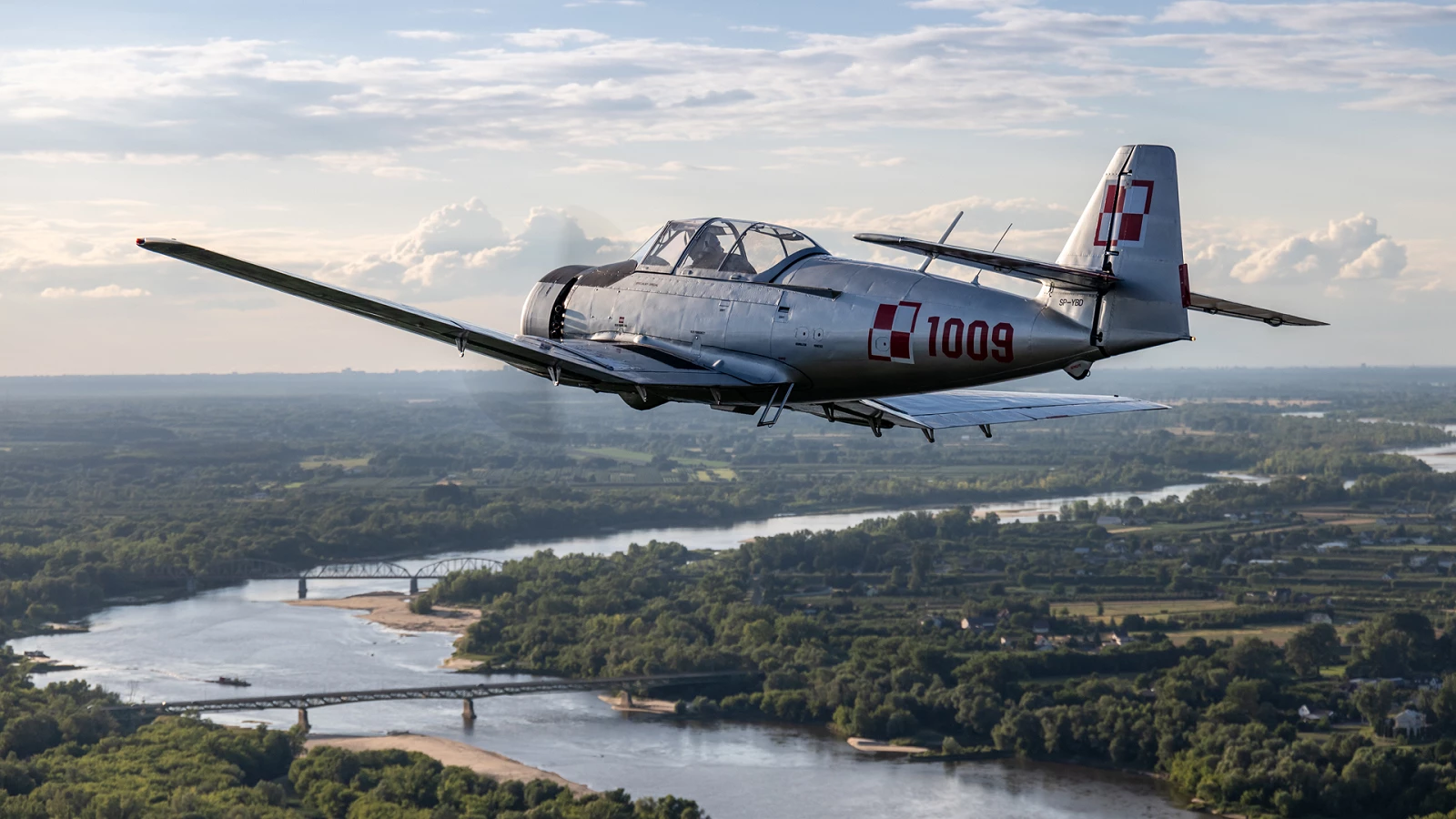
In the Air with Bies

The "Biesy" are aircraft well known in the history of Polish aviation, having trained a vast number of civilian and military pilots. Unfortunately, most of these aircraft have ended up as monuments or in museums… but not all of them! The Polish Sky Heritage Foundation maintains a TS-8 Bies in airworthy condition, and it’s still in excellent shape.
In mid-2023, there was some wonderful news—the TS-8 Bies SP-YBD (serial no. 1009) took to the skies again after a few years’ hiatus. Joy, delight, satisfaction, pride—these were certainly some of the emotions felt by many people. At the controls was Kamil Kruszczak, who, over the past two years, with the invaluable help of many wonderful people, had been working on the plane. Now he’s also showcasing it in flight. When he and Stanisław Borowski, President of the Polish Sky Heritage Foundation, suggested that I take a closer look at it, I couldn’t refuse.
Similar, yet different
In the past, the Bies was designed as a military training aircraft and performed well in its category and for its time. How does it compare to today’s training aircraft? “The biggest difference is the pneumatic system, which was very popular in aircraft designed in the East, unlike Western aircraft, which were already using hydraulic systems back then,” says Kamil.
Pneumatic systems use compressed air for all kinds of operations (e.g., deploying flaps or retracting the landing gear) and require a much deeper understanding from both the pilot and the mechanic. “They are more complicated to operate, tend to accumulate moisture, and require greater attention from the crew during maintenance. Additionally, the workload during maintenance is much greater compared to a hydraulic system. The only advantage I see is that in the event of a leak, there’s no visible stain under the aircraft,” adds Kamil.
The aircraft does not have a steerable nose wheel; taxiing direction is controlled by applying differential (including pneumatic) braking to the wheels. The brakes are operated by hand by squeezing a lever on the control column—just like in the AN-2—with the exception that there is no parking brake function. This comes as a bit of a surprise when, after starting the engine, we want to perform the usual pre-flight procedures in the cockpit—one hand must constantly hold the brake, so we sometimes find ourselves short on hands to perform other tasks. After consulting the documentation, the matter becomes clear. According to the manual, the role of the parking brake is performed by a mechanic with chocks, who, after the engine has warmed up and the pilot has conducted a test run, “folds up the boarding steps, removes the chocks, and salutes.” Compared to current designs, the Bies lacks cabin heating—but it also has no acoustic or thermal insulation in the fuselage. The engine’s heat is very noticeable in the front cabin.
It is worth noting that, despite being designed as a military training aircraft, the production models had no fixed armament and were not capable of carrying external loads. During its heyday, the Bies also set several national and international records—including an altitude of 7,084 m and a cruising speed of 317 km/h—which, of course, were records for this class of aircraft.
![TS8_20240702_8439.jpg [1.68 MB]](https://www.jbi.com.pl/storage/image/core_files/2026/10/7/ad746857d75abef6177196acae9c6e71/jpg/jbinvestments/preview/TS8_20240702_8439.webp)
Restaurant
The plane was found at the Toruń airport. After acquiring it in the 1990s, Jan and Stanisław Borowski began work on its restoration, and this project marked the beginning of the Polish Sky Heritage Foundation. It was an ambitious but achievable task.
The first step was to remove the wings and transport the plane to a hangar in Piaseczno, near Warsaw—the aircraft hadn’t flown in over a dozen years, so it required a thorough inspection. This task was undertaken by experienced mechanic Krzysztof Maruszewski, who had also assisted with other historic aircraft.
While the airframe was in good condition, many parts needed to be replaced due to wear and tear. As one might expect, the availability of such parts was—and remains—very limited, since no one manufactures them anymore. Despite this, over the many years of its existence, the FZPN was able to secure a large number of spare parts for this aircraft, which made it possible to complete the project.
“To ensure the aircraft could fly safely, we also had to replace the pneumatic system due to corrosion. During the inspection, we also discovered that one of the engine mount pipes was bent; it was replaced with a new one, and the engine truss was inspected using NDT testing. We also carried out a lot of preventive maintenance for the future,” adds Kamil.
After several years of hard work by many people, the plane was transported to Konstancin, where Jan Borowski was at the controls for a long time—over a period of about 25 years, he logged more than 200 hours flying this plane. That may not seem like much, but it’s important to remember that each flight required (and still requires) at least a dozen or so hours of work by mechanics. The aircraft flew mainly at air shows in Poland—including in Radom, Góraszka, Kraków, Gdańsk, and Mielec. Its farthest trip was a presentation at an air show in Belgium, over 650 NM from its home airport.
During its flying career, under the supervision of the Polish Sky Heritage Foundation, SP-YBD also underwent a second and third overhaul, and thanks to a grant from the JB Aero Club, the aircraft continues to be maintained in airworthy condition. Since it took to the skies again and throughout the work involved, the aircraft has been cared for by one of the protagonists of this article—Kamil Kruszczak—who is not only a licensed mechanic but also one of the very few pilots currently flying the TS-8 Bies.
![TS8_20240702_8595.jpg [1.62 MB]](https://www.jbi.com.pl/storage/image/core_files/2026/10/7/2fb4e057891fd6c46a88987ca4844734/jpg/jbinvestments/preview/TS8_20240702_8595.webp)
Let's go
Time to fly—Kamil’s at the controls. After starting the engine (pneumatic start—just like in the Wilga or Yak), we warm up the engine and do a test run on the ground—this is where a third crew member comes in handy. We taxi out to the runway, set the small flaps, and pick up speed quite smoothly. Rotation at 90 km/h, takeoff at 110 km/h, then 150 km/h and up we go. We retract the landing gear and accelerate to a speed of about 220 km/h—the 330 KM WN3 engine has only 7 cylinders, but it runs very smoothly above 2,000 RPM.
Once the flight has stabilized, Kamil explains how the pneumatic system works: “The minimum pressure required to operate the flaps, landing gear, and brakes is 25 atm. Completing a full cycle of retracting and extending the flaps and landing gear consumes about 10 atmospheres, and recharging the system takes about 12 minutes of engine operation at cruise RPM. The result: fast, 6-minute turns cannot be performed—there won’t be enough pressure...”
A scan of the cockpit reveals a distinctive light-blue instrument panel with original gauges in metric units (km/h and meters). The artificial horizon is “aerobatic”—with the ground at the top and the sky at the bottom. The Polish Sky Heritage Foundation wanted to preserve this aircraft in as original a condition as possible; the onboard equipment has been modernized as little as possible. The right side of the cockpit is occupied by huge panels for controlling the radio compass, complete with cranks for setting the frequency.
Before landing, we check the pressure in the compressed air cylinder—it’s at 40 atmospheres, so everything should work. We slow down to about 150 km/h, extend the small flaps and the landing gear, and approach at a shallow angle, which gives us good visibility. Extending the landing gear requires first moving the control valve to the retracted position. This builds up the necessary pressure in the system, which causes the mechanisms to open smoothly. If we move the valve from the neutral position directly to the extended position, the landing gear will open very abruptly, which in extreme cases could damage it. We maintain a speed of 130 km/h over the threshold and touch down—it is worth noting that during the level-out and hold phase, we must pull back on the control stick with considerable force.
Flying a historic aircraft is a great pleasure, but also a great responsibility. Thanks to the enthusiasm and passion for aviation, we can admire these aircraft in excellent condition. Future plans for this aircraft include participating in various events and air shows, as well as promoting aviation, so we will certainly see it in the skies over Poland and abroad many more times.
Text and photos:Filip Modrzejewski


