
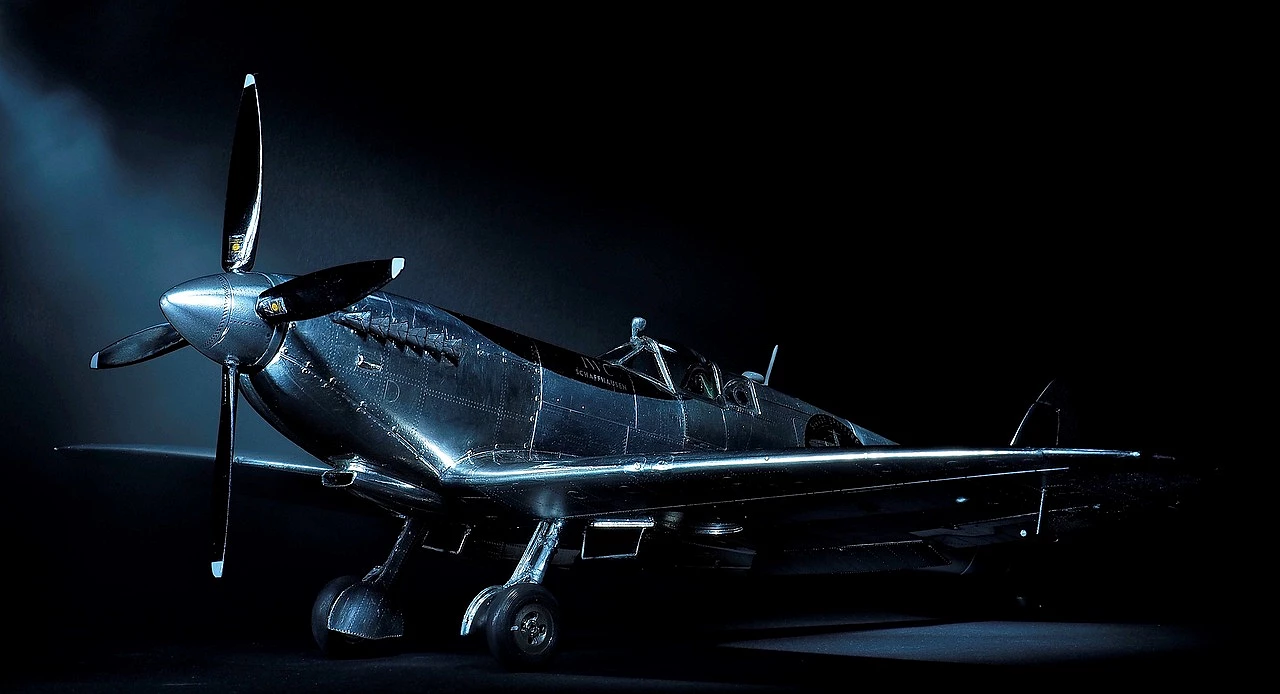
Supermarine Spitfire – an icon that changed the course of the Battle of Britain
series - Machines that changed the sky
Supermarine Spitfire – an icon that changed the course of the Battle of Britain
There are projects in the history of engineering that go beyond their purely functional purpose and become works of art. In the automotive world, this is the Jaguar E-Type, and in aviation, it is undoubtedly the Supermarine Spitfire. Its elliptical wings and the distinctive sound of its Rolls-Royce Merlin engine are recognizable in every corner of the globe.
However, this British fighter is more than just aesthetic perfection. It is a machine that, in the summer of 1940, became the only barrier between the Nazi war machine and a free Great Britain. Discover the history of R.J. Mitchell's masterpiece—the fighter that became a legend of the Battle of Britain.
From racing to fighting for survival
To understand the Spitfire phenomenon, you have to go back to the 1920s and the prestigious Schneider Cup races. It was there that the brilliant designer Reginald J. Mitchell designed incredibly fast seaplanes for Supermarine. His machines broke speed records, teaching engineers how to minimize air resistance and get the most power out of engines.
When the specter of war loomed over Europe, Mitchell used this experience to create a fighter plane. He moved away from angular, canvas-covered designs. He created an all-metal low-wing aircraft with a slender, aerodynamic silhouette. Unfortunately, Mitchell died of cancer in 1937, just one year after the prototype's maiden flight, without living to see the moment when his creation saved the country.
The wing that changed everything
What set the Supermarine Spitfire apart from its competitors—including its main rival, the German Messerschmitt Bf 109—was its unique elliptical wing. This shape was not a stylistic whim. It had a specific engineering rationale.
The elliptical outline allowed for the creation of the thinnest possible wing profile while maintaining a large wing area. The result was minimal air resistance at high speeds and excellent maneuverability. In addition, the wide wing root provided enough space to mount eight machine guns (and later cannons), giving the Spitfire powerful firepower without the need to mount weapons in the fuselage and synchronize them with the propeller.
![5.jpg [399.69 KB]](https://www.jbi.com.pl/storage/image/core_files/2026/2/5/a85f1de395de85a3cfbc11d41ab35dcd/jpg/jbinvestments/preview/5.webp)
The heart of the beast: Rolls-Royce Merlin
No aircraft can pass the test without the right engine. The heart of the Spitfire was the legendary V12 Rolls-Royce Merlin engine. It was a 27-liter unit, which in its early versions generated over 1,000 horsepower.
The sound of the Merlin—a deep growl—still sends shivers down the spines of aviation enthusiasts. However, something else was more important for British aviation: the Merlin was extremely susceptible to modifications. During the war, Rolls-Royce engineers constantly increased its power (using increasingly efficient compressors), allowing the Spitfire to evolve and keep pace with newer enemy designs until 1945.
The Battle of Britain – the ultimate test
In the summer of 1940, the most important air battle in history took place. The Luftwaffe launched thousands of bombers and fighters against Great Britain. They were confronted by RAF pilots in their Hurricanes and Spitfires.
Although the Hurricane was more numerous and took on the burden of fighting the bombers, it was the Supermarine Spitfire that became the symbol of this victory. It was the Spitfires that engaged the German fighter escort. They were faster than the Hurricanes and were the only ones capable of fighting the Messerschmitt Bf 109E on equal terms.
German pilots respected this machine. There is a famous anecdote about Adolf Galland, a Luftwaffe ace, who, when asked by Hermann Göring what he needed to win the battle, replied, "Squadrons of Spitfires." This British fighter was superior to German machines in terms of horizontal maneuverability – it was unbeatable in dogfights.
Symbiosis between the pilot and the machine
The veterans' memories are consistent – the Spitfire was incredibly easy to fly. Unlike many fighter planes of the time, which required considerable physical strength to perform sudden maneuvers, Mitchell's machine responded almost to the pilot's every thought.
The controls were intuitive and precise. The cockpit, although cramped, provided excellent visibility, and the aircraft remained stable even in extreme flight conditions. This was important for tired, often untrained pilots who had to take off for combat several times a day. Thanks to its excellent aerodynamics, the Spitfire forgave many piloting errors, allowing the pilot to focus on what was most important – aiming and survival.
![9.jpg [168.44 KB]](https://www.jbi.com.pl/storage/image/core_files/2026/2/5/afafb7049c1dada5ebdbc2fa423825f6/jpg/jbinvestments/preview/9.webp)
Heritage
The Spitfire was the only Allied fighter aircraft produced continuously throughout World War II – from the first to the last day of the conflict. Over 20,000 units were built in dozens of versions – from fighters and reconnaissance aircraft to carrier-based versions (Seafire).
Today, more than 80 years after its debut, the Spitfire remains an icon. It is proof that in extreme situations, a combination of ingenious engineering, the courage of pilots, and the determination of a nation can change the course of history. For modern aviation, it is a reminder that perfect aerodynamics never go out of style – the Spitfire's silhouette is still considered one of the most perfect shapes ever created by man.
Interesting facts about the Spitfire that will surprise even aviation enthusiasts
1. A name that sparked controversy
The name "Spitfire" (literally "hothead" or "fiery") was not initially to everyone's liking. Some decision-makers considered it too frivolous for a serious RAF fighter. Ultimately, however, it caught on so well that today it is difficult to imagine any other name for this design.
2. Production was a logistical nightmare.
The elliptical wing, which gave the Spitfire its aerodynamic advantage, was also extremely difficult and time-consuming to manufacture. It required tremendous precision and many man-hours—far more than the simpler Hurricane wing. This is one of the reasons why the Hurricane was built faster and in greater numbers during the early stages of the war.
3. The Spitfire flew faster than the speed of sound... in a dive.
During the war, pilots tested the limits of the aircraft's capabilities. In 1944, one of the RAF pilots reached a speed close to the sound barrier during a steep dive. Although it was not a supersonic flight in the full sense of the word, the structure withstood extreme loads, which was impressive for a design from the 1930s.
4. Over 20 versions were created – and each one was different.
From the first Mk I with a Merlin engine, through high-altitude reconnaissance versions without weapons, to variants with a powerful Griffon engine and five-bladed propeller, the Spitfire evolved almost continuously. Some late versions reached speeds exceeding 710 km/h, making them among the fastest piston-engine fighters in the world.
5. Poland's mark on the history of the Spitfire
Polish pilots, including those from Squadron 303, played a huge role in the Battle of Britain. Although they mainly flew Hurricanes, they later also successfully piloted Spitfires in offensive operations over occupied Europe. Their combat effectiveness was among the highest in the entire RAF.
6. The Germans tested captured specimens.
It happened that serviceable Spitfires fell into the hands of the Luftwaffe. They were thoroughly examined and even test flown by German test pilots. Their performance was analyzed in order to develop more effective combat tactics.
7. They still fly today—and cost a fortune.
Flying Spitfires can still be seen in the air at air shows in the UK and the US. Their restoration is a process that takes years, and the market value of a single aircraft can exceed several million pounds. The distinctive sound of the Merlin engine continues to draw crowds.
JB Investments LLC (all rights reserved)
The photos are from the pixabay.com library—under the standard licensehttps://www.istockphoto.com/pl/help/licenses


