Double the Power with Extras - DA42-VI

The Diamond DA42 has been on the market for quite some time, and it’s owned by both flight schools and private owners. Filip Modrzejewski takes a closer look at what makes the DA42 so popular and how it stacks up against the competition, and he also takes us on a journey through the Tatra Mountains.
I’ve flown Diamond aircraft many times—mainly single-engine models. When the opportunity arose to take a few flights aboard a DA42 and meet its owner, Tomek, in Kraków, I began to appreciate the additional features and the advantages of twin engines even more. Given the chance to fly together in the Tatra Mountains, I couldn’t say no, and after the flight, my interest in this aircraft grew even more.
Unique Diamond
Tomek, the owner of the DA42-VI with registration SP-TWH, is a true aviation enthusiast. His hangar also houses, among others, a Carbon Cub, an Extra 300, and a Pipistrel Virus. We flew the first two aircraft a year ago to take aerial photos against the backdrop of fall colors. Now we’ve met up again to see, learn about, and photograph the newest addition to his collection—the DA42.
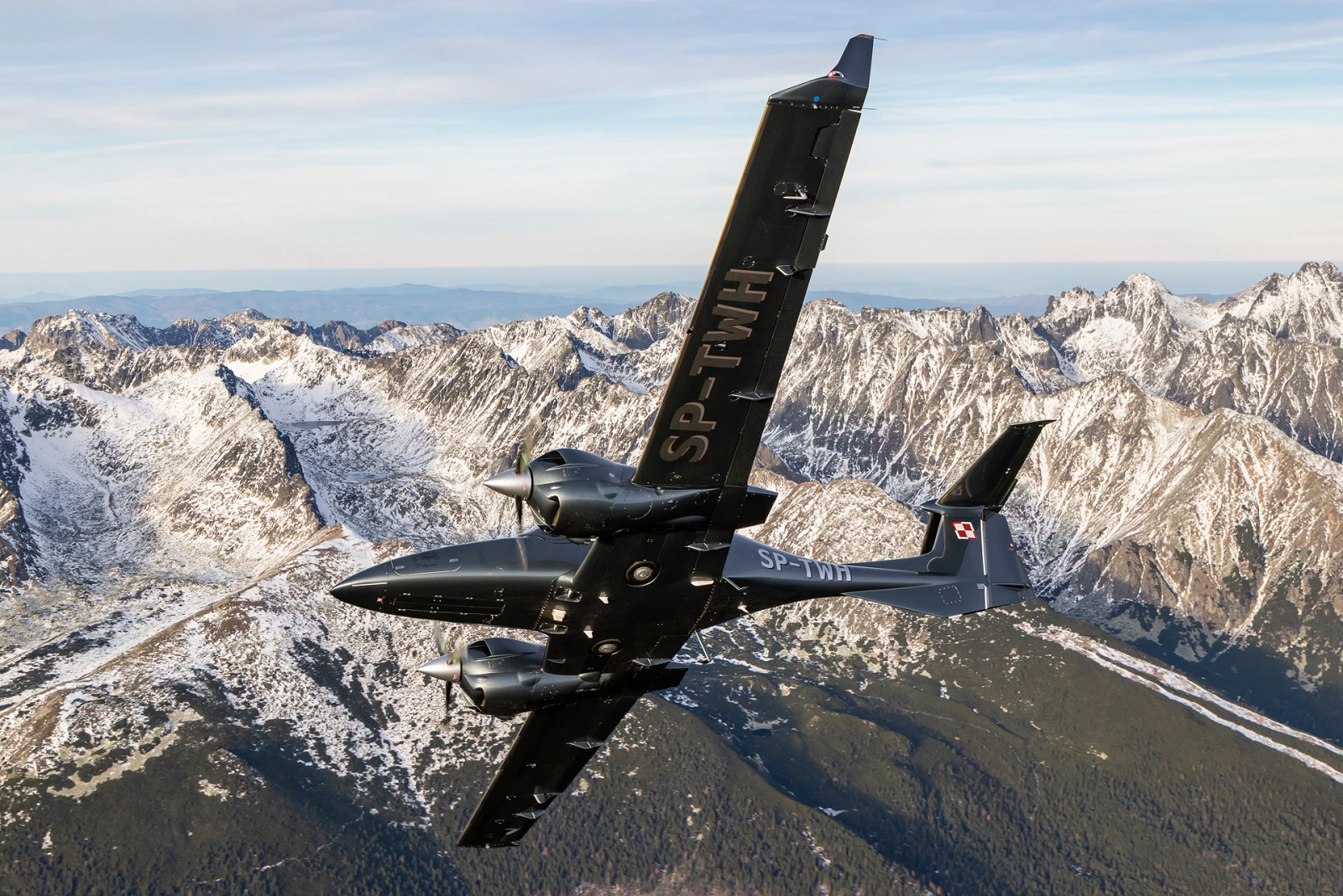
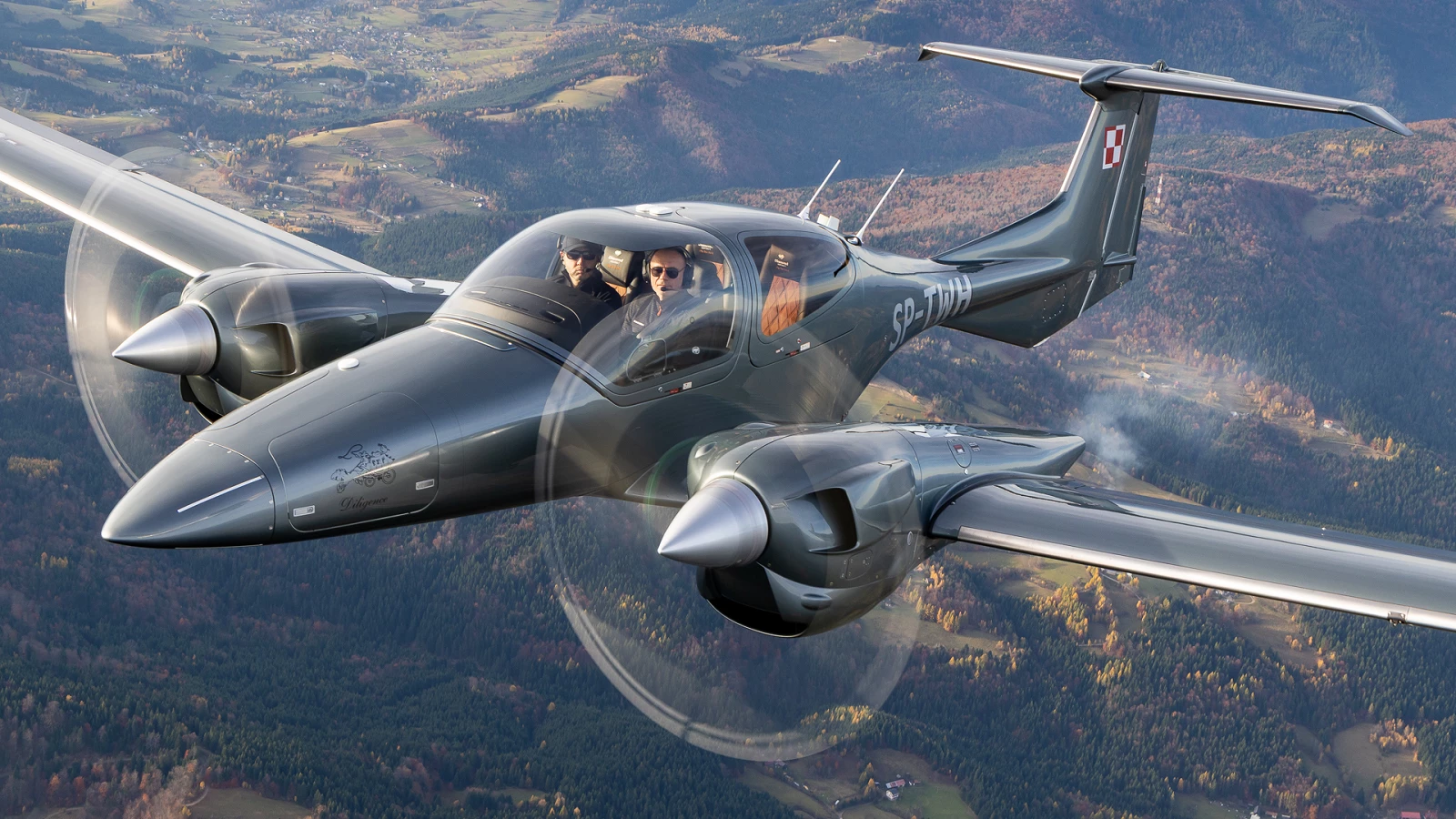
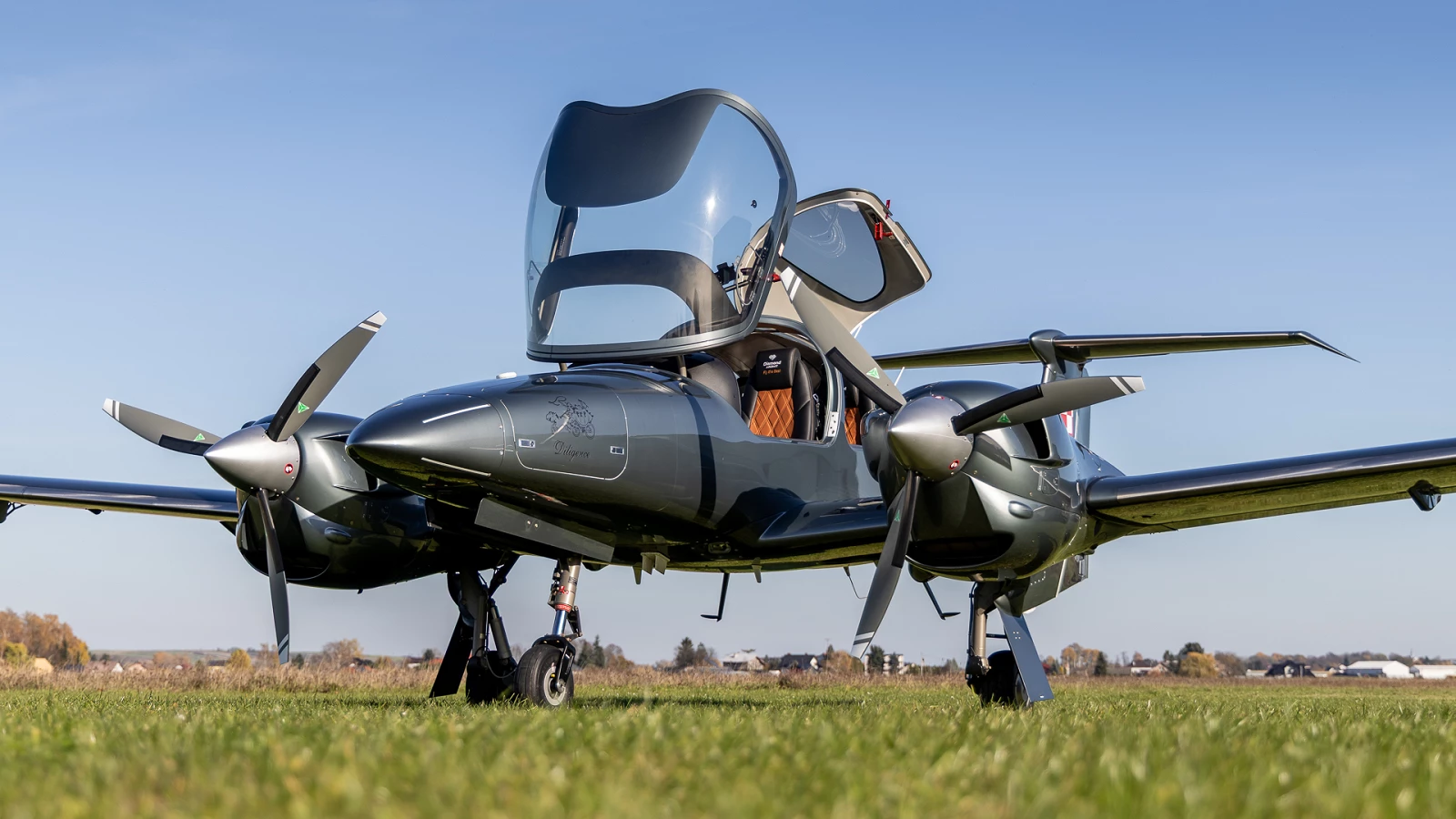
When the hangar door opens, I’m greeted by the beautiful lines of the gray Diamond, which looks very stately on the ground. I notice the plane’s name, “Diligence,” and the image of a real stagecoach on the nose of the aircraft. “I can take four peopleonboard, and we usually use this plane for longer trips; we joke then that we’re traveling somewhere by stagecoach, not by plane,” says Tomek.
The tail also features the Polish Air Force’s checkerboard pattern (instead of the typical flag), and all elements—such as the registration number and wing tips—have custom silver finishes. The interior also has its own unique character. The black-and-brown seats and leather accents blend very well with the rest of the aircraft. Inside, you can actually feel like you’re in a real stagecoach.
![DA42_SPTWH_20251031_9470.jpg [1.65 MB]](https://www.jbi.com.pl/storage/image/core_files/2025/11/12/f4d1c7077adf59083817aab2752f8301/jpg/jbinvestments/preview/DA42_SPTWH_20251031_9470.webp)
6th generation
The DA42-VI is the latest variant of Diamond's flagship twin-engine model; previously, we've seen the Twin Star (the original DA42) and Next Generation (DA42 NG) versions in flight.
The DA42 Twin Star was certified in 2004 by EASA and later, in 2005, by the FAA. It was this version that made its market debut as Diamond Aircraft’s first twin-engine aircraft, which at the time faced little competition in Europe. The aircraft were powered by Thielert/Centurion engines and featured a fairly diverse range of avionics. After the engine manufacturer went out of business, Diamond had to find another solution to keep its model in production.
This is how the next version of the aircraft, the Next Generation (NG), was developed—equipped with Austro Engine AE300 engines (168 KM) and a FADEC system for controlling engines powered by Jet-A1 fuel. It was a major revolution in aviation, and at the same time a huge improvement in opoperations, a reduction in operating costs, and improved fuel availability in many locations. These aircraft came factory-equipped with Garmin G1000 avionics and gained recognition among many pilots, particularly thanks to their speeds in the range of 150–175 KTAS.
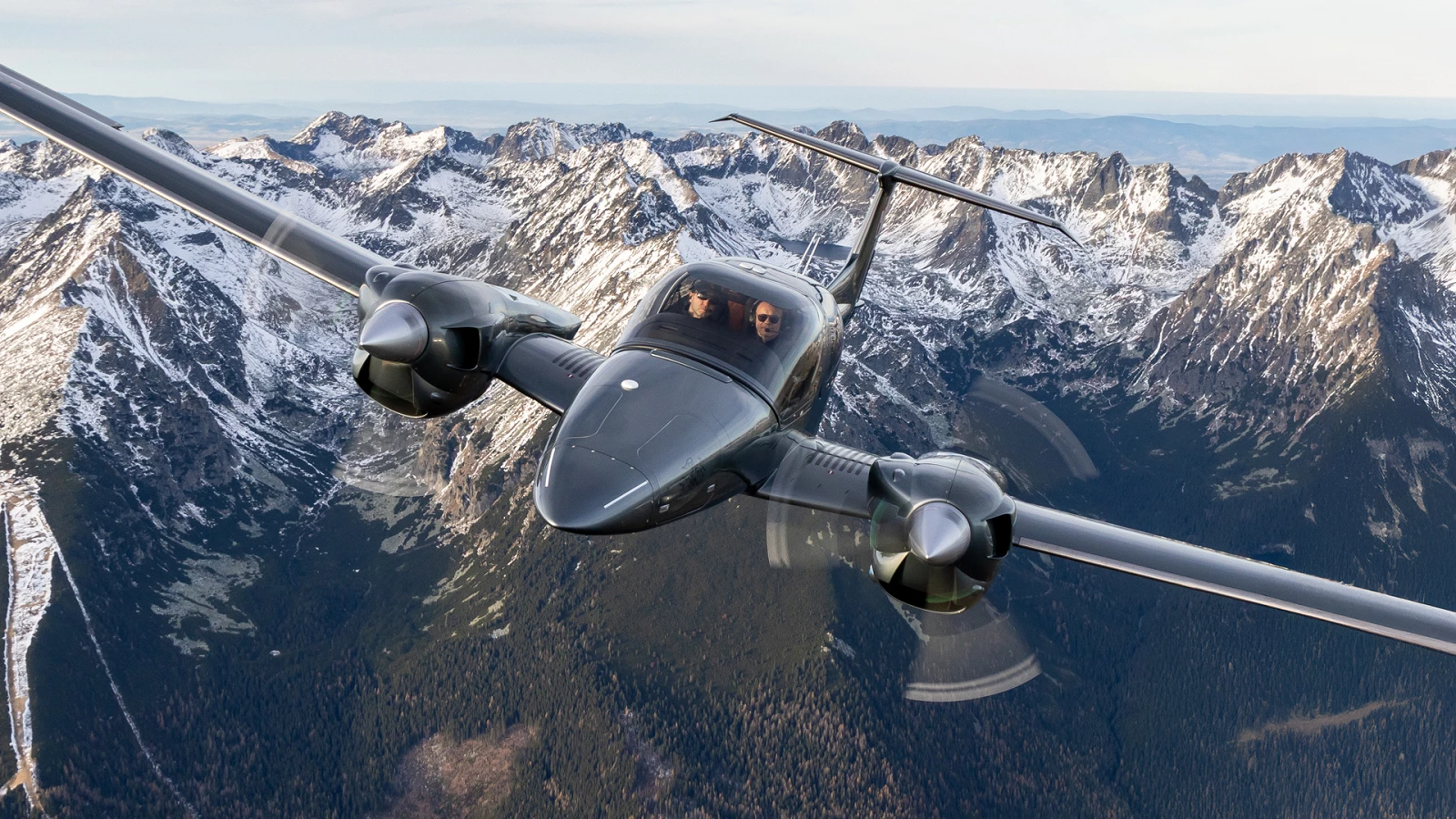
Finally, in March 2012, the current version of the DA42—the DA42-VI—made its debut. The main design changes include improved engine cowlings and aerodynamic modifications to the aircraft’s tail section, along with an improved TKS system (and FIKI certification). In addition, the propellers were replaced with 3-blade versions. These modifications resulted in improved climb performance, as well as a higher cruise speed (175–180 KTAS) and lower fuel consumption. From that point on, the aircraft was also equipped with Garmin G1000 NXi avionics and a GFC 700 autopilot.
![DA42_SPTWH_20251031_9623.jpg [1.66 MB]](https://www.jbi.com.pl/storage/image/core_files/2025/11/12/11da6597677e5ac5661ff5324fbc7001/jpg/jbinvestments/preview/DA42_SPTWH_20251031_9623.webp)
For private owners
The SP-TWH is a very good example of how the DA42 performs well in the hands of private owner-pilots. Many of them value the safety and high reliability not only of Diamond aircraft, but also of twin-engine aircraft. “When flying IFR in clouds, the fact that we have two engines gives me an added sense of security, because in the event of any failure, I still have a second engine that will help me land even in difficult conditions,” says Tomek.
We must also not forget the oxygen system, which allows for flights at altitudes as high as FL180, thereby enabling pilots to avoid certain areas of bad weather at lower altitudes. Additionally, the TKS system on the wings and tailplane, along with heated propellers (including FIKI certification—Flight Into Known Icing), also helps significantly reduce restrictions on IFR flights, especially during the colder months. In the summer, meanwhile, you can take advantage of the factory-installed air conditioning and weather radar, which not only enhance comfort but also improve situational awareness on board.
Whether flying as private owners or with family and friends, everyone values a comfortable flight. While I’ve heard opinions that the DA42 is simply a twin-engine version of the DA40, that’s not entirely accurate. While the size and layout of the cabin are the same, the rear luggage compartment is very similar to that of the DA40; however, in the nose of the aircraft, there are two additional luggage compartments that can easily accommodate a suitcase or a carry-on bag.
When we add a weather radar, a range of over 1,100 nm, and a total fuel consumption of approximately 40 l/h to the above features, this gives us a range covering almost all of Europe without any additional stops. It’s the ideal solution for people who travel for both business and pleasure. It’s no surprise, then, that this aircraft is popular among many pilot-owners.
![DA42_SPTWH_20251031_9955.jpg [1.49 MB]](https://www.jbi.com.pl/storage/image/core_files/2025/11/12/d0c8c31998c8241407a8b19032c1abbb/jpg/jbinvestments/preview/DA42_SPTWH_20251031_9955.webp)
For flight schools
As I mentioned earlier, and as is easy to see when browsing the offerings of various flight schools—not only in Europe, but also in the U.S. and Asia—the DA42 is a very popular aircraft in their fleets. It’s particularly popular for Multi-Engine and Instrument Rating training. Why is the DA42 so popular? Several factors contribute to this.
One of the key aspects is the aircraft’s reliability and operating costs, which are much lower compared to competing models—mainly due to engines powered by JET-A1 fuel, which also consume much less fuel (approx. 40 liters per hour). Despite its low fuel consumption, the aircraft can still maintain reasonable approach speeds (in the 150 KIAS range), which allows for training even at busier commercial airports.
The second factor is safety—Diamond aircraft have a relatively low accident rate. The fuselage is constructed as a single large carbon-fiber structure (just like the main wing spar), which improves the structural strength in the event of a ground impact. The avionics are equipped with SVT (Synthetic Vision Technology), which improves situational awareness during both zero-visibility flights and night flights. Additionally, the FIKI system allows for flight in a much wider range of conditions and enables training during the winter months without worrying about de-icing the aircraft.
The third element is the simplicity of flying and familiarity with the aircraft’s design. Students who complete the first part of their training on single-engine DA40s have no trouble transitioning to the DA42, which looks very similar inside and has an almost identical cockpit layout. In addition, the single-lever technology with an advanced FADEC system for engine control streamlines cockpit operations, and students don’t have to worry about how much fuel to feed the engine or what RPM to set at different altitudes. It may not seem like much, but surely all of us remember how many things we had to learn during training—if even some of these elements can be simplified, why not?
![DA42_SPTWH_20251031_0145.jpg [1.46 MB]](https://www.jbi.com.pl/storage/image/core_files/2025/11/12/747d50d2f4ea00c613148ace124b3fe6/jpg/jbinvestments/preview/DA42_SPTWH_20251031_0145.webp)
From the pilot's perspective
The plane looks great on the ground, and the conversation is flowing smoothly, so it’s time to test it in the air. We take our seats in the cockpit, turn on the electrical system, and start the engines very easily—by turning the key to the “Engine Start Left” and “Engine Start Right” positions. That’s it—the FADEC handles the rest for us, and the start is always successful, with no risk of flooding the engine with fuel. We taxi to the runway at Pobiednik in Kraków, and before heading out onto the runway, we perform one more engine test—again using a single “FADEC Test” button, which checks all parameters for us—a very convenient solution.
We increase power and efficiently break away from the runway; we’re already airborne after about 400 meters—you can really feel the power of this machine. During the climb, we maintain a steady rate of over 1,000 feet per minute—an equally impressive feat is reaching an altitude of 2,500 ft in just 2 minutes, above the controlled airspace above us, so we can freely perform more maneuvers.
We set the throttle to 70%, which at this altitude gives us about 140 KIAS and a fuel burn rate of 55 liters per hour; the higher we go, the better these performance figures become. The aircraft responds very smoothly to the controls, and both gentle and sharp turns are no problem for this machine. “During my training, we performed many single-engine exercises; whether flying in a straight line, climbing, or performing a go-around, none of these are a problem for this aircraft—in the event of an engine failure, I know I can count on my ‘stagecoach,’” says Tomek. In the DA42-VI, the critical engine is the left engine.
On the right side of the cockpit, there’s a TKS control panel—we turn it on briefly to check if it’s working properly, and after just a dozen or so seconds, we can see the characteristic glycol streaks on the wings. There’s plenty of comfortable and practical space in the cockpit, even with a pilot or an additional passenger sitting next to us, and the special compartments on the left and right sides of the cockpit are a great place to store extra items or the in-flight manual.
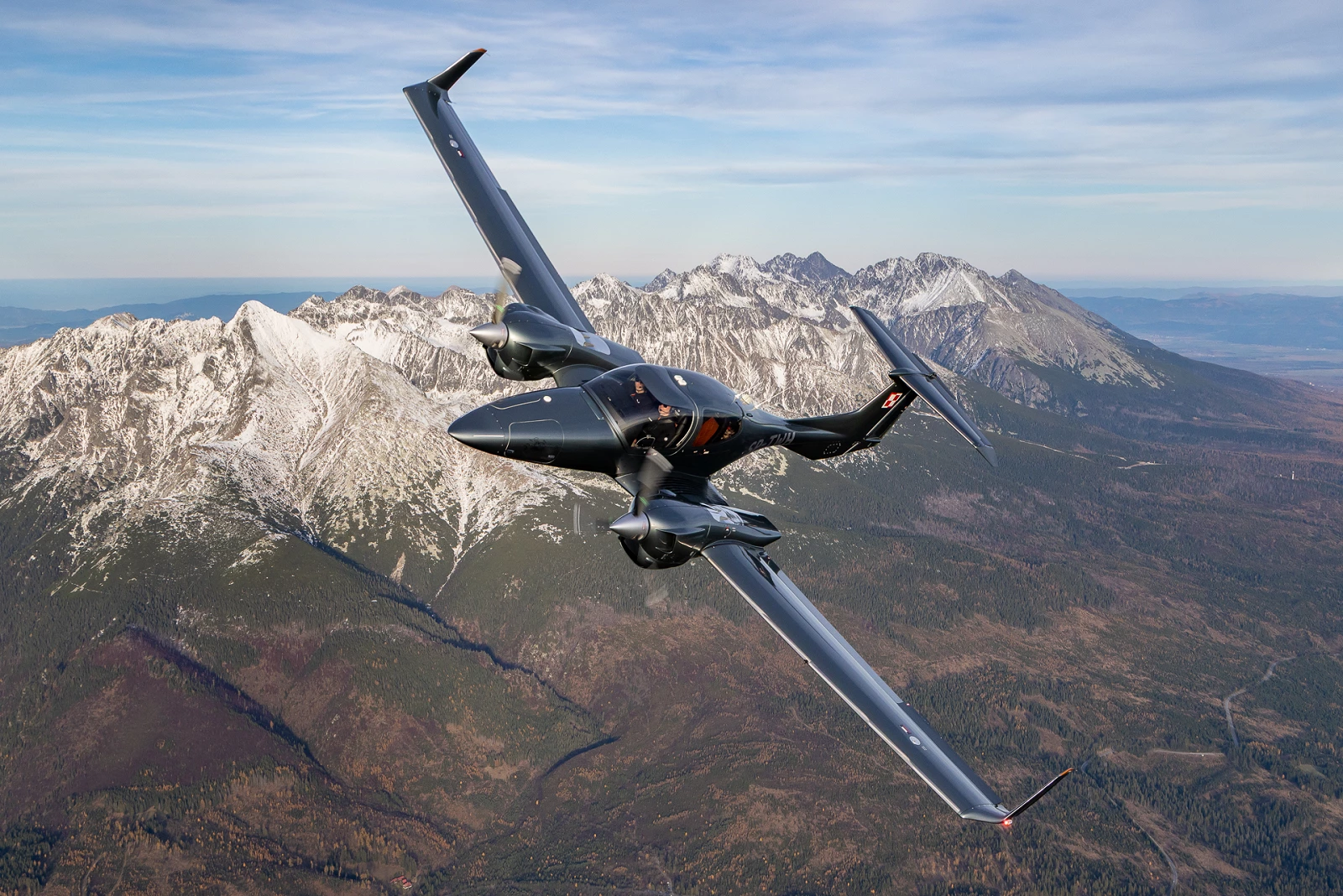
As we admire the scenery and views of the Tatra Mountains from above, we gradually head back to our home airport, where we can see the entire mountain range in the background. After another dozen or so minutes of flight, we land in Pobiednik and high-five each other after a successful flight filled with stunning scenery.
The Diamond DA42-VI is a prime example of how modern solutions can quickly dominate the market and revolutionize the approach to aviation. The aircraft is gaining popularity year after year, and we hope to see even more of these planes in the Polish skies.
Text and photos:Filip Modrzejewski