Piper M700 Fury

m700 fury
Fast and comfortable
When we decide to fly on a turboprop aircraft, time becomes the key factor. The Piper M700 Fury—the fastest model in the highly regarded M-Class line—is the answer to this need. This model is rapidly taking the European skies by storm, and the Polish registry has just added another one to its fleet. Filip Modrzejewski takes a closer look at the latest model.
The philosophy behind the M700 is based on four pillars: high power, impressive performance, uncompromising safety, and a rich tradition. The manufacturer has taken a giant leap forward. A cruising speed exceeding 300 knots, a range of 1,800 nm, and a climb rate of over 2,000 feet per minute are specifications that make a huge impression. Combined with modern technology, the result is an incredibly fast yet exceptionally comfortable aircraft.
At first glance, looking at photos of the Piper M700 Fury, one might get the impression that it’s merely an evolution and a more powerful version of the well-known M600 model. However, after getting to know this aircraft better, talking with the crew, and taking a test flight, I quickly change my mind. The key to its success lies in the details that transform this design.
Power and Performance in Practice
The most significant modification is located in the front section of the fuselage. The M700 Fury is equipped with a PT6A-52 engine (replacing the PT6A-42A unit from the M600), generating as much as 700 horsepower. This boost of 100 KM translates to a cruise speed of 301 KTAS (an increase of over 25 knots). In a six-seat aircraft, this power reserve guarantees good performance and a high degree of operational flexibility. “Over the course of a full day of intensive flights, we save up to an hour,” one of the pilots, who has already logged over 300 hours on the M700, tells me.
The increased power also improves takeoff torque and runway exit. The additional 100 horsepower allows the takeoff roll to be shortened by nearly 150 meters. This gives pilots tremendous flexibility when operating from short, grassy, or poorly prepared landing strips. As a result, you can plan a trip directly to your destination, avoiding crowded, large airports and tedious commutes, while knowing that you’ll be able to land and take off from short runways.
The new engine, combined with a five-blade propeller, reduces vibrations and makes the cabin quieter, while offering excellent climb rate (over 2,000 ft/min). Starting in April 2026, a version with a 7-blade propeller will also be available, further enhancing flight comfort. The aircraft climbs to cruising altitude FL250 in less than a quarter of an hour. These performance characteristics allow it to efficiently and quickly penetrate turbulent air layers, which is especially appreciated on hot summer days.
Higher speed naturally means higher fuel consumption—the M700 uses about 10 gallons per hour more than the M600 (75 vs. 65 gal/hr). However, due to the shorter time spent in the air, the final cost for a given route remains at a very similar, reasonable level.
![M700_SPJBB_20260513_4655.jpg [1.20 MB]](https://www.jbi.com.pl/storage/image/core_files/2026/8/11/d77088702a4d77afcc76688a997bcebe/jpg/jbinvestments/preview/M700_SPJBB_20260513_4655.webp)
Innovation and Safety
The ability to fly at a maximum speed of 301 KTAS while maintaining a stall speed of just 61 KIAS required aerodynamic modifications. To ensure optimal stability, the designers incorporated a so-called Gurney flap on the horizontal stabilizer—a solution borrowed from motorsports. This special slat optimizes airflow, which improves the stability and effectiveness of the horizontal stabilizer at high speeds. The range of the stabilizer’s deflection was also increased, and the leading edge was redesigned to ensure full control across the entire speed range.
While the fuselage shape remains the same as that of its predecessors, the interior is packed with modern pilot-assistance systems. The cockpit is based on the advanced Garmin G3000 avionics suite integrated with the HALO package. It features the familiar ESP systems, a “blue-level” button for automatic flight leveling, a pilot alertness monitoring system, and the Autoland automatic landing system, which provides added peace of mind for both the pilot and passengers.
However, the integrated autothrottle system is a real boon for single-pilot operations (SPO). It works in conjunction with the autopilot to manage power throughout the entire flight profile—from climb to descent—while the computer automatically maintains the correct parameters. This system significantly reduces the pilot’s workload during the most dynamic phases, such as the approach to landing or takeoff, preventing accidental exceeding of speed limits and facilitating smooth configuration of the flaps and landing gear.
Another new feature is PlaneSync technology. It allows the pilot to remotely check the aircraft’s technical status (e.g., fuel and oil levels) before arriving at the airport. This speeds up pre-flight procedures, allowing the pilot to focus on passenger comfort and faster engine start-up.![M700_SPJBB_20260510_3064.jpg [1.64 MB]](https://www.jbi.com.pl/storage/image/core_files/2026/8/11/c78682ffb5b9c591ac24f84442d72e5b/jpg/jbinvestments/preview/M700_SPJBB_20260510_3064.webp)
The Third M700 in Poland
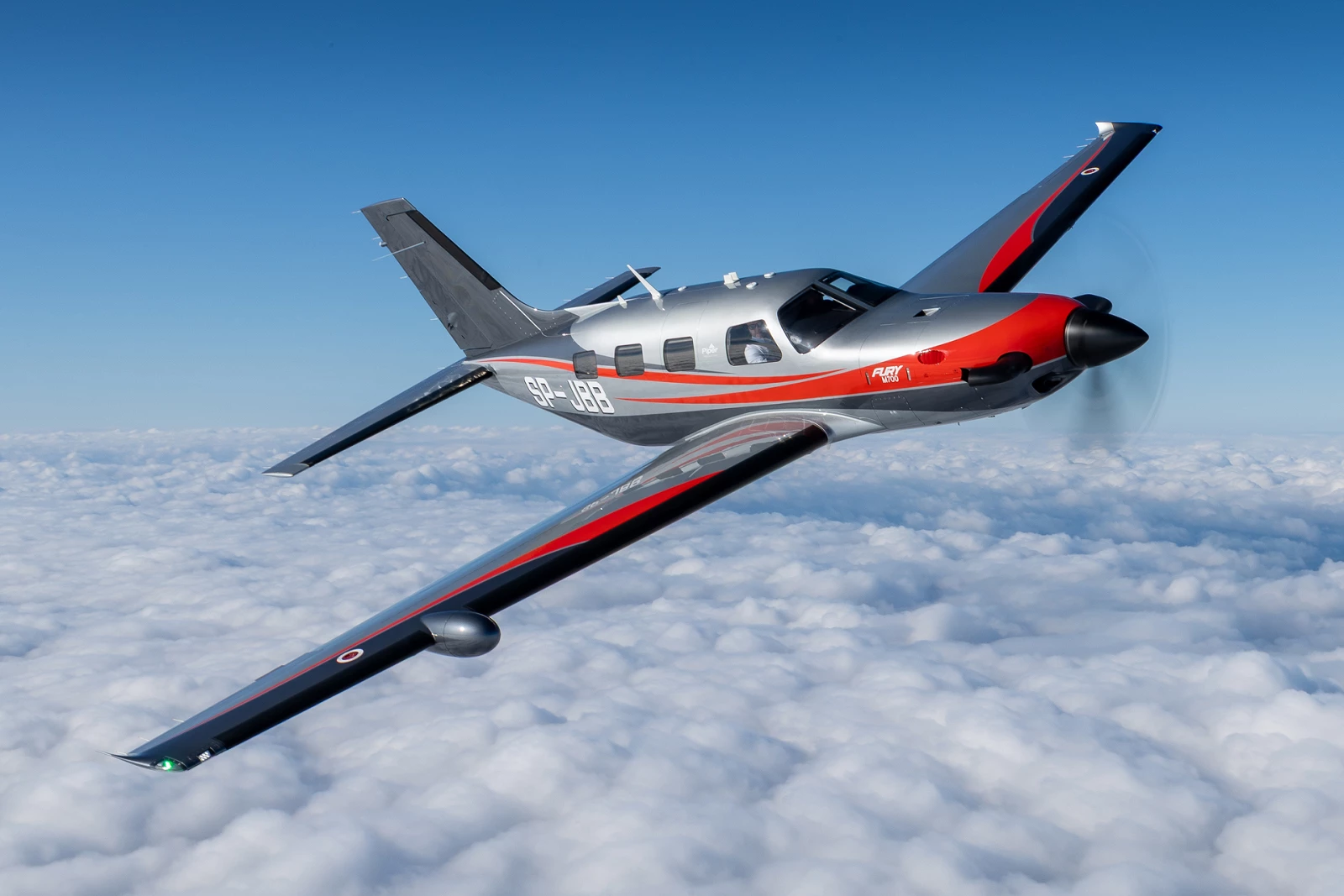
A good example of a personalized approach and custom configuration is the newest M700 Fury in Poland, with the registration SP-JBB, which arrived in the country in early May. This aircraft made a spectacular, long-distance journey straight from the factory in Florida, flying over Maine, Canada, Iceland, and Scotland, until it landed in Poland—the entire trip took three days, just like a typical transatlantic flight for a turbine-powered aircraft under favorable conditions.
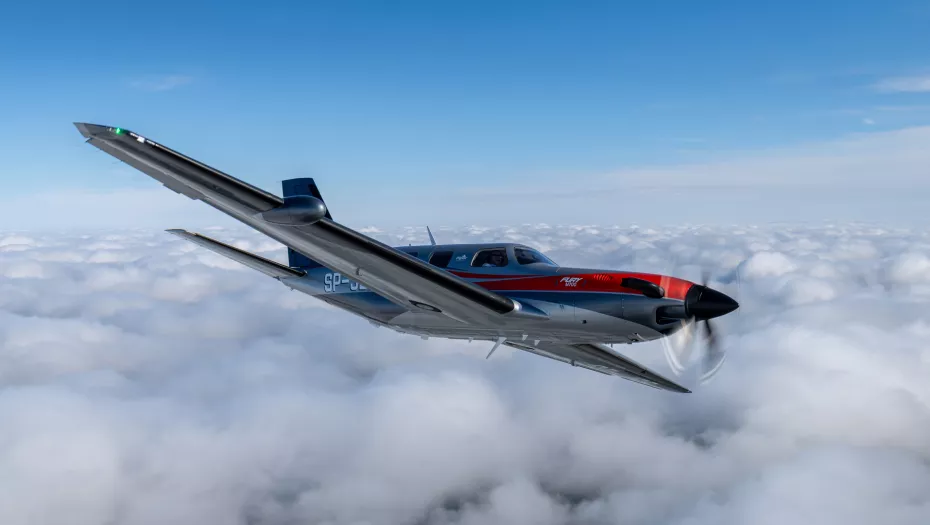
The SP-JBB stands out thanks to its exceptional, one-of-a-kind paint job—the silver fuselage with dynamic shades of red looks very elegant on the ground, but it really makes a “wow” impression only in the air, when the sun reflects off its surface and illuminates it against the backdrop of the clouds —just look at the photos to see for yourself.
The interior of the SP-JBB is designed in an elegant, light cream color, which makes the cabin appear more spacious. Once seated, passengers can enjoy chrome and carbon fiber accents, a convenient fold-out table, and the option to fold down the front seat to create additional space for drinks. When traveling with two people on the rear bench, the cabin offers a very high level of comfort, while with four passengers, the space becomes more compact—which is typical for this class of aircraft and a club-style cabin layout. The spacious luggage compartment easily accommodates several large suitcases. Passengers have access to individual air vents, modern USB-C ports, and powered LEMO jacks for headphones.
Access to the cockpit is similar to that in previous models—that is, between the seats through the cabin. Getting into the cockpit isn’t the easiest, but once we’re seated, we can feel truly comfortable. In front of us are the Garmin G3000 avionics and switches to control all engine and aircraft parameters. All the cockpit components and layout are exactly the same as before. If you’ve flown the M600, training on the M700 will be a piece of cake.![M700_SPJBB_20260510_4188.jpg [1.47 MB]](https://www.jbi.com.pl/storage/image/core_files/2026/8/11/6eabb76453d92c4b180f741a833ed7bf/jpg/jbinvestments/preview/M700_SPJBB_20260510_4188.webp)
Who is this plane for?
The Piper M700 Fury is the ideal tool for discerning businesspeople, pilot-owners, and those seeking transportation independence. The ability to efficiently travel to any part of Europe for a business meeting and return the same day for dinner with your family cannot be overstated in a world where time is money.
The main features of the M700 are speed and safety, which are of great importance in such situations. And if we can reach a destination 20 minutes faster than with the M600, why not? The aircraft’s high payload capacity—260 kg with a full fuel load—is also worth noting; it gives us plenty of options for configuration or carrying extra luggage without compromising range.
From the pilot’s perspective, the aircraft is also very pleasant to fly; it features familiar avionics and performs very well in flight. The M700 is also more stable, yet has a more responsive throttle, allowing for even more precise flying. The multitude of onboard systems also means that SPO operations are not an issue here, and Piper’s popularity in Europe and the U.S. is such that repairs and any technical maintenance are readily available.
Thanks to Piper’s extensive service network in Europe, operating this modern turboprop helicopter is hassle-free. The M700 Fury is undoubtedly a remarkable evolution of the series, redefining standards in its class, and with three aircraft already on the Polish registry, the chances of flying in one or simply seeing one at an airport are growing every day.
Text and photos:Filip Modrzejewski