
Traveling Through Europe in a Pilatus

General Aviation is a world of great diversity. Some of us spend our time at the controls of a Cessna or a Diamond, while others fly larger turbine-powered aircraft, such as the Pilatus PC-12. Filip Modrzejewski joins Kuba Śliwiński during a rotation on the PC-12 to experience firsthand what it’s really like to be a corporate pilot.
It’s not every day you get the chance to sit at the controls of a Pilatus PC-12, so when my friend Kuba called me a few days ago, I agreed right away and was soon on my way to the airport. The plan for the next few days was simple: to make a few flights around Europe, get to know the plane better in various situations, and learn more about the types of flights Kuba flies on a daily basis. Let’s get started!
From Poland to France
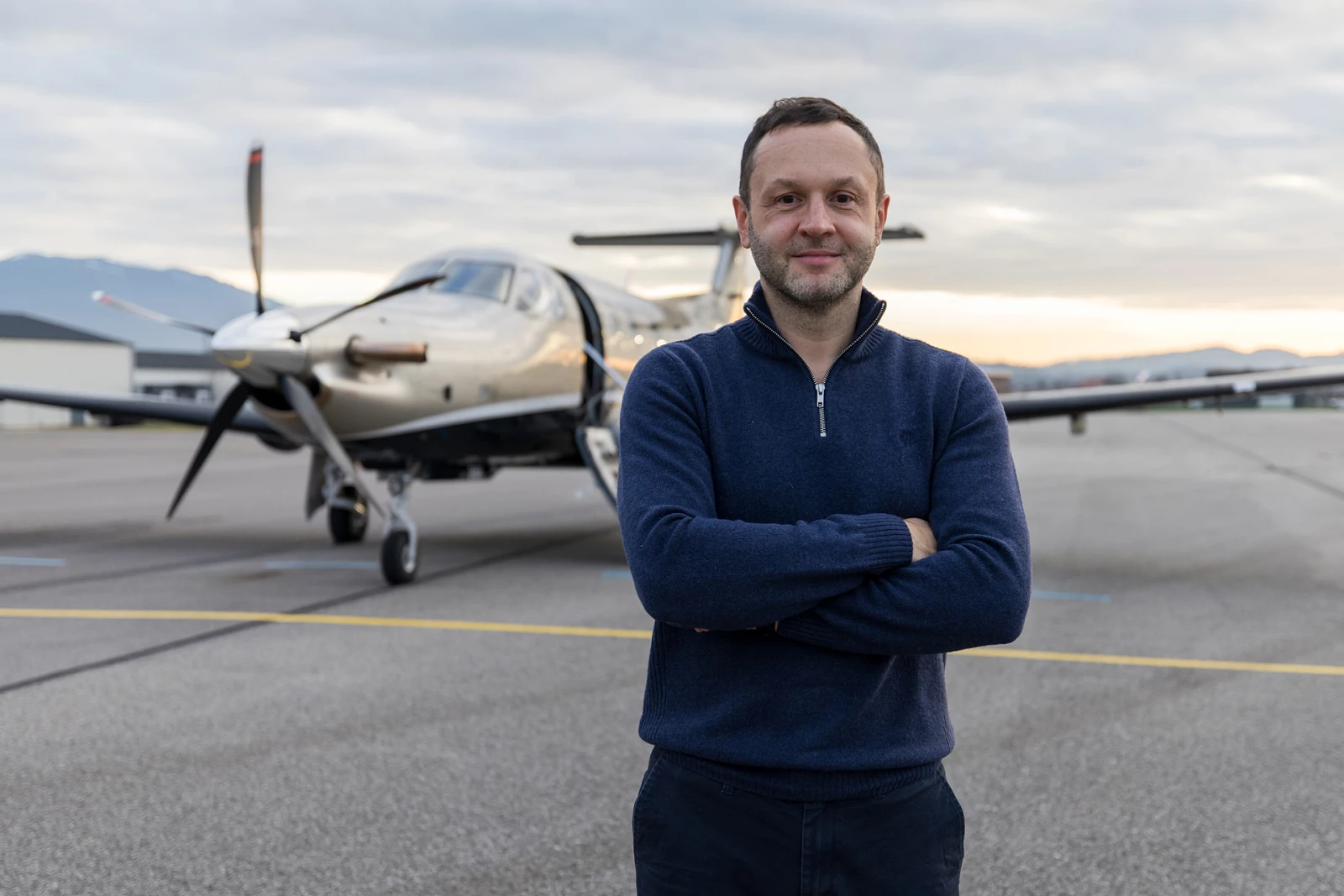
We begin our three-day flight at the Poznań airport. I meet up with Kuba about an hour and a half before the scheduled departure in front of the General Aviation terminal. After passing through security, we head toward the plane to prepare it for flight and make sure it’s fully ready to board passengers. This PC-12 features a gold-colored paint scheme with dark green accents—it looks very dignified and is in excellent condition. At the time of our flight, the plane had fewer than 300 flight hours, so you could say it was practically brand-new.
Kuba checks all the systems in the cockpit and the passenger cabin, making sure the plane is fully operational, while I remove the covers from the engine, the pitot tubes, and the angle-of-attack sensors. Later, I also familiarize myself with the cockpit—it’s very ergonomic and offers plenty of space for the pilots. On all flights during this trip, Kuba serves as PIC (Pilot in Command), and I assist him with radio communications and navigation. Single-pilot operations are very interesting for pilots of both piston and turboprop aircraft, where everything happens much faster.
After a short wait, the passengers arrive, and we greet them at the aircraft door. Once they’ve boarded, we start the engine and taxi to Runway 28. All items on the checklist have been completed, and the flight path has been programmed, so after receiving clearance for takeoff, we accelerate to rotation speed and climb to FL280, heading straight for TOMTI—an air navigation point on the border with the Czech Republic.
At cruising altitude
It took us just 15 minutes to climb to our cruising altitude. During the flight, Kuba checks the appropriate engine parameters for the given altitude and outside temperature. We’re flying on MCP (Maximum Cruise Power) settings, which gives us about 275 KTAS. That’s a very good speed, unattainable for most piston-engine aircraft—I can fully appreciate the capabilities of a turbine engine.
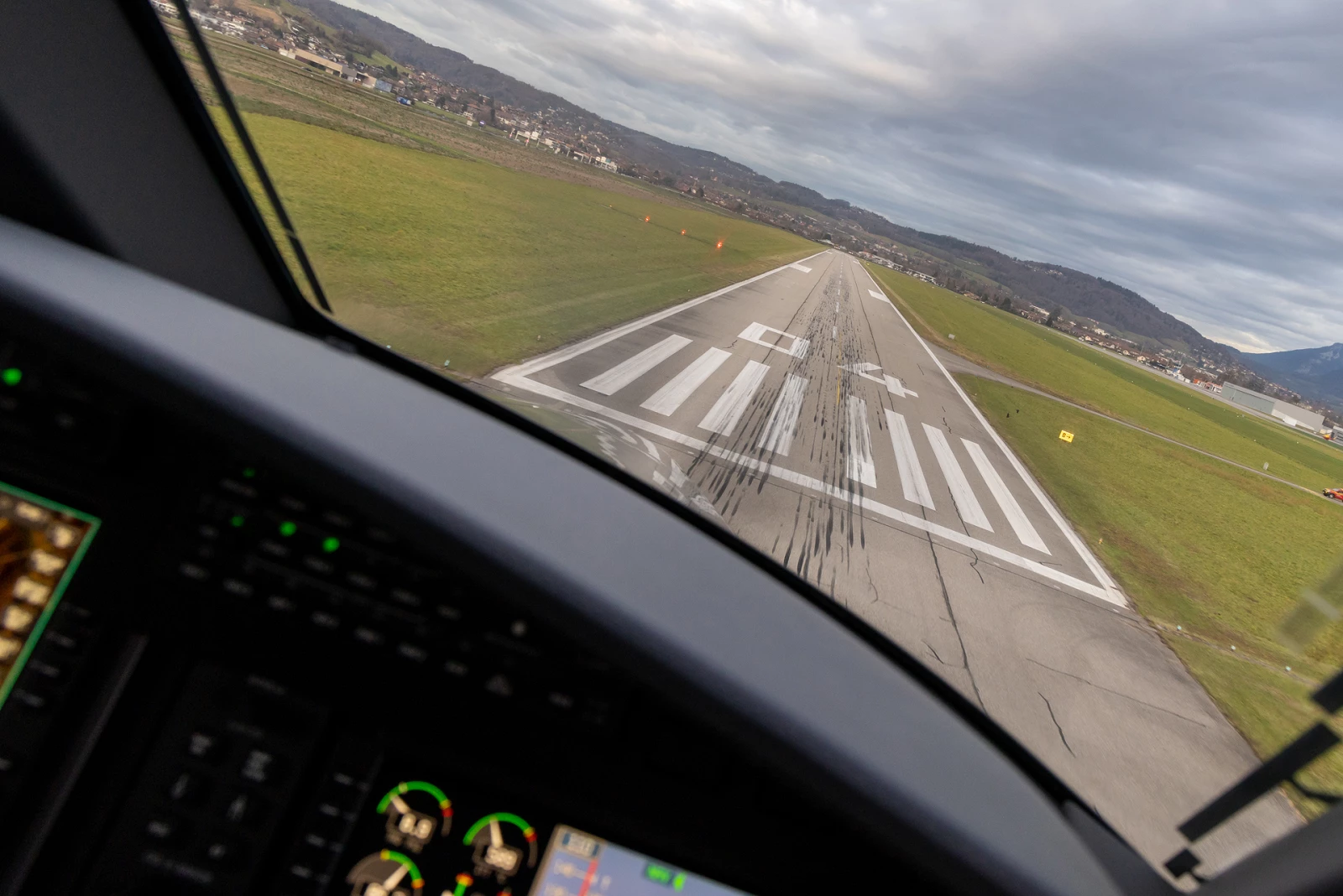
The weather during the flight is excellent; we’re flying above the clouds, passing over Germany, and slowly beginning our descent over Switzerland to reach our destination—Annecy (LFLP) in France. The RNP approach, the French accents of the air traffic controllers, and the Alps in the background—all of this creates a truly unique setting. I’m not surprised that Kuba always enjoys landing here. A smooth touchdown, and in less than three hours we’ve covered 700 nautical miles. By comparison, it would take me twice as long in a propeller plane—that’s a truly impressive achievement.
A quick stop in Germany
Our day isn't over yet—business flights can be intense, and today is one of those days. After saying goodbye to our passengers in Annecy, we're now on a ferry flight (that is, a flight without passengers) to Munich (EDDM) in Germany to pick up another passenger.
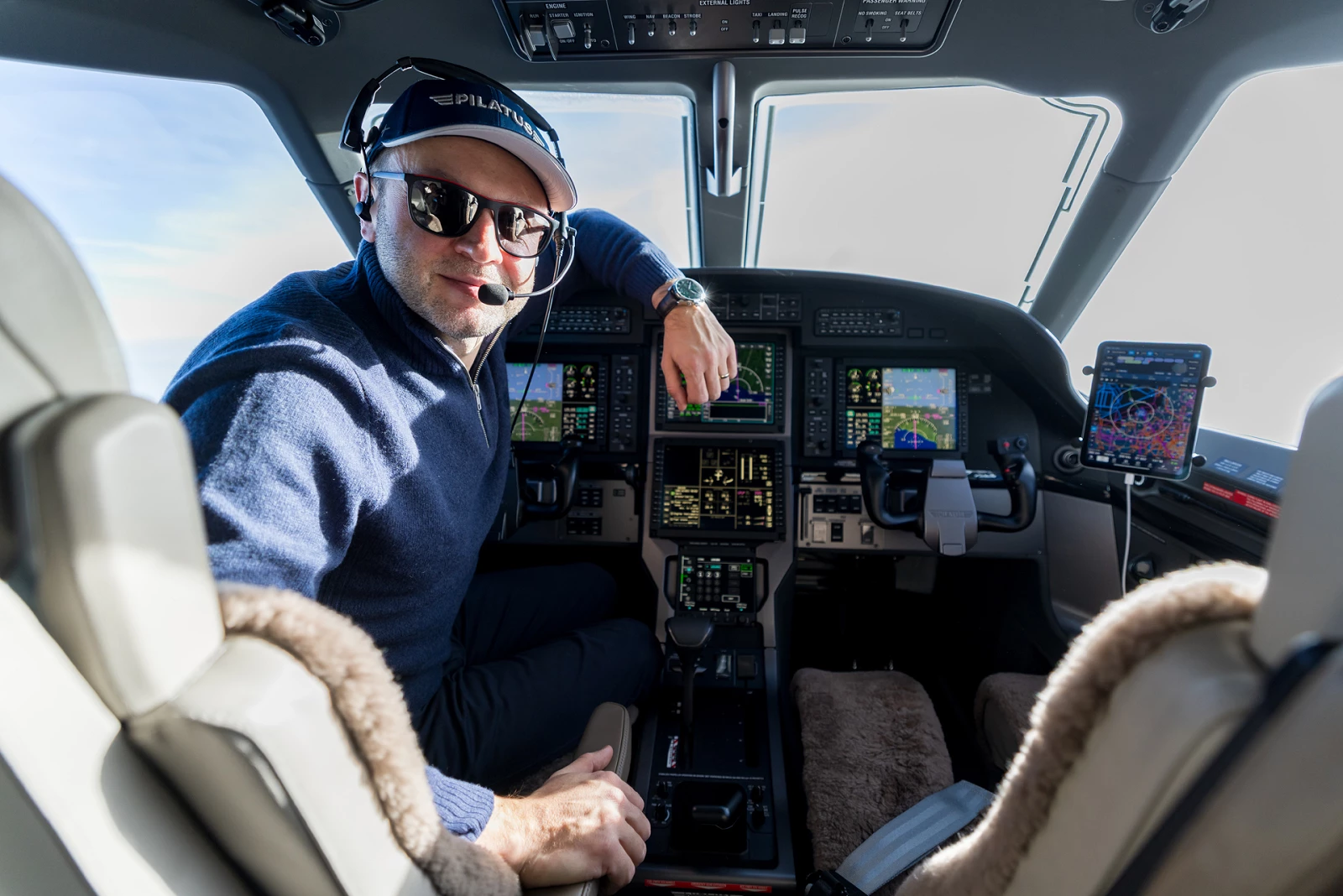
The advantage of a modern turbine engine is that it can be started quickly and be ready for takeoff almost immediately—which is exactly what we did in Annecy, taking off less than 5 minutes after starting the engine. Taking off at sunset, we knew it would be a night flight. Although this is a ferry flight and we have a moment to chat, we still maintain complete professionalism. This allowed me to take a closer look at the cockpit and the passenger cabin—the trip is very comfortable, though I must admit that without headphones, it’s much noisier than I expected.
The approach to Munich was challenging—not only because of the many STAR procedures, but also due to the associated RNAV transitions and ILS approaches, including parallel landings. It was quite a challenge both in terms of communicating with ATC and correctly programming everything on the aircraft. Just when we thought the hardest part was behind us, we had to taxi through Munich Airport—we changed the Ground frequency four times as we navigated a complex network of taxiways, some of which differed only in the color of their markings and lay right next to one another. Many challenges, but also a lot to learn—it was an incredibly valuable lesson.
A Visit to the United Kingdom
We take off from Munich as one of the last flights of the day, before the nighttime flight restrictions take effect (starting at 10:00 p.m. local time), heading toward the United Kingdom, this time with passengers on board. To ensure a smoother and quieter night flight for those on board, we switch to Low RPM mode. This is a special propeller operating mode that generates nearly the same power but at lower RPMs, resulting in a quieter cabin. Admittedly, since we were flying with headphones on, we didn’t notice the difference, but the passengers were satisfied—and that’s what matters most in this case.
There’s a unique charm to night flying. There’s less air traffic, air traffic control operates more calmly, and the controllers’ voices are more subdued—but you still need to remain fully focused and alert. The views can be breathtaking—it’s not every day you get the chance to see major European cities from the air at night. The PC-12 is also equipped with a TA (Traffic Advisory) system, which allows us to “keep an eye on” specific aircraft in the vicinity—one of them was a NATO C-17 Globemaster, yet another aircraft you don’t come across every day.
After a while, we enter the airspace and come under the supervision of an authority I’m familiar with from many previous flights—London Control, very good evening! It’s always nice to hear a familiar accent on the radio. Shortly after crossing the FIR boundary, we receive vectors—a typical procedure for British airspace. Beginning our descent at the TOD (Top of Descent) point, designated by the onboard computer, we’re transferred to Southend Approach and land there just after midnight. Getting night slots at airports like Stansted or Luton can be difficult, but Southend remains open until 1:30 a.m. local time, which makes it easier to plan late-night flights.

"Ferry" flights
Waking up in the morning, we look out the windows of the airport hotel at the apron and spot a Polish-registered Hawker next to us—a nice sight to see two planes from Poland. After completing the pre-flight check and taking a few photos, we board the plane to return to Annecy, this time without passengers—it’s “just” a ferry flight, so we have a bit more flexibility with the takeoff time.
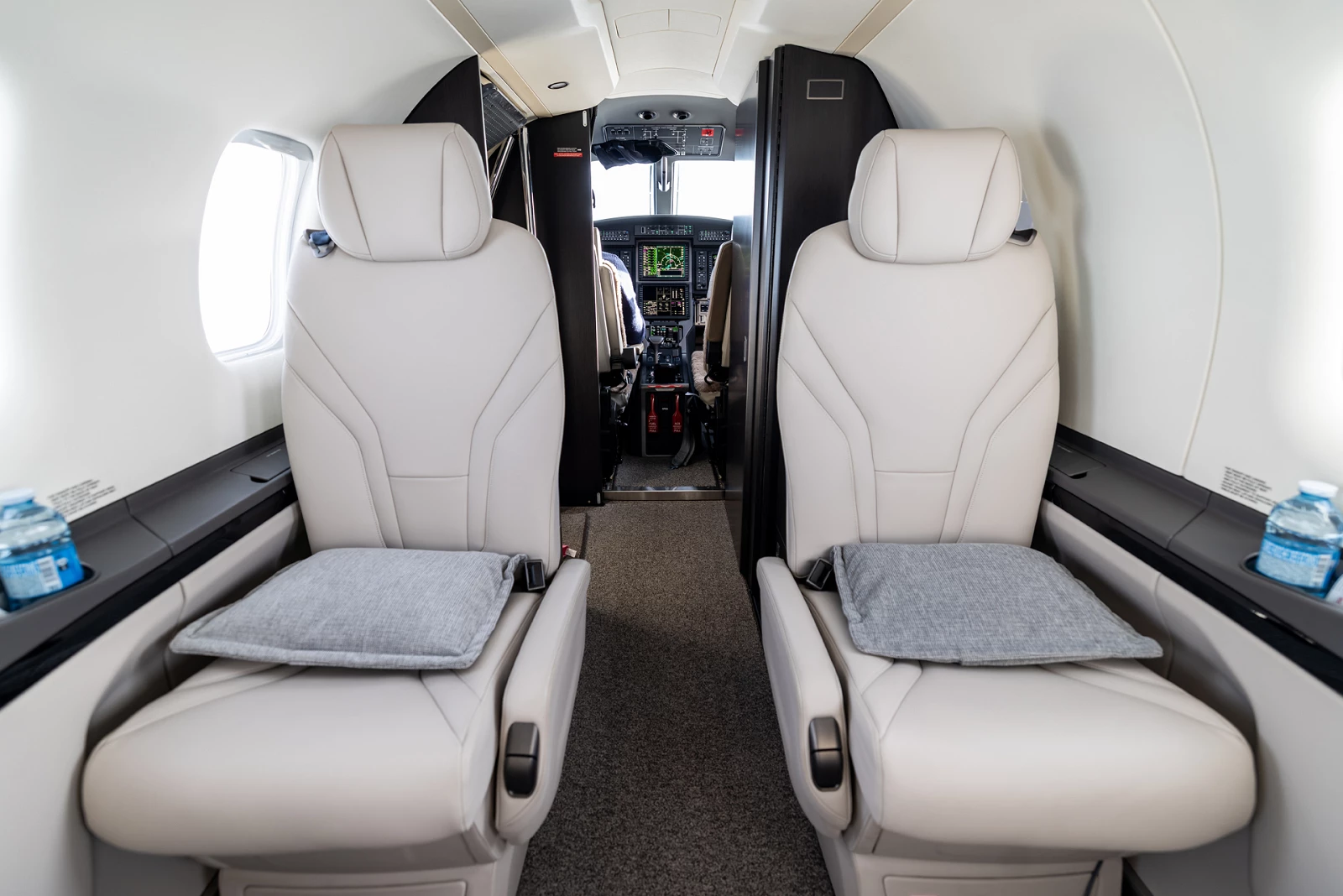
Flying without passengers, I have the opportunity to take another look inside the cabin—the level of comfort is truly exceptional, with separate climate control for the cabin and cockpit, fully reclining seats, and top-quality leather upholstery. The cabin design works well for both families with children and businesspeople who need to focus on work—Starlink can be installed on board, making it easy to use the internet.
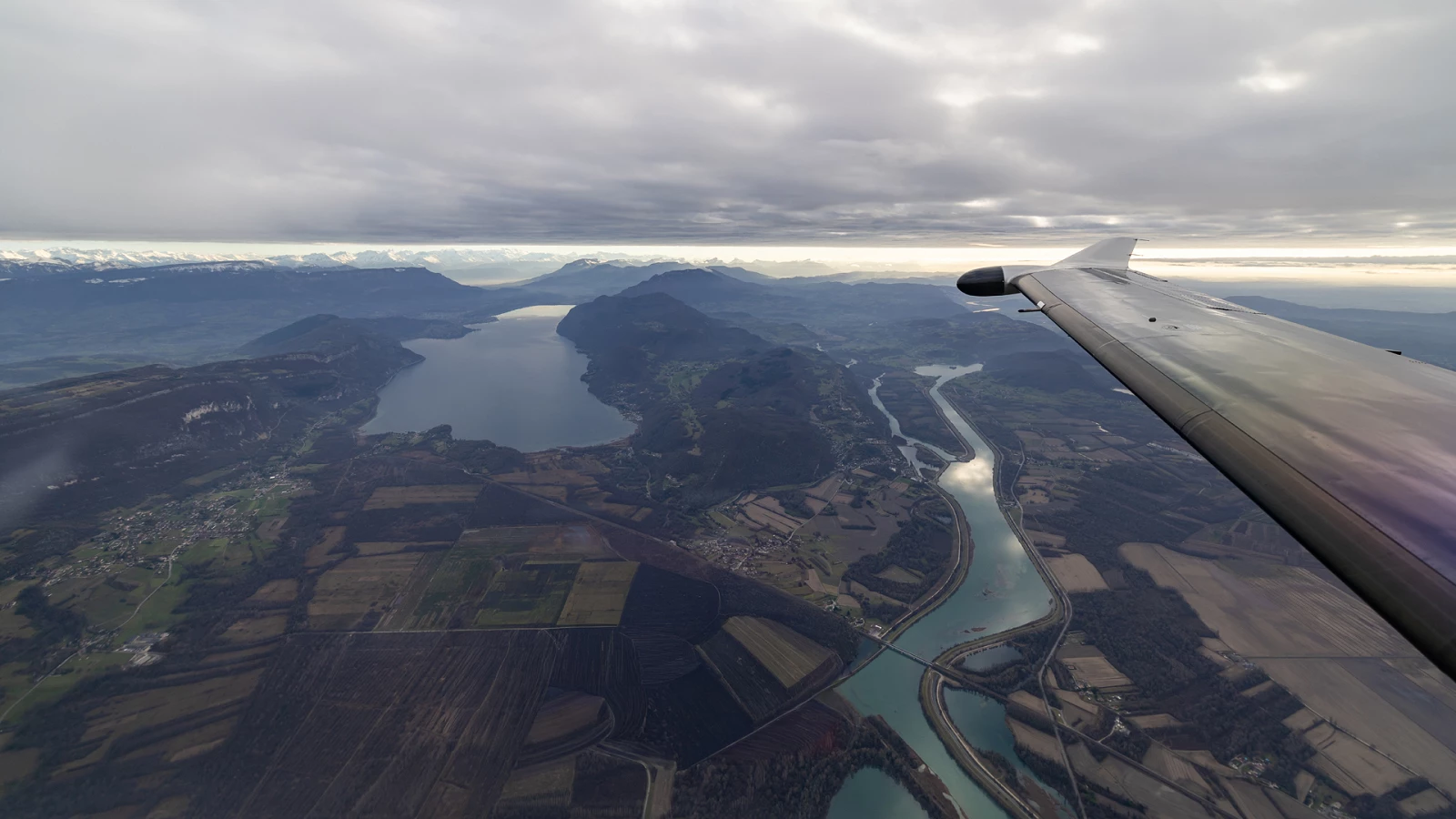
I return to the cockpit as we begin our descent to Annecy (LFLP). The weather is excellent, with only a few clouds in the sky, allowing us to enjoy the beautiful views of the Alps during the approach. Landings in a PC-12 are straightforward for experienced pilots—it’s worth noting that you don’t need to pull up much; just two degrees right before the runway is enough.
Farewell in Austria
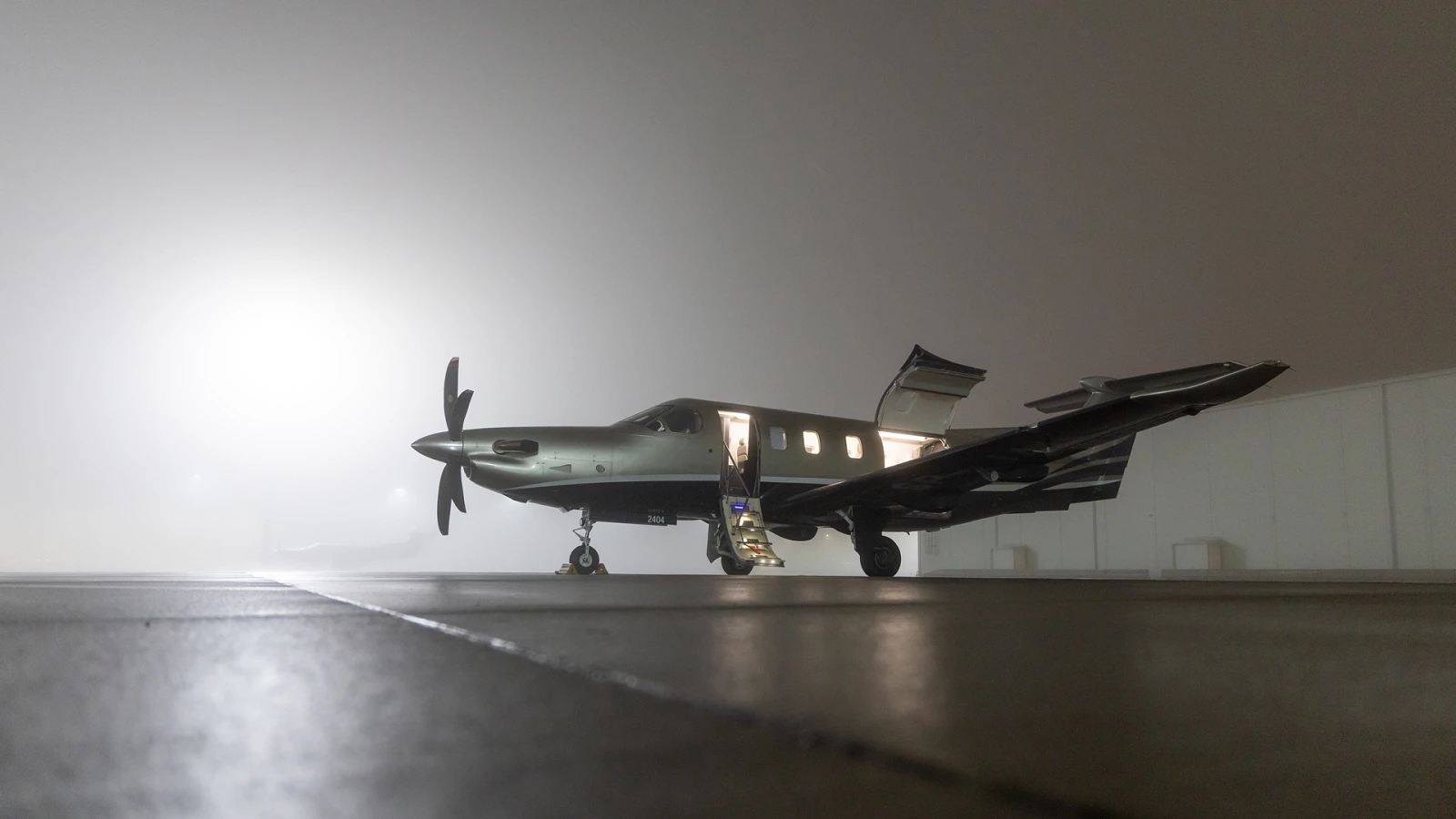
The last flight of this rotation is scheduled for the next day, which gives us time to rest in Annecy. It’s a relatively short flight—less than two hours to Vienna. From early in the morning, we’ve been monitoring the weather in the Austrian capital, as we knew there was dense fog that could prevent us from landing. We’re certified for ILS CAT I, which means a decision height of 200 feet and an RVR of 550 meters.
The weather showed slight improvement, so we decided to give it a try, with Bratislava and Graz as alternative landing sites and ground transportation arranged for the passengers. The whole day was almost perfect—from a beautiful, picturesque sunset to a smooth transition into the nighttime scenery.
As we approach Vienna, we receive an ATIS report on procedures for limited visibility and an RVR ranging between 200 and 600 meters—right at the limit of our requirements. In addition, RVR above 550 meters was available in only one of the four runway directions, which required a lot of work and careful consideration on our part to plan a landing on that runway, while the others were being used by all airlines certified for lower ILS minimums.
While descending from cruise altitude, we focus entirely on the procedures and aircraft parameters, discussing the approach and go-around procedures. On the final approach to the runway, we receive clearance to land with an RVR of 580 meters—the minimum required to land legally. Now it all comes down to staying on the ILS glide path and monitoring the runway surroundings.
Was this one of the more challenging approaches? Perhaps. Nevertheless, the safety of the passengers and the aircraft remained our top priority, and as two experienced pilots, we were able to carry it out smoothly and safely. However, for taxiing, we requested a “Follow Me” vehicle to ensure complete safety and to make our job of maneuvering the aircraft on the ground a little easier.
The world of General Aviation offers many wonderful opportunities. Flying turbine-powered aircraft like the PC-12 is one of them—and I can honestly say it’s at the top of my bucket list. It’s also a great chance to get a behind-the-scenes look at the life of a commercial pilot and share that experience with a wider audience.
Text and photos:Filip Modrzejewski


