
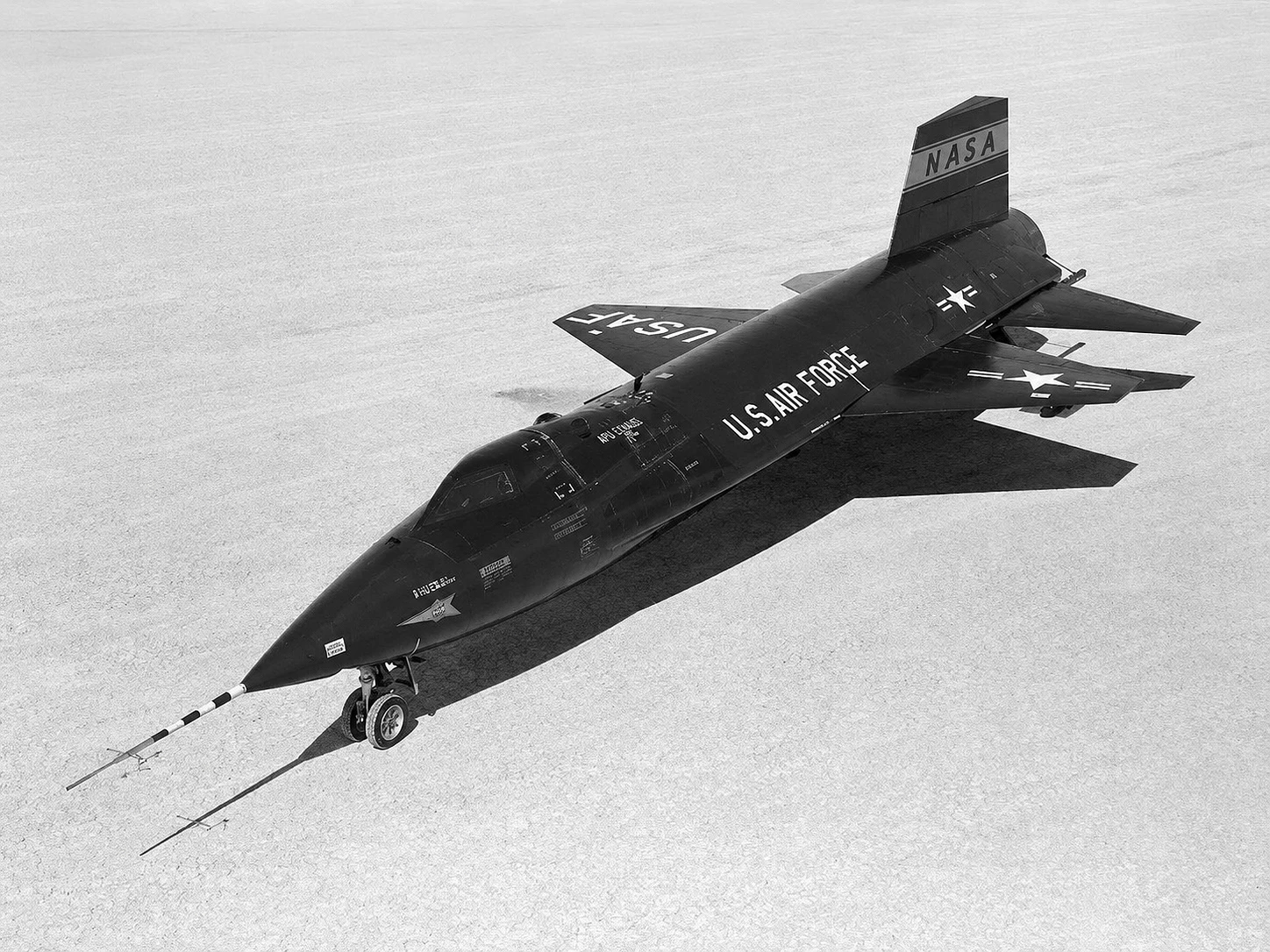
The North American X-15 – the fastest aircraft in history
series - Machines that changed the sky
The fastest to date
Altitude: 14 kilometers above the Mojave Desert. A black, missile-like craft, just under 16 meters long, hangs beneath the right wing of a B-52 bomber. The pilot, wearing a pressure suit, hears the countdown in his headset. Upon the command “launch,” the craft drops—a second later, a rocket engine with 254 kilonewtons of thrust ignites. Over the next 80 seconds, the rocket plane breaks through Mach 1, 2, 3, 4, 5, and 6 in succession and continues to accelerate. The North American X-15 is the fastest aircraft in history—its 1967 speed record remains unbroken to this day.
Aerial view of the Mojave Desert
The X-15 could not take off under its own power. It was too small to carry the fuel needed for a conventional takeoff, and too specialized to waste that fuel on climb. Each of the program’s 199 flights began under the wing of a modified B-52 Stratofortress. At an altitude of about 14 km and a speed of 800 km/h, the X-15 was released—a second of unpowered gliding, engine ignition, and 80–120 seconds of full-throttle operation. The rest of the flight consisted of unpowered gliding back to Rogers Dry Lake near Edwards Air Force Base.
The X-15 program was launched in 1954 as a joint venture between NASA, the USAF, and the U.S. Navy to study hypersonic flight—speeds exceeding Mach 5. The construction of the rocket-powered aircraft was entrusted to North American Aviation, the same company that gave the world the P-51 Mustang fighter and the F-86 Sabre jet. Only three were built. They flew between 1959 and 1968.
![Naa.jpg [44.48 KB]](https://www.jbi.com.pl/storage/image/core_files/2026/5/6/d32ceeb867fab6faf4492778fa9d3805/jpg/jbinvestments/preview/Naa.webp)
Inconel at the plasma boundary
Supersonic aircraft designers of the 1950s favored a sharp, slender silhouette. North American engineers took the opposite approach—the X-15 had a rounded, blunt nose and thick wing leading edges. At hypersonic speeds, air resistance ceases to be the greatest enemy; heat becomes the primary challenge.
The skin was made of Inconel X-750 nickel alloy, capable of withstanding temperatures above 650°C. The stabilizers had an unusual wedge-tail profile. Despite these safeguards, Pete Knight’s flight at Mach 6.7 heated the structure so intensely that holes appeared in the stabilizer skin—the metal began to melt. Knight landed without knowing how badly the aircraft was damaged.
The modified second prototype, designated X-15A-2, was fitted with an additional ablative coating—a material that absorbs heat through the controlled burning of its own surface. The same thermal protection technology was later used on the capsules of the Mercury, Gemini, and Apollo programs.
XLR99 – the first rocket engine to be brought under control
Early rocket engines, once ignited, gave the pilot no control over thrust. Reaction Motors’ XLR99 changed that. It was the first rocket engine in history with fully adjustable thrust and the ability to be reignited in flight.
It burned anhydrous ammonia with liquid oxygen, while hydrogen peroxide powered the turbopump that fed fuel to the combustion chamber. The 254 kN (57,000 lb) thrust—more than that generated by jet fighters of the time—lasted only 80–120 seconds. It was no coincidence that Jules Bergman, an ABC News reporter, titled his book about the program “Ninety Seconds to Space.”
By comparison, the first 24 X-15 flights were conducted using older XLR11 engines—the same ones that powered Chuck Yeager’s Bell X-1 in 1947. The XLR99 represented a generational leap forward.
![na14.jpg [88.55 KB]](https://www.jbi.com.pl/storage/image/core_files/2026/5/6/10258cbc94b3066e80fff0c889f960a4/jpg/jbinvestments/preview/na14.webp)
Mach 6.7 and the edge of space
On October 3, 1967, Major William “Pete” Knight accelerated the X-15A-2 to a speed of Mach 6.7, or 7,274 km/h. More than half a century later, no pilot has yet flown faster in a winged, powered aircraft—the record still belongs to Knight.
However, that was not the program’s only achievement. On August 22, 1963, NASA pilot Joseph Walker flew the X-15 to an altitude of 107,960 meters—above the Kármán line (100 km), which is considered the boundary of space. Walker crossed it twice. A total of eight X-15 pilots received USAF astronaut wings for flights above 80 km.
Among the twelve pilots in the program was Neil Armstrong, who flew seven missions on the X-15 as a NASA test pilot. The experience he gained at the edge of the atmosphere directly prepared him to command the Apollo 11 mission.
765 reports that paved the way for the space shuttles
The X-15 never entered mass production. It was neither a fighter nor a bomber. It was a flying laboratory. Its 199 flights generated over 765 NASA research reports, creating the largest body of knowledge on hypersonic flight prior to the Space Shuttle era.
The list of technologies transferred from the X-15 to the space program is long. The Reaction Control System (RCS)—gas jets used to control orientation in space, where conventional control surfaces do not work—was first used on the X-15, and later on the Mercury, Gemini, and Apollo capsules, as well as the Space Shuttle. Data on material behavior at hypersonic speeds influenced the design of the shuttle’s heat shields, and the pilots’ pressure suits became the precursors to NASA’s spacesuits.
Today, the two surviving examples can be seen in museums—at the Smithsonian in Washington, D.C., and at the USAF Museum at Wright-Patterson Air Force Base. They serve as a reminder that, during 199 flights to the edge of space, a technology was born without which humanity would never have reached the Moon.
10 fascinating facts about the North American X-15 that will really surprise you
1. It was the fastest plane in history
The X-15 reached a speed of Mach 6.7 (over 7,200 km/h) —and to this day, no manned aircraft has broken that record!

2. He flew… into space
Some flights exceeded an altitude of 100 km, the conventional boundary of space. X-15 pilots were officially awarded astronaut wings.
![newc.jpg [55.49 KB]](https://www.jbi.com.pl/storage/image/core_files/2026/5/6/634ba02e9a76febc5a2c31d92d53a516/jpg/jbinvestments/preview/newc.webp)
3. The hull was made of a material resistant to extreme heat
The aircraft was constructed primarily from Inconel X alloy, which could withstand temperatures exceeding 650°C generated during hypersonic flight.

4. He took off from under the wing of a bomber
The X-15 did not take off from a runway—it was carried aloft by a Boeing B-52 Stratofortress and its rocket engine was ignited only after takeoff.

5. Neil Armstrong flew it too
The first man on the Moon, Neil Armstrong, was one of the X-15 test pilots before joining the Apollo program.
6. It had a more powerful engine than many rockets
The XLR99 engine generated a thrust of approximately 250 kN, which was an enormous figure for a manned vehicle of that size.

7. The landing felt like flying a glider
Once the X-15’s engine was shut down, it had no propulsion—the pilot had to aim perfectly for the runway and land like a glider… on skids.

8. It was a flying science experiment
Each flight provided data on:
- hypersonic
- overloads
- the human body at the edge of space
Without this program, there would have been no subsequent space missions.
9. He helped develop space shuttles
Data from the X-15 was crucial in the design of the Space Shuttle —especially during atmospheric reentry.

10. The program was very risky
One of the aircraft crashed in 1967, and the pilot Michael J. Adams was killed. The program was extremely dangerous—pilots were pushing the limits of both technology and the human body.
Photo: NASA. Source: NASA – 65 Years Ago: First Factory Rollout of the X-15 Hypersonic Rocket Plane