
From Malibu to Scotland

Is it possible to fly to Scotland? Yes, it is. It’s a long trip from Poland, but with a plane available in the United Kingdom, we can get there in less than 2 hours—Filip Modrzejewski takes us on a flight to that region.
There are many ways to build up flight hours or fly as a General Aviation pilot—some fly small Cessnas on well-established routes, others split the costs of flights with other pilots on larger aircraft, and still others take their friends or family on vacations or longer flights. Each option is good, but the last one appeals to me the most. That’s why, in early May, I invited my family on a trip to Scotland (United Kingdom)—the perfect opportunity for a longer flight and unique views.
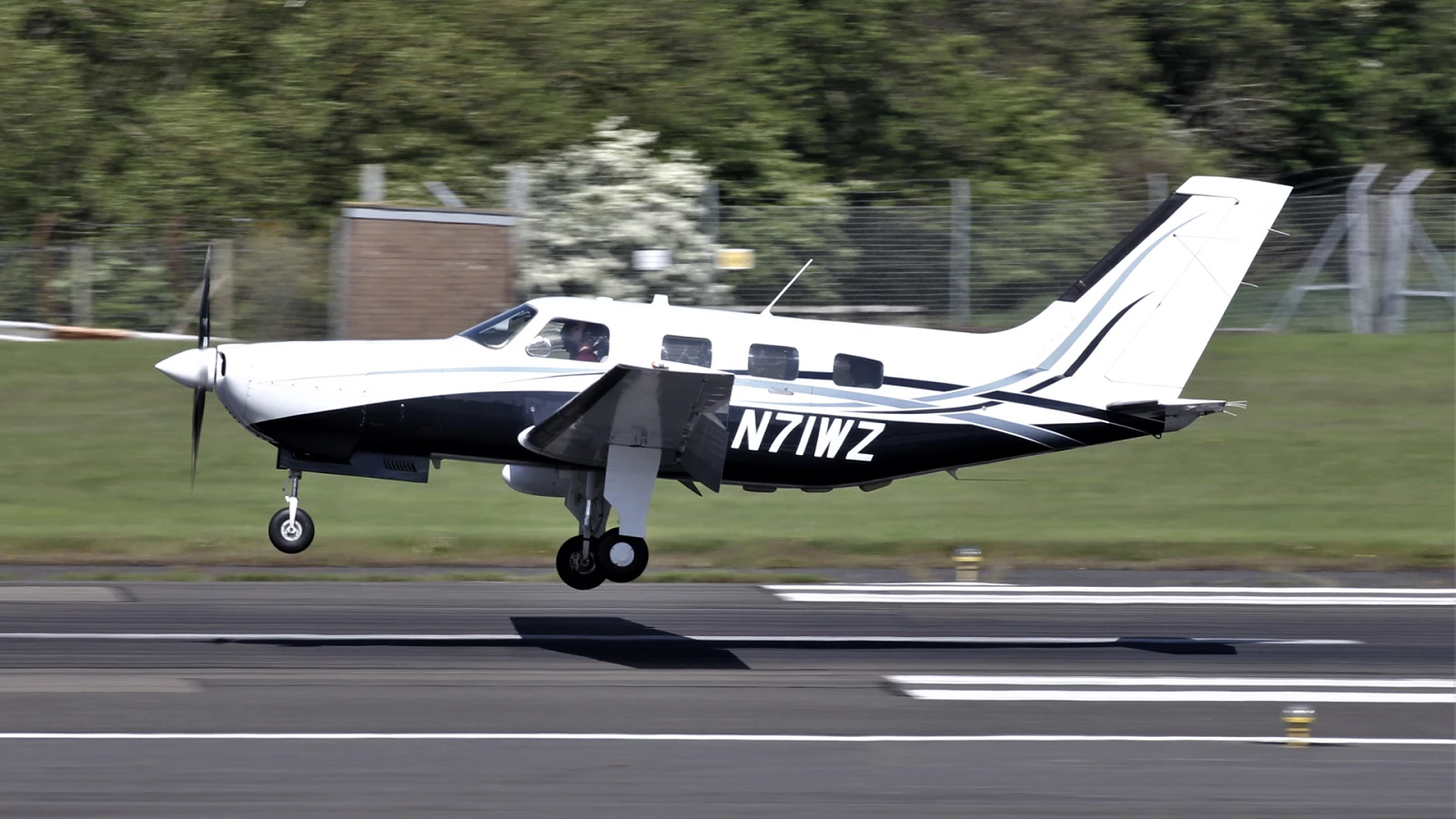
These flights also marked many “firsts”—my first time in Scotland, my first time flying so far (one leg over 350 nm), my first time flying so high (FL120), and my first experience with wing icing. To make all of this possible and to ensure the trip was comfortable, I chose a Piper PA46 Malibu as my aircraft this time. Higher speeds, a larger pressurized cabin, weather radar, and a de-icing system definitely came in handy during this flight. Since the aircraft is registered in the U.S. (registration N71WZ), my recently converted FAA license also proved useful.
Let's go
The entire trip begins at Oxford Airport (EGTK)—after checking the aircraft and the weather, I take off on my own for the first, very short leg to Sywell Airport (EGBK). The weather isn’t ideal, with low visibility and cloud bases at 1,800 ft, but VFR requirements are met, so we can fly. ADS-B and the ability to display other aircraft on the Garmin GTN-750 avionics system definitely help provide a better picture of the situation around us.
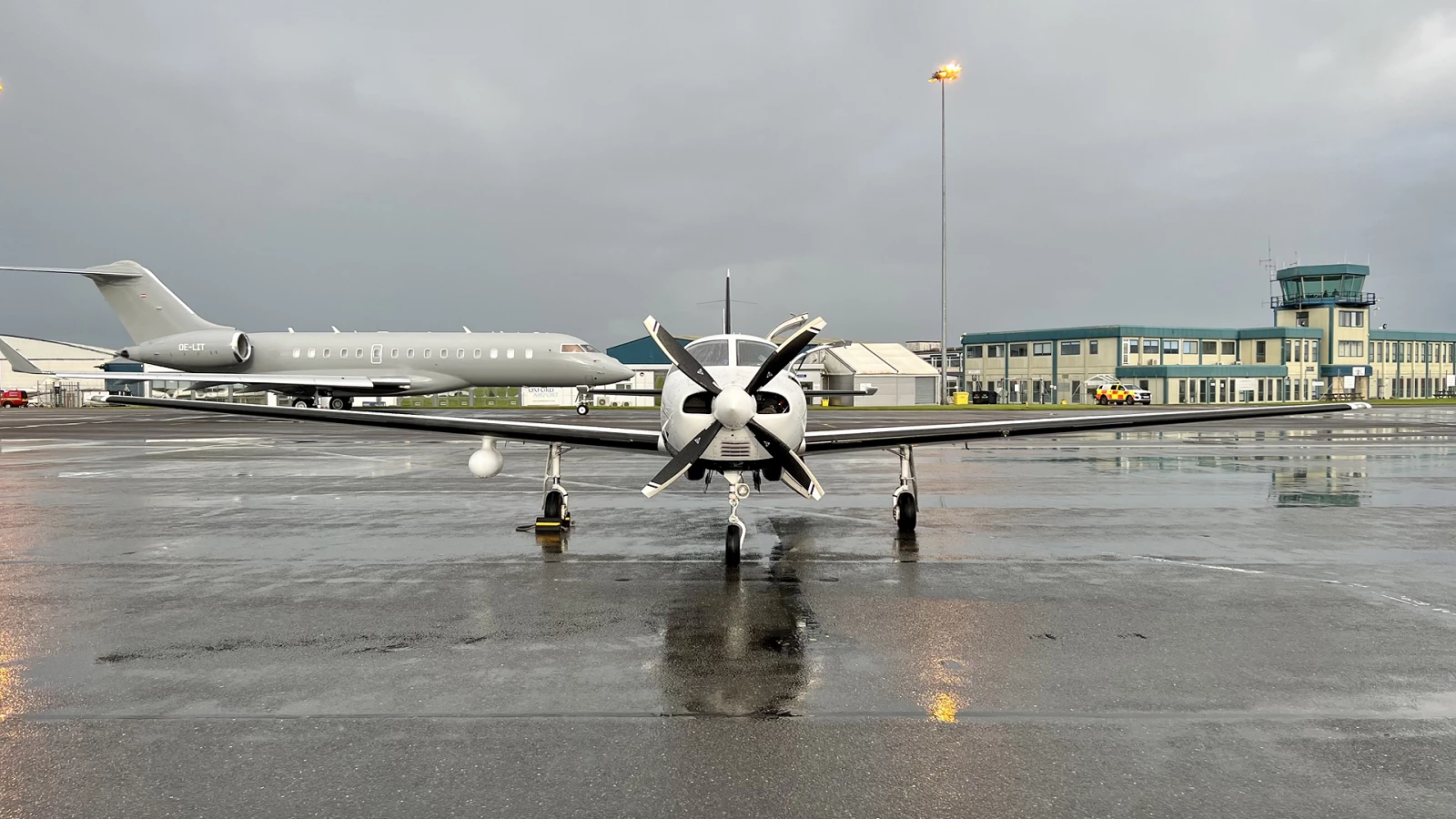
I’m practically the only plane landing at Sywell that day—just one other Tiger Moth is doing circuits. No surprise, given the weather, but thanks to that, I have the entire apron to myself, and the Malibu Mirage looks very photogenic there. Once there, I meet up with my dad and sister—while I was taking off from Oxford, they were landing at London Luton Airport and had since taken a taxi to Sywell. It was a much more economical solution to avoid the very high airport fees at Luton for general aviation (GA) aircraft —it costs nearly 1,500 GBP!
After a quick coffee break, we set off on the longest leg of this multi-day trip: to Inverness (EGPE). The route is nearly 350 nm, and due to the low cloud base, we’re already flying this leg under IFR to stay above the clouds and enjoy the beautiful views. Additionally, the further north we go, the better the weather gets, so the approach to landing won’t be a problem for us. In the UK, IFR flights can be conducted with an IR(A) or IR(R) rating—the latter does not permit flight in Class A airspace or along airways. It’s important to keep this in mind when planning, as Class A airspace covers a fairly large area of southern England at various altitudes.
After takeoff, we activate our flight plan and contact East Midlands Radar to receive Traffic Service (information about air traffic in our vicinity), which we also monitor on our built-in navigation system. As we climb to 4,000 ft, we break through the clouds—which were only a thin layer (1,500 ft thick)—and head as directly toward Inverness as possible. After about 50 minutes of flight, the Class A airspace above us rises significantly, allowing us to enter FL80 — flying at this altitude, we pass through the Leeds airport airspace, where we are radar-vectored to make way and maintain proper separation for a WizzAir Airbus A320 taking off from there, and after about 5 minutes, we return to our course.
Welcome to Scotland. We’re gradually approaching the border between England and Scotland, and the terrain is becoming increasingly mountainous and sparsely populated. These views are certainly eye-catching, but they’re just a prelude to Scotland. At the same time, the less congested airspace allows us to climb even higher to FL100. The 4-blade propeller ensures very smooth engine operation, and the pressurized cabin allows us to maintain a cabin altitude of 1,000 ft (while flying at FL100)—this really enhances the comfort and enjoyment of flying!
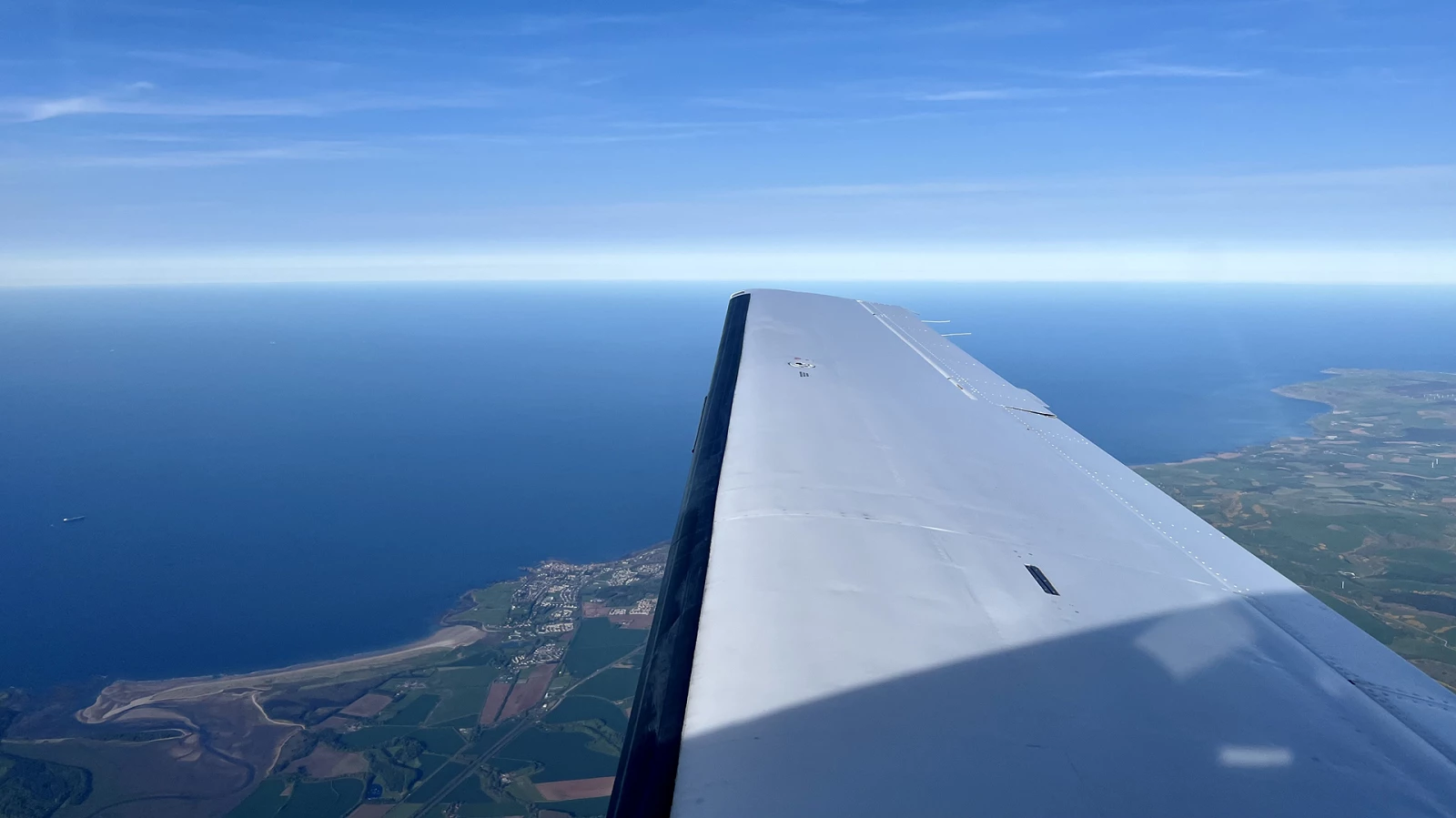
As we approach the Edinburgh area, we fly over a point where Great Britain is only 100 km wide—flying high and almost exactly in the middle, we can see the sea and the ocean on both sides of the plane. We switch frequencies to Scottish Control, where the air traffic controllers inform us of good conditions and the active runway at Inverness. We still have over 100 nm to go, so it’s a big help to know what to expect when we can’t yet receive an ATIS report. At the same time, along the route, we fly over the Grampian Mountains, where, despite it being May, snow can still be seen on the peaks. As we approach Inverness, ATC begins our descent and vectors us onto a long straight approach. On the final approach, we switch to a visual approach while using the installed ILS to maintain the approach path—this is a little trick in good weather to avoid additional charges for an instrument landing.
After landing, we leave the plane in the parking lot at the local FBO (Highlands Aviation), and I can log another 3 hours of flight time in my logbook—flights like this and covering long distances are incredibly satisfying. A quick taxi ride into town, and it’s time to make plans for the coming days. You could write an entire separate article about Inverness and Scotland, but it must be said that the mountainous terrain, crisscrossed by numerous lakes and valleys, is the perfect place for many hikes, and the rugged landscape is very photogenic. With the low clouds and local fog, you can almost feel like you’re in a James Bond movie.
A Visit to Glasgow
After a few days in Inverness, it was time to head back—to make the return trip more interesting, we’re stopping in Glasgow for a day to explore that city as well. We’re flying the entire Inverness–Glasgow Prestwick (EGPK) leg as an IFR flight. The weather forecast shows various cloud layers between 5,000 and 10,000 ft. With a mountain range and peaks exceeding 4,000 ft, climbing quickly to FL120 is the most sensible option! Our initial clearance is FL55, but a few minutes after takeoff, we receive clearance from Scottish Control for a direct route to Glasgow at FL120. We’re flying outside of controlled airspace (which begins at a higher altitude in Scotland), but we remain in constant radar contact and are kept informed of any traffic in our vicinity.
Since Scotland is further north, it isn’t the warmest place, and at takeoff, our OAT on the ground was about 10°C. As we broke through the clouds, our OAT dropped to -12°C—so it’s no surprise that we picked up some ice on the wings and windshield along the way. That’s exactly when we really appreciated the de-icing system with pneumatic leading edges, which broke up the ice without the slightest problem, as well as the heated propeller and heated windshield.
Glasgow has two airports—Glasgow International and Glasgow Prestwick. While the former is definitely closer to the city and offers very favorable terms for general aviation aircraft, it is limited to aircraft with a wingspan of less than 12 meters. The Malibu has a wingspan of 13 meters, so Prestwick was a much more economical option. There are also no additional fees for ILS landings there, so we’re using this option, combined with a vector approach, to let the Ryanair B737 and Jet2 B737—which were using the airport at the same time to train their crews—pass by.
Return Home
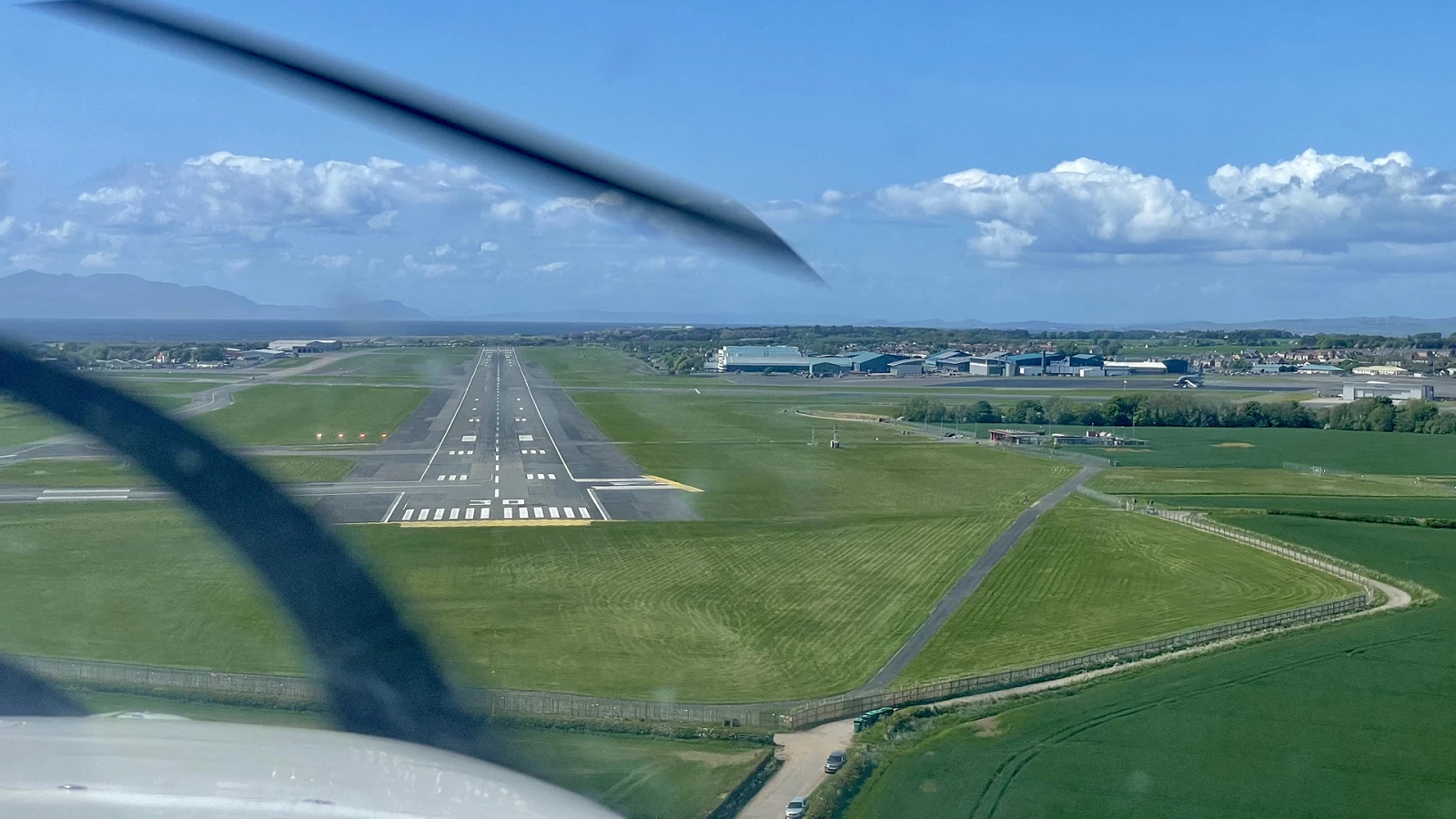
We completed the final leg of our entire trip in the afternoon of the following day—the return flight to Oxford. The weather was typically Scottish, with strong winds and a mix of clouds and sunshine. We flew this leg entirely under VFR—it was a good way to take another close look at the picturesque surroundings. Additionally, the fact that the N71WZ is equipped with a weather radar also helped us better understand what the various clouds in the area were “hiding” and how intense the weather phenomena might be inside them.
This flight was definitely shorter, thanks to the support of the ATC controllers, who allowed us to fly through both the Liverpool and Birmingham airspaces, enabling us to fly almost directly to Oxford. At the end of the day, we made a smooth landing in the rays of the setting sun, stowed the plane in the hangar, and filled out all the paperwork—all while feeling immense satisfaction from such enjoyable days and interesting flights.
Text and photos:Filip Modrzejewski


