
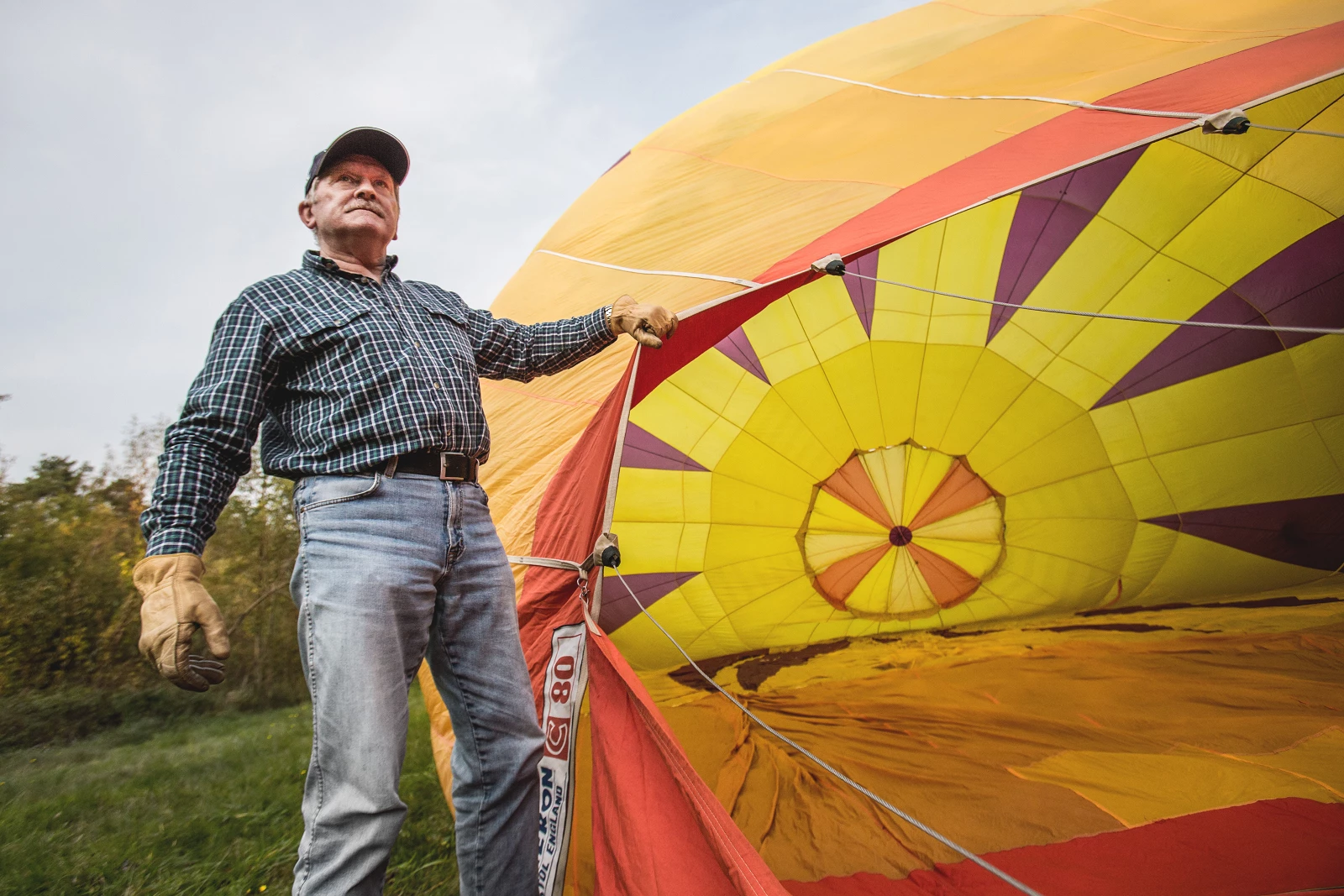
People of Polish Aviation - Włodzimierz Klósek
series People of Polish Aviation
Romantic aviator
*The interview, conducted in 2017, comes from - JB Investments archives - all rights reserved.
Agata Król: Majestic, elegant, and romantic—can a balloon in the air provide extreme sensations?
Włodzimierz Klósek: I took part in a unique feat in Polish ballooning. We flew into the stratosphere in a hot air balloon. It was the "Polish Stratosphere Project" in 2014. My friend, Dariusz Brzozowski, had the largest balloon in Poland, with a capacity of 12,000 m³. We flew in it.
It started with an idea from skydivers who wanted to jump in a three-person formation from 12,000 meters. They looked for various ways to get them that high, but no plane was capable of doing so. Even if they found one, it would have been very expensive. Their budget was limited, so they looked for something cheaper. A balloon was a good solution for them. I was invited to join the crew as a reserve pilot. At such an altitude, there must be safety measures in place, because various things can happen, whether with the equipment or with the body. The main pilot was the owner of the balloon, Darek. Apart from us, there were three other jumpers. We prepared for this long and conscientiously. At the Military Institute of Aviation Medicine, we underwent tests in a low-pressure chamber. The tests were adapted to the altitude we wanted and planned to reach. Just before takeoff, we breathed pure oxygen for about 45 minutes, because at such high altitudes, nitrogen in gaseous form begins to precipitate in the blood. This mainly affects the joints, first causing pain, and in extreme cases, leading to collapse. This situation actually occurred – one of the jumpers began to complain of joint pain at an altitude of 10,000 meters. We had to stop climbing, descend to 9,000 meters, and after 10 minutes, start climbing again. The discomfort then subsided. He probably had a leaky mask and did not have enough clean oxygen to remove the nitrogen. During the flight itself, we obviously had oxygen equipment.
How many meters did you manage to climb in the end?
At 11,000 meters, the pilot flames, similar to those in gas boilers, which ignite the main burner, went out. This was due to the lack of oxygen at this altitude. Attempts to restart them were unsuccessful, and we began to descend. At an altitude of 10,650 meters, the jumpers decided to jump. After such a significant reduction in weight, the balloon began to rise and we finally reached an altitude of 11,125 meters. After leaving the basket, the jumpers experienced a temperature of -58°C and a speed of 310 km/h. The air was thin, so they gained a lot of speed. They fell freely for 158 seconds in a three-person formation. They spread out at an altitude of 1,500 meters and opened their parachutes every 200 meters. They documented their formation with recordings from cameras mounted on their helmets. One of them had a locator, and since they landed close to each other, everyone was picked up by the ground crew. Us too. We landed north of Przasnysz. In order to make this flight, we had reserved space with a radius of about 80 km from Szczytno, up to an altitude of 12,000 meters. We took off from the edge of this space to have a 160 km reserve to fly. This was very important because if the winds turned out to be different than forecast and we were in danger of leaving the allocated zone, we would have to land.
The wind forecast was spot on. It was prepared by a team of meteorologists. They got the wind right, but the clouds a little less so. As we drove to the launch site, we hoped that the clouds would disperse. There were some breaks in the clouds, but by the time we arrived, they had disappeared. We took off on the eastern side of the Narew River, near Pułtusk, next to a forester's lodge surrounded by tall trees that were supposed to shield us from the wind. After takeoff, we entered the clouds at 500 meters and only emerged from them at 1,500 meters. And then we saw only a white desert, flat as a table. The sun was shining, and it was -30°C in the basket. It was December 3.![Polish Stratosphere Project_!.png [777.90 KB]](https://www.jbi.com.pl/storage/image/core_files/2026/2/12/04ae8f3011036ffa59697ba1b174af91/png/jbinvestments/preview/Projekt%20Polska%20Stratosfera_!.webp)
Is winter a good time for such flights?
Such tests are performed during winter because high air temperatures during takeoff reduce the chances of the balloon reaching high altitudes, as the temperature inside the envelope is then high. We only had about 80°C in the envelope, which was still a huge reserve. That is why we chose a balloon with such a large capacity, so that we would have a considerable reserve of lift. We took a basket that was half the size to minimize the takeoff weight. The entire flight lasted 2 hours and 27 minutes, from takeoff to landing. We reached an altitude of 10,000 meters in an hour, and 1,000 meters in 7 minutes. So, those 12,000 meters were within reach. A unique feat. There had been previous attempts at high-altitude flights, but the highest altitude reached was 9,000 meters.
An extreme and unique experience, because you have made your mark on the history of world aeronautics.
We broke two European records – for the height of a three-person formation jump and the free fall time of that formation. We also hold the Polish record, because no one has ever flown so high in a hot air balloon before. What a cool experience! I've been higher in an airplane, so it wasn't a big deal for me, except that here I was in a "convertible."
Which places in the world did you like the most from the perspective of a balloon?
I have been to Battle Creek, a town between Chicago and Detroit, three times. Large corn fields, mobile sprinklers. The landscape is somewhat similar to Greater Poland. In Poland, I like Mazovia. It is beautiful because there has never been large-scale farming or state-owned farms there. So there are many small fields of various shapes and with diverse crops. Because of this diversity, flying there is fun and makes landing easier. With large-scale farming, when you fly over a field for half an hour and can't see the end, you sometimes have to land on the roads between the fields so as not to damage the crops. In Mazovia, you can always find a piece of wasteland, a meadow or something. You often see wild animals – moose, they are not afraid at all, they look up to see what is making noise above their heads. In the past, farmers used to plow with horses. I remember one stopping and waving at us. We flew closer to him, and the horses, frightened by the noise, took off. But he started threatening us with his fist.
You didn't start your aviation career with balloons; airplanes came first. How did that happen? What was that journey like?
I started my aviation career by accident. My cousin was interested in airplanes and was the designer of the first amateur aircraft in Poland. His name was Jarosław Janowski. He died two years ago. He built Prząśniczka – a well-known design that was his idea from A to Z. Even the engine was made of two cylinders from an MZ 250, had 19 HP, and the whole thing weighed about 100 kg. He built it out of plywood, in his apartment, in the very center of Łódź. To paint it, it had to be pulled out of the second-floor window, because otherwise it was impossible to carry it out from there. When someone entered the apartment, they immediately asked Jarek what it was, because the tail stuck out into the hall. Jarek said it was a kayak (laughter).
Did you catch it from him?
I never aimed that high; I never thought I could be one of those superhumans flying around in the sky. I was involved in mundane matters. I graduated from automotive technical school, and my friend and I already had plans in that direction. One day, Jarek invited me to Lublinek, the airport in Łódź, to fly a plane. I went there once. His friend, instructor Lech Szybiłło, was towing gliders at the time, and that's how I flew a Gawron for the first time. Back then, there weren't any restrictions on having passengers in tow planes, etc. It was a strange feeling! Suddenly, the ground receded. It was my first flight, my first time leaving the ground, which made me wonder if I should try aviation. Jarek encouraged me to go to Dęblin and advised me against driving. My health was of great importance, and I knew that the medical examinations for candidates were very thorough. Of the more than 40 guys who were with me at the examinations, I saw maybe five at the exams. I got in.![IMG_3695.jpg [7.16 MB]](https://www.jbi.com.pl/storage/image/core_files/2026/2/12/7f51b41c0a27d1fc130b0b31e9527750/jpg/jbinvestments/preview/IMG_3695.webp)
Are you grateful to your brother for this "invitation" to aviation?
I can say that. My mother never forgave him for that, because her friend's son died shortly after graduation in Krzesiny in a MiG-21. We knew each other from an early age – I was six years old and he was three years older than me. After passing the exams to the school in Dęblin, I underwent selection training as part of the second level of military aviation training. I flew TS-8 Bies aircraft in Łódź at Lublinek. After training and flying 21 hours and 45 minutes, on November 2, 1971, I was admitted to the School of Eaglets. Due to the high demand for instructors in connection with the expansion of the practical training program for cadets, I finished school six months earlier, as I was among the group of cadets selected to become instructors. We were divided between airports where we flew on Iskras, namely Radom, Tomaszów Mazowiecki, and Modlin. I ended up in Modlin. That was good, because it gave me a better chance to spend my free time in an interesting way, in Warsaw. It was also significant when the air force began to be disbanded, and our training and combat regiment in Modlin was the first to be dissolved. If I had ended up in a green garrison somewhere, I would have been in a similar situation to the employees of state-owned farms, with no prospects, somewhere in the woods. Warsaw offered great opportunities. That's when I started working as an instructor at the Warsaw Aeroclub.
Did you leave the army for good then?
Yes. The unit was disbanded, and since I didn't receive any interesting offers, I left. They only kept the youngest pilots who did not have pension rights. It was an unimaginable waste, because people whose training had cost a lot of money left. I found a job at the Aeroclub, but not for long, because the system of financing associations changed and staff had to be reduced. Previously, there were subsidies from the state budget, from the ministries of national defense, sport, and education, so money flowed freely. I was a military retiree, so I had to leave first. But not for long. My entire aviation career has been pure coincidence, and it was also by chance that I got into ballooning. A colleague who worked with balloons at the Aeroclub was leaving his job. The director came up with the idea that I would take over his duties. And so, in February this year, it was 27 years since I started working with balloons, and now I only deal with this type of aviation.
But he had no previous experience with this discipline?
No, I had never even been to a balloon loft and had never seen a balloon up close in my life. I flew for the first time in February 1990. The weather was so beautiful that while waiting for transport, we lay down on the grass in a meadow. It was Sunday and 16°C, but quite windy. We went in two balloons to the place where the airport in Góraszka was later built. Taking advantage of the forest cover, we took off. I flew with the director of the Aeroclub, who was an active military officer at the time, because in those days the directors were officers seconded from the army. The second balloon flew at different altitudes and moved away from us. As it turned out, the second crew was luckier because they landed at a wedding reception. It must have been 9:00 a.m. They woke up the wedding guests, and when they saw the balloonists, they welcomed them appropriately.
We had an adventurous landing, but even then I could sense that I had the makings of a good balloonist. I stood behind the burners, tried to fly somehow, and finally my instructor pointed out a place to land – in the meadows, by the road. I claimed it was more of a ditch, he claimed it was a road. The wind was quite strong, so from the moment we touched down until the balloon stopped, we were dragged along the ground for about 100 meters. And it turned out that it wasn't a road, but a ditch with water in it. I say that I behaved like a true balloonist because I chose a position that would keep me from getting wet. The basket fell into the ditch, water came through the cracks, and my instructor was left wet in the water (laughter). I spread myself out above him and came out of it dry. It turned out that we had landed behind the village administrator's farm. It was a great joy, because in those days, only the village administrator had a rotary phone. We had an agreement with the crew that if we lost radio contact, and we could only hear something on the VHF when the antennas were in sight, we would call the military airport tower in Bemowo, tell them where we were, and they would find out that way and come for us. And so we lay behind that farm, in the meadow, for another hour. The village mayor's wife was frying doughnuts. She brought us some giant ones, still warm.
You remember moments like that.
Then it happened that we spent the night in a haystack. To keep warm in October, we covered ourselves with a blanket.
![IMG_3705.jpg [5.54 MB]](https://www.jbi.com.pl/storage/image/core_files/2026/2/12/ea7b46c623e8bbf305536022a72e0f8c/jpg/jbinvestments/preview/IMG_3705.webp)
Is it true in ballooning that you land wherever the wind takes you and then the action takes on a life of its own?
It used to be more common. Nowadays, this is no longer a problem, because there are systems for locating balloons using cell phones, and this has stripped ballooning of its romanticism. Anyway, today's competitive ballooning is far from my vision of the ideal. Nowadays, electronics play a primary role, and the pilot is just an accessory. This leads to situations such as when one of the competitors damaged the cross in the Cathedral in Włocławek because he was looking at the monitor in the basket instead of around him. He later became the European Champion.
Now, the position of the balloon and the target are displayed on a tablet, and the ground crew provides additional guidance via radio. Of course, the possibilities for various competitions have been expanded, because when flight recorders were introduced, people began to invent virtual competitions, such as who can cover the longest distance in a 1,000-meter square at an altitude of 1,000 meters. For me, these are absurd things. In the past, the essence of ballooning was throwing markers. A marker is a bag of sand with specific weight and size parameters, with a ribbon. The targets were laid out by the judges – they were canvas strips, arranged in a cross, one meter wide and eight meters long. You had to throw the marker as close to the center as possible. The judges measured the distances with a measuring tape. And that's old-school ballooning!
And now the competitions are such that I no longer want to fly competitively, even though I had some success flying according to the old rules, before the advent of electronics. I was twice runner-up in the Polish championships and won the first mountain balloon competition in Krosno. Now I compete in events called fiestas. The most important thing there is the pleasure of flying, and simple, old-style competitions are held, which adds to the flavor of it all.
Have you had any close calls in your career, like landing in a tree?
Almost on a tree. We were in the US for a team competition. The direction of flight was such that the wind directed me towards a large forest and died down. Evening was approaching. I'm hanging over this forest and thinking. I noticed a hole in one place, as if two tree crowns were missing, and so I moved two steps to the right, three steps to the left, a dozen or so, a few dozen meters, until finally it directed me to this empty space, I pulled the navigation flap — an opening that opens from above to release warm air and initiate descent. I descended below the crowns of the neighboring trees and when I grabbed one of them, I would have pulled it out by the roots rather than let it take me away from there. It was lucky that the shell wasn't damaged. I just wondered how my crew would find me and get me out of there, because there was no road in sight, it was dusk, and fireflies were flying half a meter above the ground. It turned out that the forest I landed in belonged to some religious sect. My crew was driving along the highway when I landed and had a rough idea of where to look for me. They let them in. I noticed the lights, so I used my whistle to guide them. It worked!
I also had an adventure in Austria. It was the most dangerous situation I had ever found myself in. I was a novice pilot. We were going to a competition near Graz in Styria – a hilly, densely populated area. We took off in fairly strong winds and, before reaching the hill, I tried to land in front of the ridge. Unfortunately, I failed because I was blown to the other side. As an inexperienced pilot, I decided that if I pulled the flap behind the ridge, I would hide on the leeward side and calmly find a place to land. Meanwhile, in stronger winds, a rotor forms on the leeward side, which causes you to be pushed to the ground. I pulled the flap, the rotor pushed me down, and on top of that, I was above the forest. I couldn't avoid colliding with a tree. In fact, I lightly brushed the branches with the basket above the forest, but one tree was sticking out and I caught it with the crown rope. The crown rope is used to set up and lay down the balloon. It is attached to the top of the envelope, and when the balloon is set upright, holding this rope allows it to come upright in a controlled manner. When deflating, it is pulled with the wind to lay the envelope in a specific direction. The other end of the rope is attached to the basket. When I caught on a tree, the rope slowed me down, the top broke, the rope snapped, and because the moment of wind pressure and balloon stoppage caused the air to be squeezed out of the envelope, we crashed into a field. We were unharmed, the organizers' teams found us quickly, and everything ended happily. It was only the next day, when we were preparing for the flight, that we noticed that under the equator, i.e., under the maximum diameter of the balloon, there was a hole so big that you could walk through it without bending down. The top of the tree that broke had pierced the envelope.
These experiences later enabled him to train subsequent generations of balloon pilots. You no longer train pilots.
No, I haven't been teaching for quite some time now, because I'm a ULC examiner for balloons. I focus on examining, because balloon training is becoming increasingly popular. I conduct 5-6 license exams a year, and there are 3 other examiners in Poland, so you could say that we have about 20 new pilots every year. In addition, I renew the licenses of instructors and pilots. There are not many balloons in Poland. There are about 200 in the register, which is 10 times less than in Germany, for example. The availability of flights is much greater there because companies that offer tourist flights set up in supermarket parking lots, for example, so you can fly after shopping. It costs about 150 euros for an hour-long flight.
Airplanes and balloons are two different worlds. Did you find it difficult to master this art?
I don't recall having any difficulties. As in all aviation, you have to make contact with the ground at a certain speed. The assessment of the rate of descent and altitude must be correct, whether it's a balloon or an airplane, it doesn't matter.
![IMG_3710.jpg [5.38 MB]](https://www.jbi.com.pl/storage/image/core_files/2026/2/12/83d5787ea5184f92e8a79f8cba3db31b/jpg/jbinvestments/preview/IMG_3710.webp)
Yes, but airplanes have controls, and you had to learn how to maneuver a balloon.
Some people ask what balloon competitions are all about. It's mainly about flight precision, getting as close as possible to designated targets or targets declared by the pilot. Yes, but there are no controls. Our control is the wind. You have to take off in an area with favorable winds and, by narrowing your tacking, just like on a sailboat, reach your destination.
What is tacking in ballooning?
It is rare for the wind to blow in one direction in the space between 0 and 1000 meters. Usually, at different heights, it deviates to the right or left from the average direction. The rule is that after takeoff, you go as high as possible in the zone of possible winds to see the target as early as possible and set a precise direction. In the past, everything was done "by eye," but this is no longer the case, because the coordinates are entered into a tablet and you can see your position relative to the target. In the past, you would draw a line on the map from the starting point to the destination and check with your finger on the map whether you were in the right place – this cottage should be on the right, and I'm flying over it, so I have to correct to the left. Coming back to tacking, it is nothing more than changing direction by changing altitude. At different altitudes, the winds blow in different directions, and we take advantage of that.
It requires spatial imagination, logistics, and planning. Compared to flying airplanes, it's a completely different world.
It cannot be compared to anything that has controls that allow us to influence the direction of flight. It is one of a kind. Everything depends on the speed and direction of the wind, the time of day and year, terrain conditions, whether there is a forest or water bodies. During competitions, with favorable winds, the target can be reached with centimeter precision. If the wind does not blow as forecast, you can fly hundreds of meters past the target. The responsibility lies with the pilot. Balloon events are usually organized in the summer, when the sun rises very early. This is important for weather forecasting. During competitions, there is always a meteorologist who probes the wind at different altitudes by releasing balloons filled with hydrogen or helium and observing them with a theodolite. After calculation, preliminary data on wind directions and speeds at different altitudes are obtained. The details are communicated during the briefing. The problem is that this survey is taken at, say, 4:30 a.m., and the launch itself is, say, two hours later. During this time, the sun is getting higher, heating the ground, causing air movements, and winds are waking up after a night of stagnation. Therefore, in addition to the meteorological report, the pilot must rely on his own observations and experience. We have balloons, like those used for children's games, which we fill with helium and release from the potential launch site. Then, using a compass, we determine the flight directions and assess whether it will be possible to reach the designated destination from this location. If so, we prepare for flight; if not, we look for another launch site. This is how all crews proceed, driving in all directions and looking for a good spot, and as a result, we all meet up in one and the same place anyway.
![IMG_3628.jpg [7.89 MB]](https://www.jbi.com.pl/storage/image/core_files/2026/2/12/6f09f0589f7a9e36a2bef235d262f0df/jpg/jbinvestments/preview/IMG_3628.webp)
I am a romantic by nature, and I jokingly say that since there was no cavalry, I ended up in the air force. I have loved horses since childhood, and for many years I rode in the CWKS Legia show jumping section under master Jan Kowalczyk as an assistant rider. Problems with my spine meant that I had to choose between aviation and horses. And since ballooning is closest to my heart, that's what I chose.
Text: Agata Król
Archive JB Investments Sp. z o.o. (all rights reserved)
Photos: Magda Starowieyska