
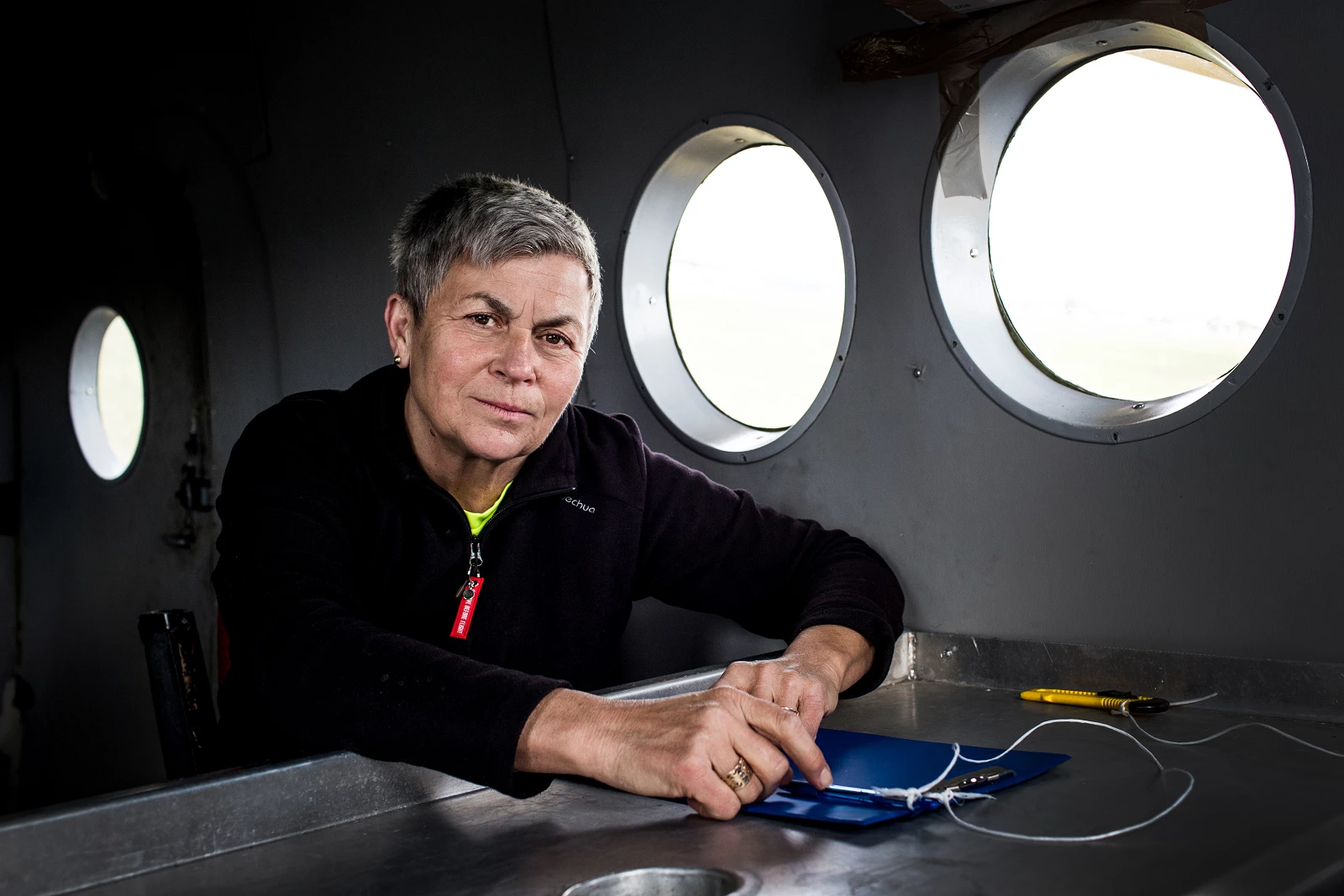
People of Polish Aviation - Teresa Ćwik-Maszczyńska
series People of Polish Aviation
I didn't sleep through my life
*The interview, conducted in 2017, comes from - JB Investments archives - all rights reserved.
To be the first female pilot in Polish air ambulance services, and even earlier – the only woman working as a helicopter pilot, you have to be a specific kind of woman. "Strong." "Down-to-earth." “I am not a fearful person.” “You have to take life by the horns” – during our conversation, Teresa Ćwik-Maszczyńska describes herself in these words. Her colleagues at work simply said: “That’s just how Tereska is.” They knew not to get in her way. When she sets her mind on something, she gets it done. "I was born that way," she sums up.
We meet at Warsaw's Babice airport. Teresa is about to pilot a plane that will drop rabies vaccines for local foxes. This fall marks 50 years since Teresa Ćwik-Maszczyńska took to the skies. She flew in the World Helicopter Championships ("In 1978, in Vitebsk, I won a bronze medal in flying, please note, precision flying") and in rescue operations during the floods of 1997 (she delivered food and water to people in flooded areas, evacuated those trapped on the roofs of houses), and with mountain rescue services, anti-terrorist units, the police, and journalists during papal visits.
I try to find out what she was like before she started flying, but she cuts my attempts short: “What did my parents do? They worked hard! They survived the war, they were strong. Those were the times: you had to be strong. Especially if you weren’t financially strong.”
Teresa came to Wrocław from her hometown to study at a technical college specializing in chemistry. Even before she finished, she enrolled in the Wrocław Aeroclub for parachute and glider training. No one in her family had ever had anything to do with flying. When I ask her where she got the idea, she answers just as succinctly. "No one persuaded me, no boyfriend, brother, or cousin. I read an advertisement in the newspaper about recruitment and signed up for training. Just like that!"
![IMG_3988.jpg [8.57 MB]](https://www.jbi.com.pl/storage/image/core_files/2025/12/11/af52cd3e0e089288be33dc3bfcdeec24/jpg/jbinvestments/preview/IMG_3988.webp)
However, it doesn't seem that simple to me, but Teresa quickly explains where my doubts come from. "Those were different times! All you had to do was want it. Come, sign up, participate. It was all free. Now everything costs money." For young people who wanted to develop, who were ambitious, stubborn, and goal-oriented, opportunities were created, which I took advantage of – first with training at the flying club, then at university, where you could obtain the qualifications needed for a professional pilot's license. Today, you have to pay a lot for such training. Young people simply cannot afford it! And older people must either be rich or willing to take out a loan, she explains. Although she did not have to pay for the training, it did cost her something. “I had to sacrifice my vacations and spend every free moment practicing. It took a lot of effort,” she recalls.
Only about 10% of her group from the Wrocław flying club remained in aviation, the rest dropped out. As a woman, it was even harder for her. "You have to have a really strong superstructure," says Teresa, tapping her head meaningfully. Where did she get this "superstructure"? Her studies certainly helped. After graduating from technical college, she worked as a laboratory assistant for a year, but at the same time she was already flying gliders and airplanes, had made over 20 parachute jumps and participated in competitions of various ranks (she won, among others, a gold badge with three diamonds in gliding). She saw her future in the laboratory becoming increasingly hazy. She decided to apply to the Academy of Physical Education. Field of study: air sports. "That's where I learned the most important thing: an active attitude towards life. It wasn't easy: running, swimming, skiing, constant movement! Thanks to this school, I can safely say that I didn't sleep through my life," she assures us. And she has proof: over 50 marathons, two 100-kilometer runs, triathlons, swimming marathons, mountain biking, skiing competitions... "Thanks to this, I am now escaping old age on my own two feet," she laughs.
![IMG_4127.jpg [7.66 MB]](https://www.jbi.com.pl/storage/image/core_files/2025/12/11/c0c6c68634cbaa6340d7913e43be927f/jpg/jbinvestments/preview/IMG_4127.webp)
I try to find out how she started running, and before I even ask the question, I know the answer: "Just like that!" Teresa recounts how one day in the 1990s, she was walking with her then several-year-old daughter to the circus. On the way, they passed people who were just finishing the Wrocław marathon. "I thought to myself, 42 kilometers and 195 meters. And then I thought, if they can do it, so can I. I decided that I would also run next year. And I started running. I ran to work and back. And I got hooked. Just like that!” she recalls. It got to the point where she was running six or seven marathons a year. “It’s a way of life,” she comments. “Yes, I didn’t sleep through this life,” she repeats.
It would have been difficult to sleep through them, even if Teresa had wanted to. After graduating, she worked for a while as a glider instructor at an aeroclub, and from 1977, after a short training course, as a pilot on an MI-2 helicopter and a Morava L-200 twin-engine aircraft at the Wrocław branch of Przedsiębiorstwo Usług Lotniczych (Aviation Services Company). At that time, she was the only woman in Poland flying helicopters professionally. Then, when she got a job with the Medical Aviation Team in 1983, she was the first female pilot employed there. But again, it wasn't easy: because if you're a woman, you'll soon have children, leave work, and cause nothing but trouble. “The director of the Central Aviation Team in Warsaw, who had no prejudice against women, decided to hire me full-time,” she recalls. “However, I had to promise that I ‘wouldn’t cause any problems’ if I decided to have a child,” she adds.
"It's a chauvinistic environment, let's be honest," Teresa says candidly. "But I didn't come there from the street, I was already known in that world. I got there through persistence and hard work," she emphasizes. When she decided to have a baby after three years, "she didn't cause any problems." She flew until her fifth month, and after the 112 days of maternity leave she was entitled to at the time, she returned to work and never took a single day off. “I quickly got back into shape because I had a fit body, which I took care of all the time by playing sports,” she emphasizes. She jokes that her daughter was almost born on a bike – Teresa was riding to her allotment when labor started three weeks before the due date.
Her mother helped her for the first year, then Teresa hired a nanny. Fortunately, she lived close to the airport (“5 kilometers and 800 meters,” Teresa specifies). Her colleagues also helped: they willingly swapped shifts and picked up her daughter from kindergarten when her mother couldn’t. “We had good, friendly relationships,” she emphasizes. Teresa’s husband is also a pilot—now retired—specializing in business aviation. “That made things even easier. Shared problems. A lot of understanding and mutual help,” she assures us.
![IMG_4171.jpg [10.06 MB]](https://www.jbi.com.pl/storage/image/core_files/2025/12/11/c0fe9f54b9db74063c54007fea029d17/jpg/jbinvestments/preview/IMG_4171.webp)
She worked in air ambulance services for 17 years, until 2000. “I always enjoyed going to work, but this job gave me the greatest satisfaction. I felt that I was doing something important, that I was helping people,” she emphasizes. She recalls a certain Christmas Eve in the late 1980s. The weather was bad, so she went home (5 kilometers 800 meters) to make dumplings. Suddenly, a dispatcher colleague called her to come in because there was a rescue flight – a man had to be taken to Gdynia to a hyperbaric chamber. Her husband was away at the time, so she called her sister to come and look after her four-year-old daughter. They took off around 4 p.m., already in the dark, and returned around 10 p.m. “I remember flying in the darkness over the cities and thinking to myself that down there, people were sharing Christmas wafer, sitting with their families at the table, and we were alone in this plane... I felt satisfied that although I had sacrificed something, it was not in vain. That it was necessary. I joined my family late and felt doubly good during those holidays,” she recalls. But sometimes flights had to be canceled. “We had to make the right decisions. Sometimes it meant not flying due to bad weather. Sometimes we had to interrupt the flight. To live, sometimes you have to turn back,” she emphasizes. For the operation to be successful, it was often necessary to take an active part in it, to help move the patient, to put him in the helicopter. “I carried the stretcher without saying a word,” she says curtly.
She moved from air ambulance services to the newly formed Wrocław police aviation unit. “I performed tasks for the police on an MI-2 helicopter for 6 years, 5 months, and 3 days. There’s a lot to tell, but I won’t do that,” she concludes, and I know there’s no point in arguing. For the next few years, she flew a Robinson 44 at the Bodzio furniture factory, whose boss bought the helicopter to travel more efficiently on business. “He was a cool guy, very down-to-earth, we respected each other,” she recalls. When the helicopter, finally sold by her boss, accidentally burned down some time later, she cried like a baby. “It was such a gem, my little helicopter!”
![IMG_4047.jpg [13.50 MB]](https://www.jbi.com.pl/storage/image/core_files/2025/12/11/fc7d9cb54e7941339235083f7d861958/jpg/jbinvestments/preview/IMG_4047.webp)
Now retired, she says she flies planes, but she hasn't flown helicopters for a year. "I'd love to, but I have nowhere to fly. I dream of working as an on-call pilot again. I'm looking for a job with someone who has a helicopter and needs a pilot but doesn't want to invest in training one. I'm available," she smiles encouragingly. When I ask her if she was ever attracted to so-called big flying, she tells me how she applied for a job at LOT right after college. “I even had an interview with the director, but at that time, no one could imagine a woman piloting a large aircraft. So I went into small aviation and I don’t regret it. It turned out to be exactly what I enjoyed the most,” she says, and I ask her for details. “It’s simple! When you fly small planes, you see the beauty of the world. Here something is blooming, there something is flowing, sometimes green, sometimes gold. For me, that's the greatest value of flying. You don't get that in large-scale aviation. In a moment, I'll be flying at an altitude of 200-300 meters to drop these vaccines for foxes, so I'll get a good look at spring from above!
![IMG_4068.jpg [10.68 MB]](https://www.jbi.com.pl/storage/image/core_files/2025/12/11/47a27116413cbb8be1b447d773be1d2e/jpg/jbinvestments/preview/IMG_4068.webp)
Text: Olga Wiechnik
Archive of JB Investments Sp. z o.o. (all rights reserved)
Photos: Magda Starowieyska