
People of Polish Aviation - Ryszard Witkowski (deceased)
series People of Polish Aviation
Life from the perspective of dreams
Ryszard Witkowski - born May 9, 1926, died March 14, 2022 - test pilot and instructor, one of the first professional helicopter pilots in the history of Polish aviation
*The interview, conducted in 2017, comes from - JB Investments archives - all rights reserved.
“You know, I’m made up entirely of spare parts. Starting from the top: an artificial ear, a pacemaker, three bypasses, endoprostheses…” lists Ryszard Witkowski, a legend of Polish helicopter aviation, when I visit him in his apartment in Warsaw’s Ursynów district. I listen, admiring the expansive view from the windows, and think to myself that coquetry is probably not the most important trait for a pilot, but Mr. Witkowski, a 90-year-old retired test pilot, certainly has no shortage of it. Nor does he lack courage and common sense – two qualities that must go hand in hand in this profession in order to live to see your "spare parts."
Entering the third dimension
His first contact with real aviation consisted of hiding from Luftwaffe planes, which dropped several bombs in September 1939 on Milanówek, where 13-year-old Ryszard lived with his mother, a widow raising two children on her own. Even earlier, there was his first toy – a plywood airplane – there were aviation films at the Oaza cinema, there was an exhibition where he saw a real motor glider for the first time. But it was largely the war that determined Mr. Ryszard's later fate. “Aviation was the fruit most forbidden by the Germans. They were the ones who flew, we could only watch them from below. Of course, it wasn’t a very friendly gaze,” he recalls with a smile. However, he did not stop at just watching – from 1941, he was active in the underground National Military Organization, which merged with the Home Army in 1943. He passed his high school exams in the spring of 1945, while the war was still going on.
Warsaw was slowly rising from the ruins of the uprising, and its residents were trying to return to normal life. A handful of surviving lecturers from the Warsaw University of Technology enrolled at the Wawelberg and Rotwand Engineering School, whose Mokotów building had survived. It was here, in the fall of 1945, that the first post-war class began studying aviation, even though Wawelberg had had nothing to do with this field before the war. And this is where the newly minted wartime high school graduate ended up.
The future aviators studied from German textbooks, flew on former German equipment, under the supervision of the remaining German instructors. "We pursued our dreams using whatever tools were available," recalls Mr. Ryszard. "And the power of the dream of entering the third dimension is enormous. Humans are creatures that for millennia moved only in two dimensions: on the ground. Only birds flew, and our ancestors could at best jump a little. Eventually, they wanted to be creatures not like amphibians, but with access to the third dimension. Aviation has come a long way from primitive takeoffs from the ground to a very complex but safest method of transportation! concludes Mr. Ryszard. His role in shaping this path – not only in Poland – cannot be overestimated.
![ryszardwitkowski_natural_2.jpg [5.00 MB]](https://www.jbi.com.pl/storage/image/core_files/2026/2/20/8a1fb6042e1c5c60962725a56be9af08/jpg/jbinvestments/preview/ryszardwitkowski_natural_2.webp)
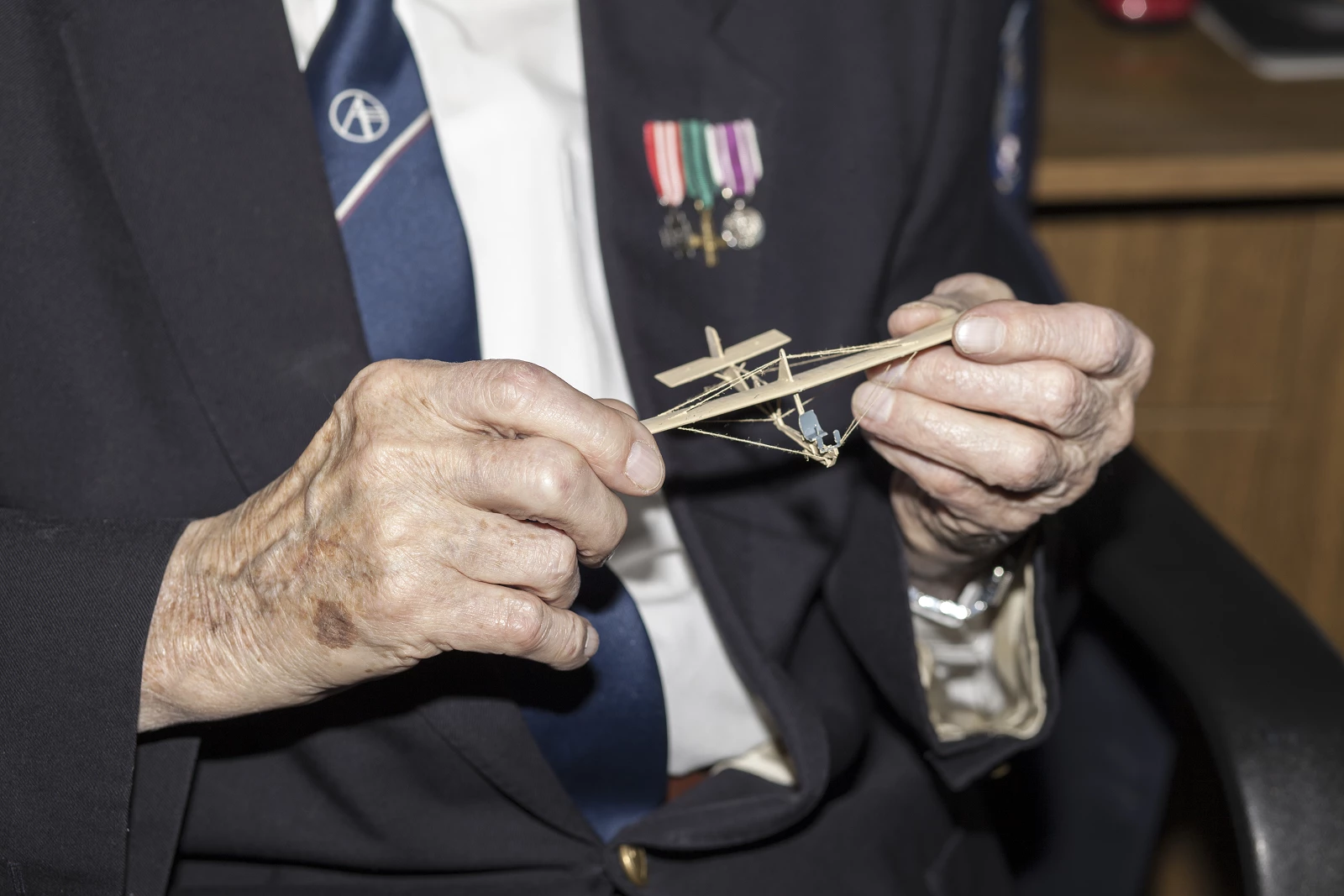
, a retired pioneer In 1945, only the military had access to serious flying. Mr. Ryszard and a handful of his colleagues decided to join the military through gliding. When they succeeded, they became the first civilians trained after the war. After being hired by the Main Institute of Aviation, they became involved in a newly developing branch of aviation technology, helicopter aviation, whose history is different from that of airplane aviation. Although the first take-off from the ground took place at around the same time as that of the Wright brothers, helicopters did not come into use until World War II. "It was only years later that we realized we were pioneers. When I retired and started meeting with fellow pilots and talking about our experiences, I gained a perspective that was even broader than from above," he says.
Like most of his colleagues, Mr. Ryszard started out with gliders. His interest in helicopters was largely determined by his wartime experiences, or rather their consequences. “Ninety percent of us were former Home Army soldiers. When the Stalinization of the country began, we found ourselves on the blacklist. We, already trained pilots, were thrown out of our jobs without any explanation,” he recalls.
Deprived of the opportunity to fly, he worked for five years in a “chandelier factory.” “That’s what Marciniak’s factory in Okęcie was commonly called,” laughs Mr. Ryszard. After the war, the nationalized chandelier factory began producing lighting equipment for virtually all branches of industry. "From the perspective of a retiree, I look back on those years fondly. I learned a lot, and that time was not wasted," says Mr. Ryszard. "It was only wasted from the point of view of fulfilling my dreams," he adds after a moment. It was there, through the window of his office, that he saw a helicopter for the first time in his life. A "Chinese spinning top," as it was called at the time.
Entering the unknown
When he was finally able to return to flying after five years, he decided to change his career path slightly. Previously, he had been involved in testing the strength of aircraft structures, but in this industry, five years is a real era. When he left, the strength of wings was tested, for example, by loading them with sandbags. When he returned, this method was almost prehistoric. In order not to fall behind, he took a big step forward.
The Polish aviation industry, although completely devastated after the war, made attempts to join the global race of designers. In the 1950s, the experimental SP-GIL helicopter was created, followed shortly thereafter by the BZ-4 Żuk utility helicopter. Ryszard Witkowski was the only person who flew it, as he became a test pilot.
"This is the most noble field of flying, because it involves consciously entering the unknown," he says. "A professional pilot gets into a machine that has been thoroughly tested. But someone had to do those tests. If, for example, a helicopter is approved for a maximum speed of 220 kilometers per hour, the test pilot has previously flown it 10% faster," explains Mr. Ryszard. "Every safety margin has been exceeded by a test pilot before.
A job that involves constantly pushing the boundaries must require a certain willingness to take risks, but when I ask about this, Mr. Ryszard says briefly: "I just didn't think about it. The task was the task, it had to be done. That's all," he cuts off.
But the fact is that some test pilots paid for the task with their lives. This was the case with Antoni Śmigiel, Mr. Ryszard's friend, a pilot testing another Polish prototype – the JK-1 Trzmiel jet helicopter.
Mr. Ryszard thinks of the machines he tested a bit like children who had to be raised and shaped, helped to enter adulthood. However, not all of them passed the test. "I have never been immune to emotion," wrote Mr. Ryszard in his book Six Degrees of Freedom, which has been reprinted several times. In it, he described, among other things, his successful efforts to save the SP-SAD helicopter, which for many years had been a "flying laboratory" for pilots, from being scrapped and to ensure it a peaceful old age in a museum (after landing in front of the museum hangar after the helicopter's last flight, Mr. Ryszard bid it farewell with a furtive kiss on the cold nose of the fuselage).
watch and compass Although Polish design attempts were discontinued in the 1950s in favor of introducing licenses for Soviet helicopters, Mr. Ryszard's work did not end there. As a test pilot, he tested, among other things, the usefulness of helicopters in medical rescue (at that time, such an application was just beginning to be considered) and in agriculture. He flew to Indonesia to train local pilots, conducted experimental spraying of date palms in Libya using a helicopter, and fought locust plagues in Nigeria. When, in the early 1980s, it turned out that the Polish Mi-2 SP-SBO helicopter, which had been in the United States for three years but had been forgotten by everyone, had to leave American territory immediately – otherwise the Polish government would have to pay a heavy fine when its permit to stay in the United States expired – Mr. Ryszard was entrusted with the task of transporting it to Canada. However, this seemingly simple task became much more complicated – the machine, which was supposed to be in working order, turned out to be partially inoperable – as evidenced not only by the bird nests filling it, but also by a malfunction that forced it to land on a farm that was, among other things, a rehabilitation center for former psychiatric hospital patients. One could go on and on about the adventures Mr. Ryszard experienced during his prematurely ended career due to middle ear disease and the resulting problems with his vestibular system. When I ask him about his greatest experience, he answers without hesitation. "My trip to Libya. Five thousand kilometers covered in a small helicopter. Those were different times: I flew to an oasis in the desert using the Wright brothers' method, with only a watch and a compass to guide me. I flew over green, flat Poland, over the high mountains of the Tatras and the Balkans, over two seas, over the desert..." he says in a dreamy voice.
Thanks to his work, Ryszard Witkowski saw the world at a time when few people could see it. "I became richer by this third dimension," he says, and when I ask if there is something spiritual, perhaps even religious, about this experience, he replies: "For a believer, believe me, an almost stratospheric flight, reaching an altitude of 5-6 kilometers with a glider, is already a mystery. This loneliness and absolute dependence only on oneself and on some higher powers, perhaps, elevates these impressions to the level of mysticism. They say that a pilot at such an altitude is closer to God, and I even like that," he smiles. But after a moment, he adds that the helicopter is the last flying machine that stays close to the ground. "Like in that joke: 'Grandma, I'm going to be a pilot!' 'All right, grandson, just fly low and slow,'" laughs Mr. Ryszard. “Today, practically all types of flying have escaped upwards. Especially in large planes, you lose the feeling that you are in the air at all. In a helicopter, you work with the ground, you experience it.”
To the ear by the moon
We are slowly ending our meeting when Mr. Ryszard suddenly asks: "Do you know how to say 'I love you' in Japanese?"
It turns out that he considers a collection gathered throughout his life to be the most interesting effect of his adventures. "During my stay in Indonesia, a Chinese friend wrote three hieroglyphs in my notebook, but she wouldn't tell me what they meant. I sent these characters to Warsaw and received the translation: 'I love you,'" he says. From that moment on, he decided to collect this expression in all the languages he came across, even if only briefly. "Today, my collection includes 'I love you' in over sixty languages. I always asked how to write and pronounce it," he says proudly, showing me a small notebook with carefully calligraphed declarations of love: Swahili, Finnish, Hindi, Mongolian, Arabic, Korean, Cambodian, Somali... "Because it's obvious that the French 'je t'aime' is perfect for whispering in someone's ear under the moonlight, but doesn't the Japanese 'watakusiwaanata o aisimasu' sound wonderful?" Mr. Ryszard smiles mischievously, and I think to myself that coquetry is probably a very useful trait for a pilot...
![F1000018-2-768x306.jpg [47.75 KB]](https://www.jbi.com.pl/storage/image/core_files/2026/2/20/686920c84f3d9abde399ea6975b3b7e7/jpg/jbinvestments/preview/F1000018-2-768x306.webp)
Text: Olga Wiechnik
Archive of JB Investments Sp. z o.o. (all rights reserved)
Photos: Filip Skrońc and private archives