
People of Polish Aviation - Paweł Dobrzański
series People of Polish Aviation
With a falcon, as with a child
*The interview, conducted in 2017, comes from - JB Investments archives - all rights reserved.
– They have their own personalities too. If one of them is having a bad day, it doesn't want to work. It sits in the hangar and waits for me to come and get it. It knows I won't leave it behind. It has its own bird brain.
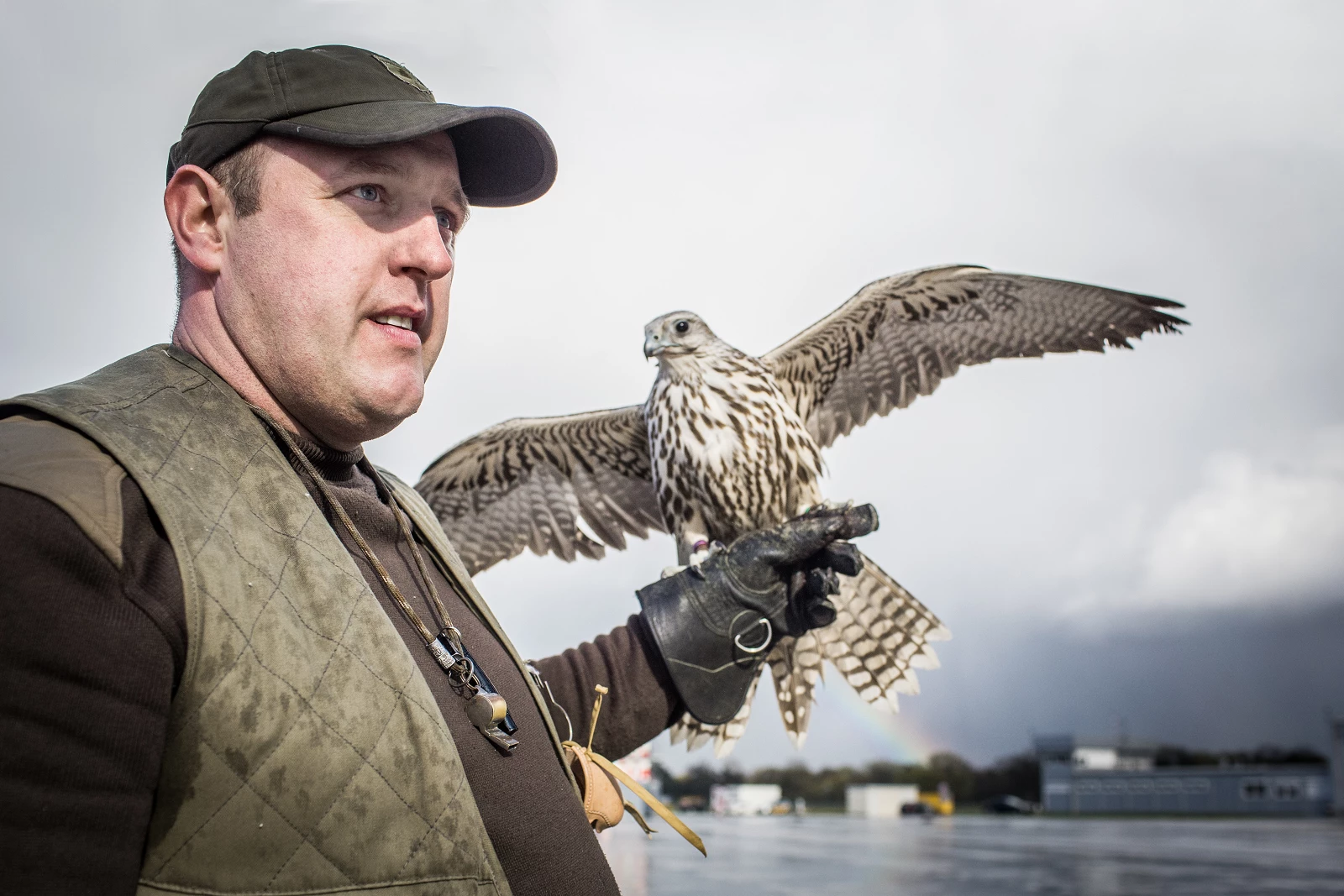
Paweł Dobrzański has been working as a falconer at Modlin Airport for six years. It is a difficult airport for a falconer, as it is located on a large river, in an area that until recently was forested, and in close proximity to a landfill site. In other words, everything that birds like best. Airplanes taking off and landing cross the permanent migration routes of many animals. Collisions are not uncommon.
Paweł and his employees (ten birds of prey – falcons, hawks, and goshawks) start at dawn. In spring, they make their first round – or rather, drive around in a specially adapted car – at 6 a.m. They repeat it every hour. A falcon sits on a beam mounted in place of the passenger seat, and Niko, a dog, sits on the back seat, chasing away larger animals (geese, storks, or foxes that climb over the high fence and jump onto the airport grounds). The first round is the most difficult, as it is necessary to check whether there are any dead animals on the runways and taxiways that could attract other birds. Dead animals must be removed, and the falcon must be released to chase away live ones. Paweł is in constant contact with the control tower, where pilots and airport staff report any birds they spot in the area. “I think they’ve started training them, because in the past they would only say ‘a flock of white ones’ or ‘small black ones,’ and now they recognize ‘starlings,’ ‘seagulls,’ and even buzzards,” laughs Paweł.
![IMG_1893.jpg [7.58 MB]](https://www.jbi.com.pl/storage/image/core_files/2025/12/2/554e9c3c248f43829e243a3a10af90db/jpg/jbinvestments/preview/IMG_1893.webp)
The worst time is after rain – earthworms and caterpillars crawl out onto all the paved areas of the airport. Lunch served on a plate. That's when the seagulls flock in. "Everyone is calling, the lines are jammed, because everyone is required to report a hazard," explains Paweł. “And a seagull is already quite large. The danger of a collision depends on the weight of the bird. If an airplane collides with a bird weighing more than a kilogram, such as a buzzard or a stork, especially if the bird gets into the engine, the danger is fatal. This is exactly what happened in the case of the emergency landing of that plane on the Hudson River. Several geese flew into two of the Airbus engines, and the engines shut down,” he explains. But small birds can also be dangerous. At the end of March, a plane flying into Modlin collided with a flock of starlings during its approach. “It caught 46 of them. None survived, and the plane did not fly anywhere else that day. Mechanics flew in from Dublin, cleaned, checked, and repaired it,” he says.
Today, falconers are employed at virtually all civil airports to ensure that collisions between birds and aircraft are kept to a minimum. Although this is a relatively new method, at least in Poland, the threat has been known for a long time. The first collision between an aircraft and a bird is considered to be the one that happened to the Wright brothers in 1908. Calbraith Perry Rogers, the first man to fly across the United States from the east to the west coast, went down in history as the first fatal victim of a bird strike. With a seagull, to be precise. Although planes were becoming bigger and faster, this did not increase their chances – on the contrary: a small, slower-flying machine can avoid a bird more easily. “And birds are not suicidal; if they have a chance to avoid hitting a plane, they will not hit it,” emphasizes Paweł.
According to data collected by the international bird strike information system IBIS, approximately 90% of collisions with animals occur at airports or in their vicinity. “We try to do this work honestly and reliably, but we cannot give a 100% guarantee, because that is impossible. We report every collision, even with a small bird, in detail, and each case is reviewed by the aviation accident investigation board, and then by the airport's own board, which also includes an independent falconer," explains Paweł.
Airport falconers also have technology to help them, but in the case of animals, it is not very useful. Sound deterrents that emit the sounds of frightened birds (“voices of fear,” says Paweł) not only encourage other predatory animals, which sometimes check to see if they can join in on a feast, but are also not very effective on other birds, which simply get used to them after a month.
There is also a blank-firing revolver, which is used when rain or strong winds prevent the falcon from being released. "A falcon released in strong winds will veer off course and may end up somewhere near Warsaw," he explains. "Fortunately, some birds flee at the mere sight of the falconer's car. We do all our operations from the same car so that they associate it with danger," he adds.
![IMG_2013.jpg [13.70 MB]](https://www.jbi.com.pl/storage/image/core_files/2025/12/2/a11bd624e952420d6e557d93d66de084/jpg/jbinvestments/preview/IMG_2013.webp)
The car we are driving around the airport in is surprisingly clean. When I ask about it, Paweł laughs and admits that it was cleaned especially for my visit. “It usually looks different,” he admits. “The car is the least of our problems, but the pants, the shoes! Birds don’t warn you, they don’t give you a heads up. And its range is considerable! Hawks in particular can shoot up to 1.5 meters. In the past, when I used to transport birds on my glove on trains or buses, I often had to apologize to some lady in a beautiful fur coat or other clothes that had been clean just a moment ago,” he recalls.
Paweł Dobrzański is a forester by profession. His adventure with falconry began in high school – at a forestry technical college in Zagnańsk, where the school ran a rehabilitation center for birds of prey. Together with their teachers and local veterinarians, the students rescued birds that had collided with cars or high-voltage power lines. Using falconry methods, they rehabilitated the birds and then released them back into the wild. The birds in the falconry in Modlin come from closed breeding facilities. In Poland, all birds of prey are protected, so they cannot be obtained from the wild. “Even though they were born in captivity, they have not had much contact with humans, so the young are completely wild. The trick is to overcome this innate wildness and convince them to treat humans not as enemies, but as companions," he explains to me. How can this be done? "Force won't work here. Only kindness. Bribing them with meat works best," he adds.
![IMG_1831.jpg [9.24 MB]](https://www.jbi.com.pl/storage/image/core_files/2025/12/2/98a7bb568c3a0388f7782942a34a505a/jpg/jbinvestments/preview/IMG_1831.webp)
The young bird is first taken to places similar to those where it will work in the future: among people, cars, buildings, and planes, to familiarize it with such surroundings. A harness is put on it – straps on its legs and a long leash. It is carried on a thick leather glove. “If you do it sensitively, the birds react calmly from the start,” Paweł assures us. A leather hood is placed over its head to limit the number of stimuli. Once it gets used to the auditory stimuli, the hood is removed (for a few seconds, a few minutes, then longer), and visual stimuli are added. The next stage is training the bird to return to the glove. “We place the falcon, attached to a string, on the seat and walk away a few meters. We put a tasty treat on the glove and encourage it to jump onto the glove. First from a distance of half a meter, then a meter, then five. When the bird flies in without resistance from 30 meters, we unfasten the string. The rest is innate instinct; you don't need to teach a bird to hunt," he assures us. Before each free flight, a telemetry transmitter is attached to the feathers. "Because the bird doesn't run away, it gets lost: in pursuit, it sometimes goes too far and doesn't know how to get back. It usually sits down somewhere and waits. And we track it down and go get it," says the falconer.
![IMG_1748.jpg [7.16 MB]](https://www.jbi.com.pl/storage/image/core_files/2025/12/2/0582e5d88785f162698d791f8cf52bb4/jpg/jbinvestments/preview/IMG_1748.webp)
Paweł explains to me that falcons are calmer and easier to train than hawks, which require more work. Hawks are short-flight birds – they hunt by surprise. A falcon circles high and attacks whatever flies beneath it. In such a dive, it can reach speeds of up to 300 kilometers per hour. When I ask if he has a favorite bird, he initially denies it: “I try not to favor any of them, so that none of them feel offended,” he says. But after a moment, he adds: "Okay, I do have a favorite hawk. He no longer works at the airport, he lives with my parents. My mom takes care of him. Because I became interested in these birds, my mom learned a lot. She had no choice: her son brought home various creatures, so she had to take care of them. But she didn't complain."
Between patrols of the airport grounds, the falconer must take care of the falcons. To keep the birds fit and healthy, each one must fly for at least half an hour every day. Besides, there is always something to do in the falconry.
"Calmness. And patience," Paweł replies when I ask him what is most important in this job. "To teach a wild animal to trust humans, you have to be very patient. You also need to have a lot of time. If someone wants to take this seriously, they have to be ready to devote that time," he says, adding after a moment, "I didn't even have time to start a family. I'm here with these animals all the time. There are no vacations, no holidays. Even when you theoretically have time off, you have to come in, feed them, check if any of them have hurt themselves, gotten their legs tangled in a rope, or stuck their heads in the fence. It's like having a small child! This isn't a job, it's a way of life.
![IMG_1716.jpg [8.96 MB]](https://www.jbi.com.pl/storage/image/core_files/2025/12/2/5fcea63f12d226485f70ed002a907a0e/jpg/jbinvestments/preview/IMG_1716.webp)
Text: Olga Wiechnik
JB Investments Sp. z o.o. archive (all rights reserved)
Photos: Magda Starowieyska


