
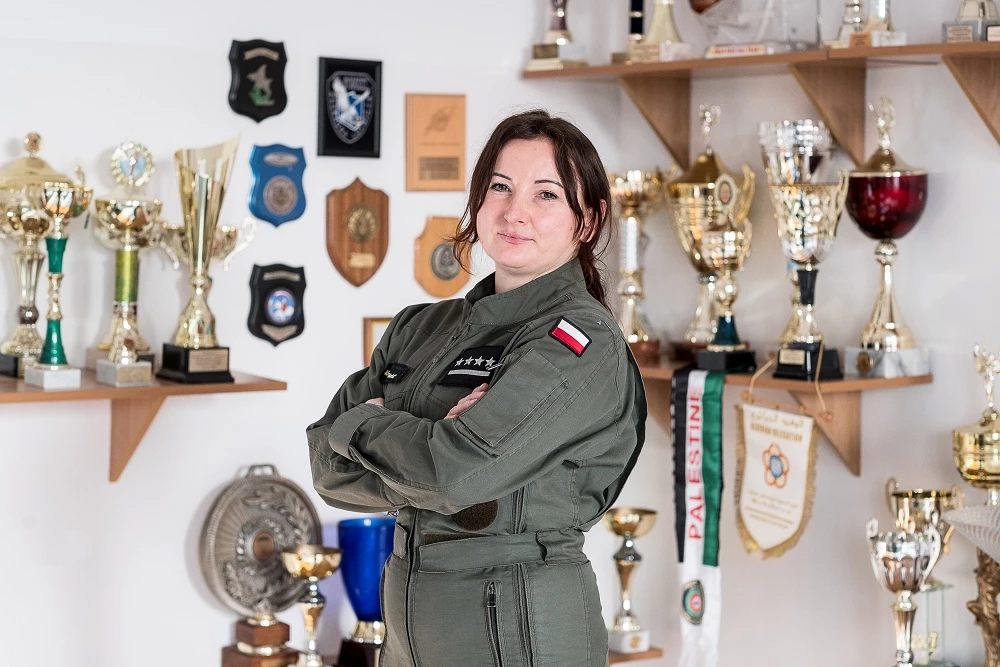
People of Polish Aviation - Monika Bekhit
series People of Polish Aviation
The Woman from Heaven
*interview conducted in 2017 source - JB Investments archive - all rights reserved
381 km/h is her personal record for falling speed. However, it is not speed that is most important in her life as a skydiver, but distance. Monika Bekhit is a world champion in accuracy jumping, which means that she hits a target with a diameter of 2 centimeters without fail. Before she started jumping, she wanted to be a veterinarian, but her first jump changed her whole life.
Agata Król: Do you remember your first jump?
Of course! It was 28 years ago, in Nowy Targ, on June 4, 1989. The first jump was a huge surprise. The idea of it on the ground is completely different from the reality. First of all, I wasn't mentally prepared for the speed of the plane and the rush of air that awaited me outside the door. I was convinced that the parachute would open immediately. The result was that I managed to do a somersault before it opened. That was the first shock. It wasn't as easy as I thought it would be on the ground. They trained us using the older method, where the first jumps were made using a parachute rope, on round parachutes, and then the height and delay in opening the parachute were gradually increased – 3 seconds, 5 seconds, then 8, etc. It was more time-consuming, but thanks to that we jumped a lot. It didn't cost us anything, so I wasn't picky.
How many jumps do you have under your belt now?
5942. There is a chance that I will make my 6000th jump next season. I am less than 60 jumps away.
Will it be a unique jump?
I don't like such events. Many people do it with great pomp and circumstance, but I don't. The 5,000th jump was just a regular accuracy jump, because we were preparing for the World Military Games and training was very important at that time. So it depends on where I'll be at the time, what I'll be doing, and whether it will coincide with any parachuting competitions. If possible, these anniversary jumps are made more interesting – from a greater height, in a larger group of people, etc.
![1monika_30012017_01.JPG [323.32 KB]](https://www.jbi.com.pl/storage/image/core_files/2026/1/30/688c22322d78778286ee2e3758306116/JPG/jbinvestments/preview/1monika_30012017_01.webp)
Which jumps do you remember in particular?
A jump from 200 meters using American landing equipment at an air show in Tomaszów Lubelski. It was a historical reenactment of the Cichociemni parachute drop. I remember it because of the low altitude. I was so scared that I thought I wouldn't make it to the door. I'm not used to such low altitudes – the parachute opens immediately and there is no time to open the reserve. Usually, at this altitude, with the parachute already open, I prepare for landing and don't think about jumping out of the plane. I felt like I was base jumping. Another cool adventure was jumping in Kisielów from a two-seater motorized paraglider, where I had to squeeze between the lines to jump out. I was also afraid because I didn't trust the motorized paraglider at all. Another interesting piece of equipment I jumped from in Japan was a Chinook – a twin-engine, huge military helicopter. And then there was the jump from a glider to celebrate my 3,000th jump! We took off with the cabin open, then I climbed onto the wing and jumped. It was an interesting experience, difficult to compare with any other jump.
Was it difficult to maintain balance on the wing?
I managed it, but I felt uncertain. You know you have a parachute on your back, but no skydiver wants to fall when they haven't planned to. It's not a pleasant feeling. A glider flies slower than an airplane, so when I jumped at that low speed, I did two somersaults... and it was recorded on camera, so everyone had plenty of reason to laugh at me. They said it was a 3,000-foot jump, and I fell like a rag doll (laughter).
The world looks different from above, but which place is the most beautiful?
I guess I'll disappoint you if I say that during competitions I don't even have time to look around. When I was jumping in Finland, after my seventh jump, my coach asked me: Monika, tell me, are there thousands of lakes? And I replied that I hadn't noticed... OK, I'll jump again and take a look. After landing, I said: yes, they are! I am very focused during competitions. I think the most beautiful jumps are in the Dolomites. Every year, there is a World Cup in Belluno. The mountains are impressive, just like in Slovenia or Switzerland. I have jumped in over 30 countries around the world. One of the more interesting places I've landed is the Old Market Square in Krakow. Gen. Mieczysław Bieniek was also jumping at the time, and I remember that it was very windy and there were a lot of people in the market square, so the designated landing area seemed small. That jump cost us a lot of nerves. The most interesting competitions were the military ones in Switzerland, where each jump was in a different place. These were competitions for landing accuracy, but we could only see the landing sites in published photos from Google Maps. These places were very difficult – for example, on a headland somewhere between trees, in Zurich on the beach in front of a casino – such a narrow passage, and the last four rounds took place on barges on the river, where the barge was not much bigger than the mattress we land on. On top of that, there was a natural obstacle in the form of a bridge, like a dam, and very strong wind. I landed in the water twice (laughter). After this competition, I believed that I could land anywhere.
![IMG_8190.JPG [136.47 KB]](https://www.jbi.com.pl/storage/image/core_files/2026/1/30/63b1221743c0b63fd02780bb511b39c0/JPG/jbinvestments/preview/IMG_8190.webp)
Where did this interest in skydiving come from? Before your first jump, you had no idea about this activity.
I was encouraged by a friend I met in Nowy Targ. Danuta was already a very experienced skydiver, and it was from her that I learned that skydiving was not so unattainable. All I had to do was sign up for the skydiving club, work off my community service hours, and meet the requirements. Not everyone was accepted at the time; younger people who could eventually become competitors had a chance. I grew up in Nowy Targ, where aviation was always present. There was an aeroclub, and there was always something flying or jumping there. I always thought that to jump out of a plane, you had to be in the military, you had to have some kind of connections. I didn't know that it was so accessible and within reach at the time. Any healthy teenager could have a new hobby or find a passion. What was important to me was that there was no financial barrier, I didn't have to pay anything.
Was it a window to the world?
Yes, back then, traveling abroad was a big deal, completely different from today. Practicing skydiving as a sport—and at the time I didn't know it was a sport, that there were competitions—gave me the opportunity to travel the world. That also motivated me to stick with it.
Did that first jump encourage you, or did it scare you a little?
He encouraged me so much that all I dreamed about was doing the next one, and the next one... how I miss those first three seasons! It's such greed and such terrible jealousy of others who are jumping, and not me. I miss that hunger for jumping that you have at the beginning.
When did it become apparent that you had potential as a competitor?
You can't say after a few jumps that one person has potential and another doesn't, because training is a long process. To see if someone has talent, you first have to let them do a thousand jumps and train for a few seasons. My advantage was that I was very young—I was not yet 16—and the instructors could see that I was athletic. At the time, I was training karate quite intensively and was in very good physical shape. It's a sport for women who are much more physically fit than the average woman on the street – I had to do at least one pull-up on the bar with an overhand grip – not many women can do that. The instructors saw potential in me. In the second season, they called me up to the national team. This opened the door for me to go on training camps and train more intensively. We jumped 10-12 times a day, which amounted to about 300-400 jumps a year. In the fourth season, when I was 18, I had completed a thousand jumps. This amount of training was conducive to learning, and I had great instructors – Andrzej Palenik was an experienced competitor and knew how to pass on his knowledge, while coach Stanisław Świerczek gave me enormous opportunities and reinforced my belief that I was good and had a chance to achieve something. I never even dreamed that I would achieve such results, that I would be able to compete with the world's best. I knew that in Poland, a gold medal happens once in many, many years, and with our training, even though it was very intense, we still jumped less than competitors from other countries.
As a teenager, did you dream of a future in ski jumping?
I wanted to be a veterinarian... but then everything changed because of jumping. After that first time, I knew that this was what I wanted to do in life – I had such a hunger for jumping! Finding a job in this industry would have been a dream come true, but at the time it seemed very unrealistic. Those were the days when women were not as readily accepted into the military as they are now. However, I continued in this direction, went to the Academy of Physical Education and continued training at the Wawel Military Sports Club in Krakow under the supervision of coach Tadeusz Matejek. I got a lot of jumping practice there. After graduating from university, I got a job as a civilian employee of the army, where I could freely participate in training without any restrictions... and it paid off.
![2monika_30012017_01.JPG [500.16 KB]](https://www.jbi.com.pl/storage/image/core_files/2026/1/30/df53d706980e4eea8e7bc5a88557cd87/JPG/jbinvestments/preview/2monika_30012017_01.webp)
When did the greatest successes come?
These early successes came at just the right moment. I was mentally prepared for my jumping career to last only as long as I was a junior. After that, girls usually left on their own or were removed from the team because it was difficult to compete for medals in the senior category. I started winning my first international junior medals in 1993. But my real successes began three years later, in 1996. I was surprised by my results myself – still as Monika Filipowska, I won a gold and silver medal in the junior classification and, at the same competition, third place in the senior classification. It was a great joy and euphoria – I felt that all those years had not been wasted. I believed that success was possible, that I could win a medal and compete in the senior competition. I got a big boost of self-confidence, and then I won a medal almost every year. A year later, the moment came when I no longer wanted to be in the junior category. At Ikariada, at the World Air Games, there was a dilemma as to whether to register me as a junior or a senior. They knew that I had a good chance of winning a medal in the junior category, but that it would be difficult in the senior category. I insisted that I wanted to be a senior, that I would take the risk, that I wanted to compete, and that at worst I wouldn't win a medal. They entered me in both competitions.
With what effect?
It was 1997. I had two medals in the junior competition, but in the senior competition I was in fifth or sixth place. On the day of departure for the competition, I had a car accident. I competed with a sprained leg and a splint, but I didn't want to give up on the competition. Considering the circumstances, the place I took was really good. The landing area in the competition was so difficult that it was less important to place your foot precisely and more important to reach the disc at all. Thanks to this, the injury did not have as much of an impact on the result as it usually would.
You won the cup, the gold medal—the most important trophies. There was Mazurek Dąbrowskiego.
It is very rare to hear the Polish national anthem in skydiving. It was a very moving moment. I was shaking so much, it was hard to control myself. Once you have a gold medal, I must admit that silver or bronze leaves you feeling unsatisfied. I have one gold medal from the FAI World Senior Championships, and it seems that in the history of Polish skydiving, there are only two such gold medals in FAI individual jumps [previously Stanisław Sidor in 1973]. I also won the World Cup in accuracy in 2014, after six editions. I also value this achievement because the Cups are very difficult. There are six competitions in mountainous locations – it is difficult to prepare for this in Poland because we do not have training in such conditions. Only accuracy competitors take part, and there are no limits on the number of competitors from each country, so the level is very high. I have had a lot of second and third places, but one silver medal makes me particularly happy. I won it during the Military World Games in Brazil in 2011 with a knee brace.
![IMG_8188.JPG [244.07 KB]](https://www.jbi.com.pl/storage/image/core_files/2026/1/30/afe9408c63c300ed4cba8f7f39c40417/JPG/jbinvestments/preview/IMG_8188.webp)
What is the tactic for aiming at those 2 centimeters?
I would divide the jump into two stages. The first stage is to bring the parachute within range of the center. The center is a two-centimeter point. You have to assess the weather conditions very carefully and decide which side to approach from. The second stage is actually placing your foot. This is difficult enough that in order to land precisely, you need to have your leg properly relaxed. If you are tense, your body is tense, it is very difficult to land the tip of your heel in the center. You need nerves of steel to maneuver and place your foot precisely while the parachute is swaying in all directions. Accuracy must be refined from the first jump to the last. You cannot afford to make any mistakes in any jump because the leaders are so evenly matched. After that, the mistake is irreparable.
Your specialty is landing accuracy. Do you also jump for pleasure?
Accuracy is my sport. Recently, I've really gotten into speed skydiving. Unfortunately, I can't do it at the Center, but I've been jumping privately. My average speed record in the zone is 381 km/h. It's a very addictive activity, and if I had the choice, I'd prefer it to accuracy right now. I need new experiences.
That's jumping from a great height.
I jump from 4,000 meters. The jumper's task is to achieve the highest possible speed. You fly head down, because this position guarantees the highest speeds. This is measured with special electronic equipment, between 2,700 meters and 1,700 meters, and the average is calculated. The most difficult thing is to maintain your position at such increasing speeds. World record holders reach speeds of under 600 km/h. I like it, I feel that I am making progress and I am getting more and more into it. It is an alternative to accuracy.
Is it dangerous?
I haven't heard of any fatal accidents, but if you miss the moment to open your parachute, there's not much time left for a safe landing, given the speeds involved. I am also familiar with individual acrobatics – 2,200 meters above ground and a 25-second delay – the task: to perform six required figures before opening the parachute, in the shortest possible time.
When did the military show up?
The military appeared in my life in 2003, when, as a result of the restructuring of the WKS, part of my job was taken away from me. I had to do something with myself. I started looking for a job anywhere, which was not easy because it was January. I received information that an experimental officer training program was starting for university graduates. After completing the program, I would have a job in the army as a platoon commander. The situation forced me to make this decision. It wasn't easy because I had a 9-year-old daughter, and the training meant being away from home. Life forced me to make this decision because I didn't have a job. I'm glad I took advantage of it.
![IMG_0006.JPG [623.74 KB]](https://www.jbi.com.pl/storage/image/core_files/2026/1/30/3593c2dd7ad7d9a6775bb58b13100a26/JPG/jbinvestments/preview/IMG_0006.webp)
What kind of commander was she?
On Women's Day, I received flowers from the soldiers with a note saying: "For a wonderful woman and commander." It meant a lot to me, it was a huge honor. What kind of commander I was, you would have to ask the people I served with. The soldiers were great and I had no problem maintaining discipline... but is that the key factor in the assessment? I worked well with my subordinates, with the team commanders, who helped me a lot. I had no experience, and without the support of the staff, it would have been difficult for me to command a subunit. For three years, I was a platoon commander in the 16th Airborne Battalion in Krakow. At that time, I had to stop competitive jumping and made five jumps a year with parachutes. The job was not easy. It was a period when the first wave of women joined the ranks of front-line platoon commanders. I felt a lot of pressure to prove that I was fit for the military as a woman. Today, I am a captain in the Air Force at the High Altitude Rescue and Parachuting Training Center in Poznań.
At competitions, you represent not only the military, but also Poland.
I am a member of the Polish Army team, a second-class parachute instructor, and currently doing what I enjoy. I wish everyone could have a job like this.
Text: Agata Król
Archive: JB Investments Sp. z o.o. (all rights reserved)
Photos: Michał Adamski and private archive