
People of Polish Aviation - Andrzej Rutkowski
series People of Polish Aviation
Airplanes won't give you bread
*The interview, conducted in 2017, comes from - JB Investments archives - all rights reserved.
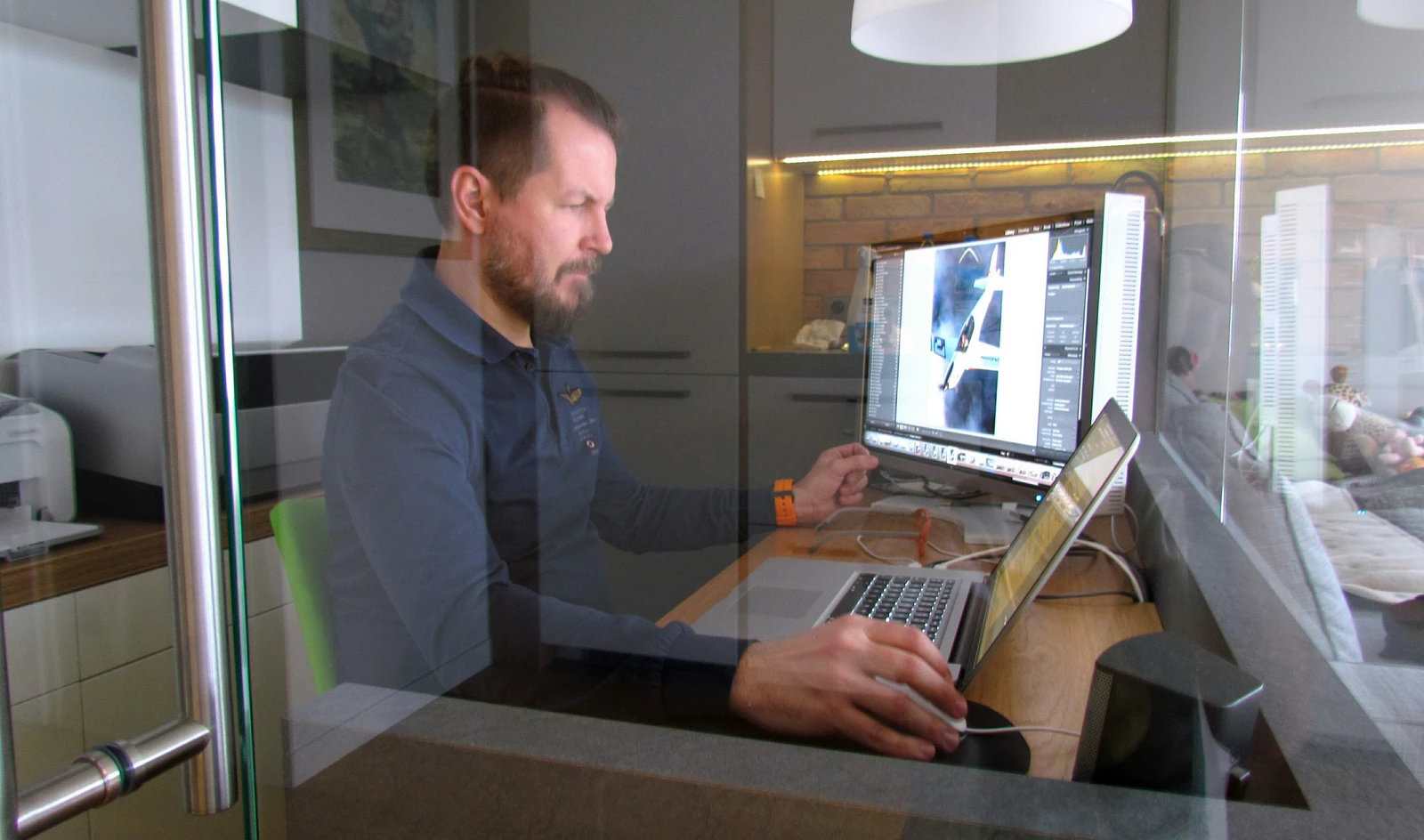
Andrzej Rutkowski is an aviation photographer, pilot (with a tourist license), journalist for Przegląd Lotniczy magazine, and employee of the Air Information Service at the Polish Air Navigation Services Agency. I met him in his apartment, which was full of subtle aviation references. There were a few models and toys belonging to his child depicting airplanes, a computer on which Andrzej (we immediately switched to informal address) was editing photos, and he was wearing a commemorative T-shirt with an aviation motif.
Rafał Dadura: Let's get one thing straight right from the start. Probably the most common (and most hackneyed,
and certainly the most pointed) question asked of aviation photographers is: "If you're such a big fan of aviation, why didn't you become a pilot?" I know that this doesn't bother you, because you have a pilot's license and you also work for the Air Information Service.
Fortunately, no one has asked me that yet, because, after all, so far I've been the one "tormenting" others with interviews... (laughter). I think that the diversity of aviation fields I deal with is quite helpful when taking photos. First of all, it is easier for me to get along with other pilots when planning or conducting a session in the air. I am a photographer who conducts sessions during flight, so-called "air to air." I don't take photos at shows, I'm not a "spotter." My pilot's license gives me an idea of what is feasible and what is better not to attempt. Because I use aeronautical charts and work with radar, I know where I can fly and which places are off-limits, because the air is full of zones that should not be entered. It is better not to cause any "trouble" in the air, as it can have serious consequences.
I think that my years of work at Przegląd Lotniczy have given me unique knowledge in the field of aviation, which in turn helps me in my work with radar at the Flight Information Service (FIS). In turn, I often write about safety issues for Przegląd, drawing on my experience at FIS. All areas of my aviation activities complement each other beautifully, which is why I don't want to give up any of them, but my favorite activity is photography.
Let me take this opportunity to ask you another one of my favorite killer questions: "How did it all start?"
OK! So then – How does it...
Somewhere between kindergarten and elementary school—I must have been six or seven years old—my dad started buying me issues of the Czechoslovakian aviation weekly Letectvi a Kosmonautika. Wow, what planes they had there! Not like the ones in our Skrzydlata Polska (Winged Poland) magazine. How they captured my imagination! Then came the time for model making. Years of tinkering with plastic, inhaling glue and model paints. All this to create a shape that resembled the airplane from the inspiring picture on the model's packaging. Those illustrations alone made me want to buy the models more than once.
![IMG_20170123_160414-01.jpg [887.23 KB]](https://www.jbi.com.pl/storage/image/core_files/2025/12/28/744f7de7e7c0377c990a8e9a682d5e72/jpg/jbinvestments/preview/IMG_20170123_160414-01.webp)
My practical flying began with gliders in high school. Later, I took up paragliding. Tamara Dudek, my instructor, persuaded me after one of my trips abroad to write an article for Przegląd Lotniczy (Aviation Review), which I had been reading avidly since I started flying gliders. I wrote one, then another on the next occasion. My writing must have been good, because I was soon invited to work in the editorial office. And so one day, the editor-in-chief, Krzysztof Krawcewicz, asked me, "Listen, there are shows in Kętrzyn, do you have a camera?" "I do!" "Then you'll go there, get on (the plane), fly and do it!" And so I did. That was in 2001. Today, when I think about those photos, they seem simply hopeless to me. Here they are poorly framed, there they are poorly exposed, and generally lacking in ideas.
However, nothing teaches you as much as your own mistakes and creative anger at yourself, which wins out over self-admiration. Looking for answers to the question "what went wrong?", I began to observe the work of other photographers, wondering "what is their secret?" and trying to figure it out. An ambitious approach gave me a lot – there is nothing like the perfect photos of other photographers. However, when you want to amaze the world with your photo, you must never forget humility, because it is easy to overlook a detail and make a spectacular mistake. All you have to do is not prepare your camera for the session...
Exactly. One of the most important things in a pilot's job is meticulous and careful preparation for the flight. I guess there is also a lot of preparation before a session in the air. What does it look like?
A session involves managing a whole host of details. These details translate into the final result. That's why a checklist is very helpful to me – it's the sum of lessons learned from mistakes I've made during over a hundred air-to-air sessions.
First of all, you need to decide which aircraft is best for taking photos. The decisive factor here is the speed of the aircraft being photographed – you need to choose one that can match its speed and from which you can take photos without having to shoot through the window. Fast planes pose the most challenges. I'm not talking about jets, but planes such as the Spitfire. From the point of view of small aviation, it is a hellishly fast plane. For the 2014 session, we had to find another aircraft that could fly fast enough to keep up with the Spitfire (which was to slow down to about 300 km/h for the photos). In the end, I took the photos from the cockpit of another beautiful World War II relic – a yellow Harvard. This session was unique, also because it was the first time that a Spitfire flew to Poland piloted by a Pole. This was achieved by my friend Jacek Mainka, with whom I have already completed many sessions. The plan was to intercept the Spitfire returning to Modlin from the air show in Piotrków Trybunalski in the air near Warka. The moment the Spitfire caught up with us in the air and Jacek was literally flying "within arm's reach," instead of taking pictures, we both stared at each other with blissful smiles on our faces. It lasted a few seconds, but it feels like an eternity. I thought to myself about Jacek: "Man, you did IT!", and Jacek... well, I don't know what he was thinking (laughter). On top of that, I was looking at a real Spitfire flying next to a real Harvard. Then I felt like I had been transported to that magical world from plastic model boxes, right into the middle of the action. At that moment, the little boy from years ago woke up in each of us, and he loved it. It's for moments like these that I fly and take pictures.
Reality has caught up with your dreams! Just please don't tell me that you just realized you took the wrong lens or something like that...
No, don't worry. Everything went perfectly. As for the session itself, I remember it being quite short – only 7 minutes. It turned out that the Spitfire couldn't fly for too long at such a low speed and with such low engine revs. At one point, Jacek simply stepped on the gas, and when I saw him disappear on the horizon, I understood how the Spitfire differed from other planes. I had the impression that Marcin, the Harvard pilot, and I were standing still, even though we were flying at 300 km/h.
As an aerial photographer, however, you have to be someone who can keep a cool head and not get carried away by the magic of the situation.
Every now and then, you need to take a step back and look at the camera settings. Depending on the amount of light, you may need to increase or decrease the ISO. Remember to take different parts of the photo at different exposure times. Use the preview to see how the propeller looks with these settings. You can't let it come out stationary. On the other hand, the pursuit of a beautifully blurred propeller sometimes results in a terribly out-of-focus photo.
It is also enough to extend the lens from the cabin by literally a centimeter (I usually take photos through an open window so that nothing between the lens and the aircraft causes image distortion; photos taken through glass rarely turn out well) and the entire series of photos will show the pilot with blurry eyes and the aircraft fuselage with blurry rivets. Imagine sticking your hand out of a window of a train traveling at about 120 km/h – it would be difficult to keep it still, right? And what happens to a camera at speeds of 300 km/h!
![Spitfire-5396.jpg [623.35 KB]](https://www.jbi.com.pl/storage/image/core_files/2025/12/28/341efeb9578bf52e5bcf0ee431833eaf/jpg/jbinvestments/preview/Spitfire-5396.webp)
What else is important when preparing for a session?
Take the weather into account. If we have weather like today (it was cloudy and gray outside; a typical January day), we won't achieve much. Without light, the photos will simply be ugly. Here again, it is useful to have knowledge that allows you to understand the types of weather and read weather maps for pilots, to know what types of cloud cover will occur as the fronts move.
I remember a session like that in Poznań. Just before the planned flight, a storm passed over the airport. Clouds, darkness, and wetness. In a word – hopeless conditions for taking photos. The only thing to do was to go home, but... since a cold front was passing (and I could tell by reading the map), soon after it would be clear, transparent air. You can also count on fresh, low-hanging small clouds (which make a very good background for photos), which even a weaker plane can easily fly over, allowing you to enjoy magical views. I really like such sessions. They allow people with their feet firmly on the ground to discover an unknown world.
You mentioned the background. In aerial photography, the background is completely different than elsewhere. Only here can you see the earth from above. How does this specificity affect your work?
It's good that you ask, because it has to do with planning the session. Once we have the plane and know the weather conditions, we choose the location we will fly over. After all, the overall atmosphere of the photo is created not only by the plane, but also by the landscape, which has to look nice. Poland is a country whose entire territory is already developed. There are buildings, vehicles, industrial plants everywhere – in a word, traces of human presence. This is not a bad thing as long as we are dealing with a regular grid of fields or forest roads. It is worse when we look at the buildings. In southern Europe, everything looks somehow more elegant and natural. Here, someone will build an eccentric roof with metal tiles in a surprising color, or clearly try to dazzle their neighbor with a garish color of plaster – it's like aesthetic pollution of the environment. The world seen from the perspective of a passerby is different – everyone takes care of their yard so that it looks neat, at least from the street. And what about this order seen from above? It varies... and for me, it's a fundamental issue. Sometimes only Photoshop can help. Because I am a perfectionist, if I have no other choice, I allow myself to "displace" a farm, replacing it with a forest, for example. After all, the purpose of a photo is to evoke pleasant emotions, not to archive reality for historical truth.
![Cessna421-0353.jpg [965.47 KB]](https://www.jbi.com.pl/storage/image/core_files/2025/12/28/cec75f2c864d0f9bf11261f7555a60ab/jpg/jbinvestments/preview/Cessna421-0353.webp)
How many photos do you take during a single session?
During an average session, I take about four hundred photos. Of these, about 50 are discarded due to blurring and obvious flaws (e.g., a cut wing). Ultimately, I select about 70 of the most diverse shots to compile an 8-page article. However, it takes some time to arrive at these 70—selection, post-production, erasing a cottage from a photo—it usually takes a few nights.
For comparison, a session in the air – if everything goes well and you don't have to fly too far to find a nice background – usually takes about 30 minutes from takeoff to landing. A good briefing effectively saves time and fuel burned in the air. It simply pays off. However, that half hour in the air is just the beginning of the work. The photo I brought back to earth and have on my camera card will never be a finished product for me.
In that case, coming back down to earth—what equipment do you use?
My first camera was a simple Minolta SLR, the kind for amateurs. A colleague from the editorial office had equipment from this brand, so in the absence of others, I considered it a good recommendation. It was an analog camera. For many years, I took pictures with it and took them to a photo studio, which was the best place in Warsaw for regularly developing slides. I liked them. Unlike negatives, you could immediately see the color and mood of the photo. However, it was because of the distance (25 km one way to the photo lab and 25 km back) – and not for technical or ideological reasons – that I bought a digital camera. I bought a first-generation Canon 5D full-frame camera. Again, there were no special reasons for this – I chose Canon because at that time, Allegro had the largest selection of new and used lenses for Canon cameras. Over time, the 5D was no longer enough for me (mainly because of the auto-focus – in aviation photography, efficient automation is crucial). So I bought another Canon full-frame camera – the EOS 1Ds mk III. I still use it today, even though it's already ten years old. I still use the "five" as a backup and a great, compact camera for taking pictures of cockpits during flights.
A ten-year-old camera?
Yes. When I bought it, it was the most advanced equipment of its time, so it hasn't aged that much. After all, the fact that two successors have appeared since then doesn't mean that it suddenly started taking bad pictures. Its biggest drawback is its small memory buffer, which is why it's not suitable for continuous shooting. And that's fine—who has time to browse through and select hundreds of identical shots?
I think that chasing after better and better equipment is a bit illusory. At a certain level of equipment, every new camera model will obviously have better parameters than its predecessor, but I don't think it's worth the expense. The technical step forward that we take with such a purchase will be disproportionately small compared to the expense involved. An older camera can serve you very well. It is important to know its capabilities and limitations in order to use it consciously for a photo shoot. After all, even with the latest marvel, you can completely mess up your photos.
![Bremgarten-9285-Edit.jpg [429.07 KB]](https://www.jbi.com.pl/storage/image/core_files/2025/12/28/1f758f50c7fb040f16fc79865a9bd04b/jpg/jbinvestments/preview/Bremgarten-9285-Edit.webp)
After years of taking photos, what is crucial for you in this field?
Photography, especially aerial photography, is a continuous learning process where attention to detail pays off. A critical approach to the results of one's own work is a prerequisite for development. And I think that the fun we get from what we do lasts as long as we continue to develop. It is worth finding someone who is better at it than us and understanding why we like their photos more. Subscribing to Western photography magazines is very helpful. Training courses organized by specialists are also a great thing. I once took part in a fantastic workshop on photo editing and color management organized by Cortland. I still praise them highly to this day. Such training saves a lot of time that we would otherwise waste on learning through trial and error.
Another thing is safety. Let's be honest – taking photos in the air is a high-risk job, but we have to do it in such a way that everyone returns home safely. That's why we always agree during the briefing that if things don't go well, we'll land, discuss the situation, and decide whether to fly again. Nothing by force.
I would also like to emphasize that aerial photography is a "team sport." I am just a photographer who takes pictures, and I know that I cannot do anything on my own. After all, I need pilots and help in organizing planes. An aerial photo shoot is always the result of the work of the entire team.
A month ago, my one-and-a-half-year-old daughter said "Cesna Karawan" while pointing to a Cessna Caravan in a book about airplanes. A few days later, she said "Pilatus." Today, her new word is "Hercules." I wonder how this will all turn out, because I started five years later... Maybe, as a parent, I should intervene somehow and say what my grandmother used to say to me: "You should take an interest in something, read a book, not just those planes and planes! They won't put bread on the table!"
Text and photos: Rafał Dadura.
JB Investments Sp. z o.o. archive (all rights reserved)


