
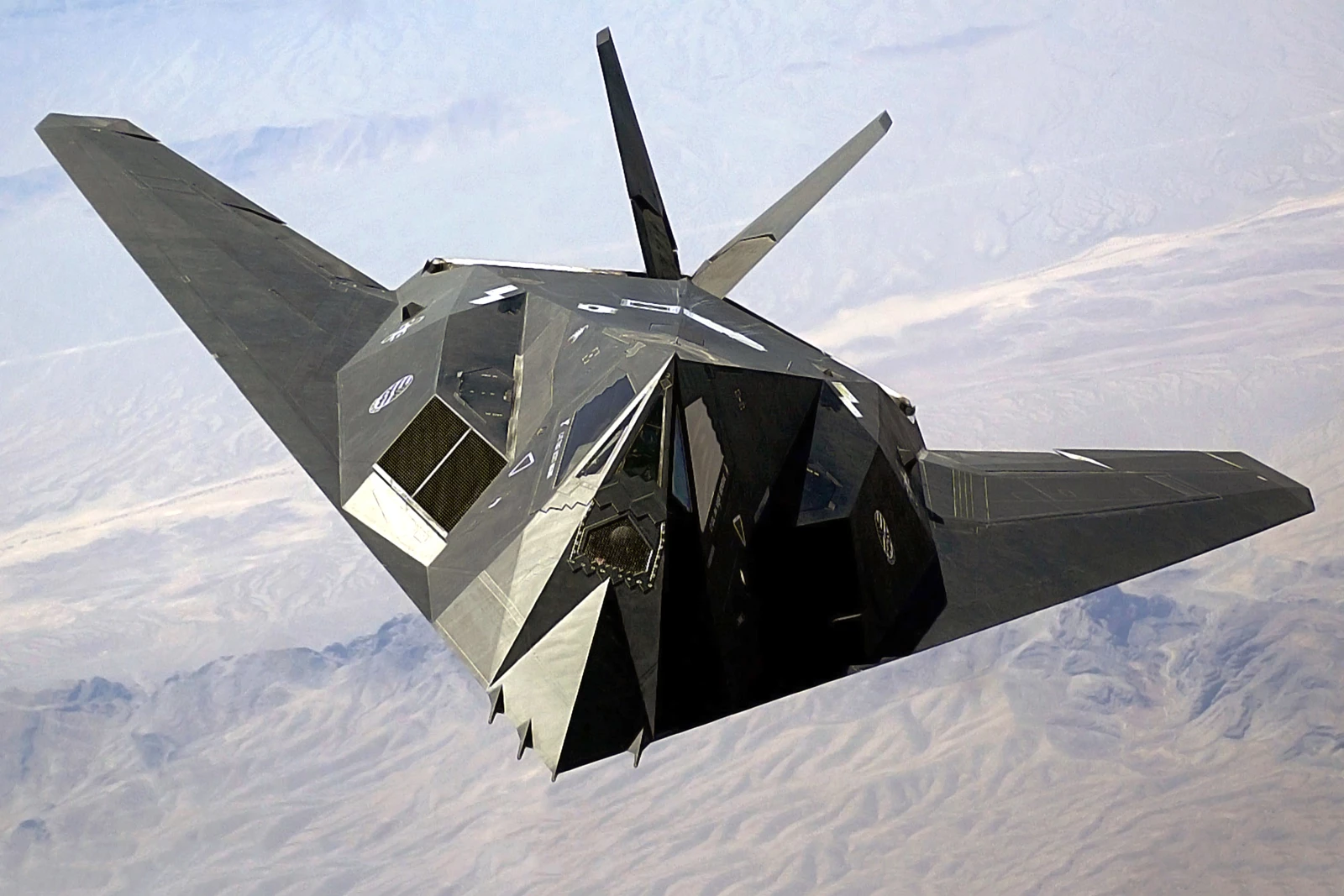
Lockheed F-117 Nighthawk – the first operational stealth aircraft

series - Machines that changed the sky
An Unassuming Beginning
In 1964, Soviet physicist Pyotr Ufimtsev published a paper on the behavior of electromagnetic waves on surfaces of various geometric shapes. In the USSR, no one recognized its military potential—the paper was theoretical and was quickly shelved.
A decade later, Denys Overholser, an engineer at Lockheed’s Skunk Works division, read the same publication and, based on it, created a computer program that made it possible to design a jet aircraft that would be extremely difficult for radar to detect. The Lockheed F-117 Nighthawk, the first operational stealth strike aircraft, changed the rules of aerial warfare—and the stealth technology that made it possible was based on work published on the other side of the Iron Curtain.
A Helpless Diamond
The Vietnam War and the Yom Kippur War in 1973 demonstrated that Soviet surface-to-air missiles were capable of decimating conventional air forces. Analyses by NATO and the USAF stated the matter plainly: in a conflict with the Warsaw Pact, air defenses would likely prevent effective airstrikes on targets in Eastern Europe. A way had to be found to ensure that a bomber could reach its target at all.
In 1975, DARPA announced the XST (Experimental Survivable Testbed) program, whose goal was to develop a machine with minimal radar cross-section. Overholser, armed with Ufimcev’s mathematics, wrote the “Echo” program, which calculated radar reflections from flat panels. Based on this, the Skunk Works team built the first model—a geometric object with edges so sharp and walls so flat that the engineers dubbed it the “Hopeless Diamond.” It looked absurd, but it was very difficult to detect on radar.
Ben Rich, the new head of Skunk Works, convinced Kelly Johnson that faceted geometry would result in a smaller radar cross-section than the rounded shapes Johnson preferred. Rich won the argument—something that happened extremely rarely in his dealings with Johnson.
All you can see on the radar is a pole
In 1976, DARPA commissioned Lockheed to build a technology demonstrator codenamed Have Blue. A test was conducted at the White Sands radar range that went down in history: a wooden model was mounted on a metal pole, and during radar tests, the model produced such a weak signal that operators could see only the pole on which it was mounted on their screens.
Two Have Blue prototypes took flight in December 1977. Both were lost due to mechanical failures, but radar data confirmed the concept. On November 1, 1978, the decision was made to build an operational aircraft—the Senior Trend program. The first F-117 made its maiden flight on June 18, 1981, and achieved operational readiness in October 1983. For the next seven years, the USAF kept the aircraft under operational secrecy before officially revealing its existence in 1988.
How can you fool a speed camera?
The entire surface of the F-117 consists of flat, triangular panels arranged at precisely calculated angles. A curved surface scatters radar waves in all directions—flat panels reflect them in strictly defined directions, away from the transmitter. Over this is applied a multilayer RAM (Radar Absorbent Material) coating, which absorbs the remaining radar energy.
Detail by detail, every component of the aircraft was designed to minimize its detectability. The cockpit windows were coated with a metallic layer that masked the pilot’s helmet. The exhaust nozzles were flattened into a slit shape—the hot exhaust gases mixed with cold air, reducing the infrared signature. The air intakes were shielded with a mesh that deflected radar waves. Despite its “F” (fighter) designation, the F-117 was not designed for air-to-air combat—it was a tactical bomber capable of carrying two guided bombs weighing 900 kg each.
The price paid for the faceted shape was aerodynamic instability. Without a fly-by-wire system with quadruple redundancy, the pilot would not have been able to keep the aircraft in controlled flight.
2% of flights, 40% of destinations
Its combat debut took place on December 19, 1989, during Operation Just Cause in Panama. The real test, however, came two years later. On the night of January 16–17, 1991, CNN reporters Bernard Shaw and Peter Arnett reported live from Baghdad’s Al-Rashid Hotel on the explosions visible outside their window—these were bombs dropped by F-117s on the most heavily defended targets in the Iraqi capital.
During Operation Desert Storm, the F-117s flew 1,271 combat sorties without a single loss. They accounted for just 2% of all coalition sorties, yet struck 40% of strategic targets. The stealth jet proved capable of operating over the world’s densest air defense network—without suffering any losses.
In 1999, a Serbian SA-3 missile shot down an F-117 over Kosovo (pilot Dale Zelko survived). This is the only combat loss in the program’s history and serves as a reminder that stealth technology reduces risk but does not eliminate it.
A Pension That Doesn't Exist
Officially, the F-117 was retired from service in 2008. In practice, the USAF continues to fly these aircraft from Tonopah Air Force Base in Nevada. They serve as test platforms for new stealth technologies and as “red air” in exercises—simulating a threat from foreign low-observable aircraft.
The legacy of the Nighthawk can be seen in every modern combat aircraft: the Northrop B-2 Spirit, the Lockheed Martin F-22 Raptor, the F-35 Lightning II, and the Northrop Grumman B-21 Raider. As F-117 pilot Scott Stimpert put it, since the F-117, no credible combat aircraft design has overlooked reduced detectability as a key parameter.
![Lockheed-F-117A-Nighthawk-1-scaled.jpg [358.21 KB]](https://www.jbi.com.pl/storage/image/core_files/2026/7/6/7e5d644a78f13c88341655236477952f/jpg/jbinvestments/preview/Lockheed-F-117A-Nighthawk-1-scaled.webp)
10 Interesting Facts About the Lockheed F-117 Nighthawk That Might Surprise Even Aviation Enthusiasts
1. It wasn't really a fighter jet
In American nomenclature, the letter “F” stands for “fighter,” but the F-117 was designed from the outset as a strike aircraft for precision bombing. It had no radar for air-to-air combat nor any weapons for engaging other aircraft. The name was intended, among other things, to make it easier to recruit the best fighter pilots for the secret program.
2. Its shape was developed by a Soviet mathematician
The key calculations regarding radar wave reflection were based on the work of Soviet scientist Pyotr Ufimtsev. Interestingly, his research was not utilized in the USSR, but American engineers from the Skunk Works program recognized its potential.
3. The computer keeps it in the air
The F-117 is aerodynamically unstable. If the computer controlling the fly-by-wire system were turned off, the pilot would be virtually unable to fly it safely. The computer makes thousands of tiny adjustments in real time.
4. He did not fly at supersonic speed on purpose
From the outset, the design was optimized for subsonic flight. Why? A shockwave could give away its presence, negating some of the advantages of stealth technology.
5. It was one of the most effective aircraft during the Gulf War
In 1991, the F-117s accounted for only a small percentage of all combat flights, but they struck many of the most important and best-defended targets in Iraq with exceptionally high effectiveness.
6. Only one was shot down in combat
Despite hundreds of combat missions, only one F-117 was lost. This occurred in 1999 during operations over Serbia, when it was hit by a modified Soviet air defense system. It was likely detected while opening its bomb bay and due to its predictable flight paths.
7. "Stealth" does not mean "invisible"
The F-117 was not undetectable. Its purpose was to minimize radar detectability as much as possible, not to disappear completely from radar screens. With the right tactics and older radars operating at specific frequencies, it could be detected.
8. For years, he officially… didn't exist
The aircraft became operational in 1983, but the U.S. government did not disclose its existence until 1988. Prior to that, a great many rumors had circulated about the mysterious “F-19.”
9. It had an extremely small effective radar cross-section
It is estimated that its radar cross-section (RCS) was approximately 0.001 m², which is comparable to that of a very small object, even though the aircraft was nearly 20 meters long. This was achieved thanks to its distinctive flat surfaces, special materials, and the concealment of its weapons inside the fuselage.
10. Officially retired… but still flying
The F-117 was withdrawn from combat service in 2008, but some of the aircraft are still kept airworthy. They are used for testing new technologies, training, and exercises with modern aircraft, making it one of the most remarkable “retirements” in aviation history.
It was the F-117 that ushered in the era of modern stealth aircraft and became the technological forerunner of designs such as the Northrop B-2 Spirit, the Lockheed Martin F-22 Raptor and the Lockheed Martin F-35 Lightning II. Despite its angular appearance—which many consider it to be “the ugliest airplane in the world”—it was one of the most groundbreaking aircraft designs of the 20th century.
Photos: Wikipedia, public domain, andhttps://www.aerospaceutah.org/