
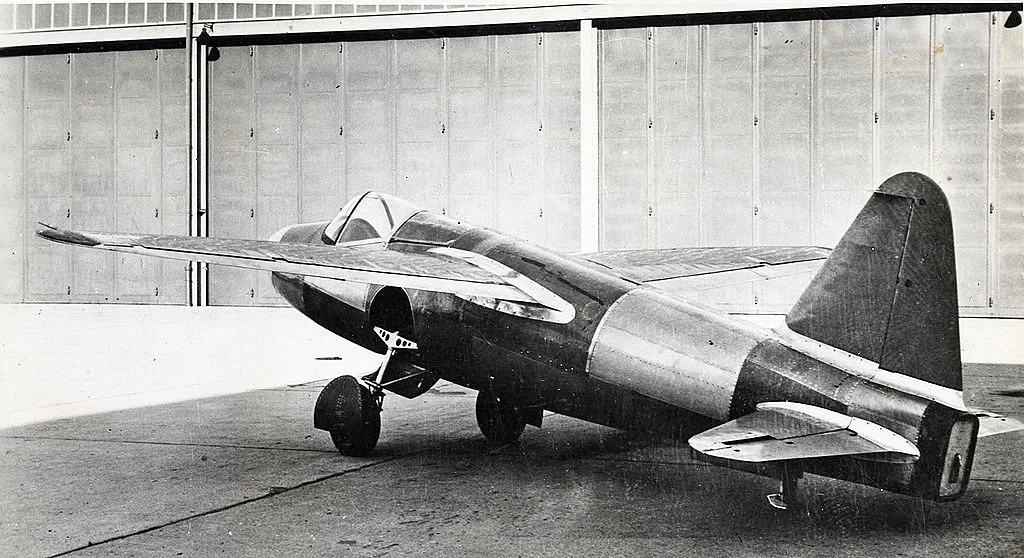
Heinkel He 178 — the world's first turbojet-powered aircraft
series - Machines that changed the sky
The Beginning of a New Era
August 27, 1939—five days before Germany’s invasion of Poland—at the Heinkel factory airfield near Rostock, pilot Erich Warsitz starts an engine that has neither a single piston nor a propeller. Six minutes later, he landed. The most significant breakthrough in the history of aircraft propulsion since the days of the Wright brothers had just taken place—kept secret from the Reich Aviation Ministry and the rest of the world. The Heinkel He 178, the first turbojet aircraft, quietly ushered in the era in which we all fly today.
A young physicist who convinced the tycoon
In 1935, Hans Joachim Pabst von Ohain, a young physicist at the University of Göttingen, patented the concept of using gas turbine exhaust to power an airplane. A year later, his professor and mentor, Robert W. Pohl, wrote a letter of recommendation to Ernst Heinkel—an aircraft manufacturer who had long been fascinated by the pursuit of speed. Heinkel met with von Ohain, listened to him, and immediately hired him. In 1936, von Ohain and mechanic Max Hahn began working at the Heinkel plant in Rostock-Marienehe.
What set this project apart was its complete independence. Heinkel financed the program privately as a corporate venture, without the involvement or knowledge of the Reich Aviation Ministry. The secrecy was so strict that not even Luftwaffe officers knew about the work on the turbojet engine.
Meanwhile, on the other side of the English Channel, a parallel race was underway. The British engineer Frank Whittle filed a patent application for a turbojet engine as early as 1930 —five years before von Ohain—but a lack of adequate government funding meant that his aircraft (the Gloster E.28/39) did not take flight until May 1941, twenty months after the Heinkel.
![He178_1.webp [58.10 KB]](https://www.jbi.com.pl/storage/image/core_files/2026/8/19/43b21e60e4f778ff6bef8f5310555669/webp/jbinvestments/preview/He178_1.webp)
From Hydrogen to Kerosene
The path to flight was paved by a series of engines, each of which taught the engineers something new. The HeS 1, demonstrated in the fall of 1937, ran on hydrogen—a dangerous fuel, but one that allowed the problem of the turbine to be separated from that of the combustion chamber. The HeS 3, completed in the spring of 1938, already burned aviation gasoline and achieved 500 kg of thrust on the dynamometer. That was less than the planned 800 kg, but enough to consider a flight.
Before the engine was installed in a dedicated airframe, it was tested in flight mounted beneath the fuselage of a Heinkel He 118—as an auxiliary power unit alongside the piston engine. The engine provided data that made it possible to build an improved version, the HeS 3b, with an extended combustion chamber. By the summer of 1939, it was ready for installation in the He 178.
The airframe itself was modest: a compact duralumin fuselage, high-mounted wooden wings, an air intake in the nose, and an exhaust nozzle at the rear. The landing gear was designed to be retractable, but during flight tests it remained extended—presumably in case of an emergency landing following a failure of the as-yet-unknown propulsion system.
The Six Minutes That Changed Aviation
On the morning of August 27, 1939, Erich Warsitz—the same pilot who had test-flown the Heinkel He 176 rocket plane a few months earlier—took his place in the cockpit of the He 178. He later described that moment: the takeoff run was slow (a disappointment after the rapid acceleration of the rocket-powered He 176), but after 300 meters, the aircraft picked up speed. The landing gear failed to retract. The turbine emitted a distinctive sound. The controls functioned “almost normally.”
The flight lasted about six minutes. Immediately after takeoff, a bird struck the engine, damaging the blades, but Warsitz managed to circle the airfield and land the aircraft. The only witnesses were Heinkel engineers. No movie cameras, no official delegation—the greatest breakthrough in aviation propulsion in over three decades took place without an audience.
A lackluster demonstration
On November 1, 1939, following the victory over Poland, Heinkel organized an official demonstration of the He 178 for Reich officials. Göring—commander-in-chief of the Luftwaffe—did not attend. Ernst Udet and Erhard Milch were present, but they showed no enthusiasm. Although the aircraft, powered by a HeS 6 engine, reached 598 km/h, it had a range of only 10 minutes and no combat value. The officials failed to realize that they were looking at the future of aviation.
Ironically, the Reich Aviation Ministry was running its own secret jet engine program. BMW and Junkers were developing axial-flow turbines that promised higher performance than von Ohain’s centrifugal engines—these programs were conducted independently. Heinkel did not give up and began work on the twin-engine He 280 fighter, but it was the rival Messerschmitt Me 262, powered by Junkers Jumo 004 engines, that ultimately entered combat service as the first operational jet fighter.
A Lost Historic Site and an Enduring Legacy
The He 178 V1 prototype was sent to the German Aviation Museum in Berlin, where it was destroyed during an Allied bombing raid in 1943. The second aircraft, which never flew under its own power, was destroyed by fire during the bombing of Rostock in 1945. No He 178s have survived to the present day.
However, something more durable than aluminum and wood remained. Von Ohain and Whittle met after the war and became friends, mutually recognizing the independence of their work—both are now considered the fathers of turbojet propulsion. A direct line runs from the He 178 to the de Havilland Comet, the Boeing 707, the Concorde, and every modern passenger aircraft. The Heinkel He 178 remained an experimental prototype; it never entered mass production and no examples have survived in any museum. Nevertheless, its flight on August 27, 1939, forever changed the course of aviation.
![2---jaC4wUm_1724743216_1.jpg [73.44 KB]](https://www.jbi.com.pl/storage/image/core_files/2026/8/13/56f078b4487afc7613329a1103199c64/jpg/jbinvestments/preview/2---jaC4wUm_1724743216_1.webp)
10 Interesting Facts About the Heinkel He 178 That Might Surprise Even Aviation Enthusiasts
1. It was the world's first jet aircraft
The Heinkel He 178 was the first aircraft in history to take to the skies powered solely by a turbojet engine. The historic flight took place on August 27, 1939, just a few days before the outbreak of World War II.
2. It was developed almost in secret
The project was not initially funded by the German Ministry of Aviation. Ernst Heinkel covered most of the costs out of his own pocket, believing that jet engines were the future of aviation.
3. The first flight lasted only about 6 minutes
The flight was very short, and the pilot had to shut off the engine before landing and glide the glider to the runway. Despite this, the experiment was a success.
4. The military wasn't impressed
The demonstration for Luftwaffe representatives did not generate much enthusiasm. It was concluded that the aircraft had too short a range and was not yet suitable for combat use. This delayed the development of German jet aircraft.
5. He had only one flying prototype
Only the unit designated V1 was built. Further versions were planned but were never completed. A unit designated V2was also built, with a modified wing, a more powerful engine, and retractable landing gear, but it never took to the air.
6. The engine was created by a young genius
The drive was developed by Hans von Ohain, who was just over 20 years old when he began working on his jet engine concept. He was one of the fathers of modern jet aviation.
7. He was surprisingly small
Its wingspan was about 7.2 m, and its length was about 7.5 m. In terms of size, it resembled a modern light sport aircraft more than a military jet.
8. He wasn't carrying any weapons
The He 178 was nothing more than a flying laboratory. It was not equipped with machine guns or bombs—its sole purpose was to prove that jet propulsion worked.
9. The original did not survive the war
After the tests were completed, the aircraft was sent to a museum in Berlin, where it was destroyed during an Allied air raid in 1943. Only replicas remain today.
10. He ushered in the era of jet aircraft
Although the He 178 itself never went into production, its success paved the way for designs such as the Messerschmitt Me 262 and the British Gloster E.28/39. Without the He 178, the development of jet aviation would likely have proceeded much more slowly.
Photos from Wikipedia (public domain) and under theCC BY-SA 3.0 licensede