
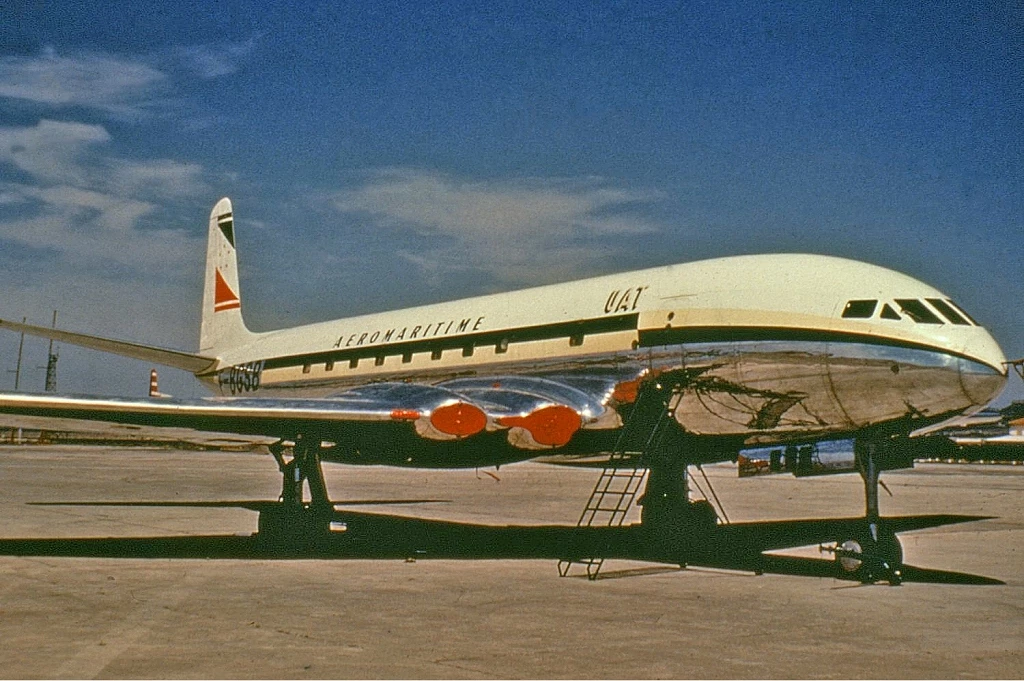
De Havilland Comet – the first commercial passenger jet
series - Machines that changed the sky
A New Deal
On May 2, 1952, an airplane took off from London’s Heathrow Airport, ushering in a new chapter in the history of transportation. The De Havilland Comet—the world’s first jet airliner—cut travel time in half and established Great Britain as a leader in civil aviation. In less than two years, however, the aircraft became a symbol of something else: the greatest engineering mystery of the decade—a mystery whose solution changed the rules for building every subsequent aircraft.
The Empire's Jet-Powered Dream
Even during the war, in 1943, a committee appointed by the British government set goals for postwar civil aviation. One of them was a long-range jet passenger aircraft. The United Kingdom possessed advanced jet technology, which had been intensively developed since the war—the Gloster Meteor and de Havilland Vampire fighters had proven that jet propulsion was mature enough to be considered for civilian applications.
De Havilland took on the challenge under the leadership of designer Ronald Bishop. The approach taken was innovative: four de Havilland Ghost turbojet engines were concealed within the wing roots, rather than being mounted on pylons—as Boeing would later do with the 707. This gave the Comet a clean, elegant silhouette and low aerodynamic drag. The pressurized cabin allowed for flight at an altitude of approximately 12,000 m, above most clouds and atmospheric phenomena experienced during flights at lower altitudes by piston-powered aircraft. The prototype made its maiden flight on July 27, 1949, piloted by John Cunningham—a Royal Air Force “night fighter” ace.
Much faster than Constellation
BOAC’s inaugural flight on the London–Johannesburg route (with stopovers) took nearly half as long as a flight on the best piston-engine aircraft of the era, the Lockheed Constellation. With a cruising speed of about 780 km/h, a cabin free from the noise and vibrations of piston engines, and the ability to fly above storms—passengers spoke of “the future of flying.”
The Comet operated BOAC routes to Africa, Asia, and the Middle East. British industry was celebrating a triumph, as the Americans had nothing comparable—the Boeing 707 did not enter commercial service until 1958. The Comet 1’s cabin could accommodate only 36 passengers, which limited its profitability, but the very fact of its jet speed was a revolution sufficient to fill every flight.
The Mystery of Material Fatigue
In early 1954, two similar Comet crashes occurred over the Mediterranean Sea—both aircraft broke apart in midair while climbing to cruising altitude. The fleet was grounded, and its airworthiness certificate was revoked.
The investigation was entrusted to the Royal Aircraft Establishment (RAE) in Farnborough. A team led by Sir Arnold Hall conducted an experiment that went down in engineering history: the entire Comet fuselage was placed in a tank of water and subjected to repeated cycles of pressurization and depressurization, simulating pressurized flight conditions. After 3,057 cycles, a fatigue crack appeared in the fuselage near the emergency exit.
The cause turned out to be material fatigue in areas of the fuselage where stress concentrations were highest, including around holes and structural cutouts. During subsequent cycles of cabin pressurization, cracks formed in these areas and gradually grew larger. The problem was exacerbated by the method used to create some of the rivet holes—by punching—as this could cause minor damage to the skin. Previous structural strength tests on the fuselage also made it difficult to detect the problem, as they had locally increased the material’s fatigue resistance.
Comet 4 and a Transatlantic Photo Finish
De Havilland did not give up—the redesigned Comet 4 featured rounded windows, thicker fuselage skin, and more powerful Rolls-Royce Avon engines. On October 4, 1958, BOAC inaugurated the first regular transatlantic passenger service operated by a jet aircraft—from London to New York—beating Pan Am and the Boeing 707 by three weeks.
However, the victory turned out to be a Pyrrhic one. The Boeing 707 was larger, faster, and more fuel-efficient, which allowed it to quickly dominate the market. A total of 114 Comets were built across all versions, while production of the 707 exceeded 1,000 units. De Havilland’s jet airliner failed commercially, though its airframe lived on in military service: the RAF Nimrod—a maritime patrol aircraft based on the Comet 4C design—served in the Royal Air Force from 1969 until 2011.
A Lesson in Every Window
Every rounded window in a modern passenger aircraft is a direct legacy of the de Havilland Comet. The “fail-safe” principle—a design philosophy assuming that a structure must remain intact even after a crack appears—was incorporated into airworthiness standards precisely as a result of the RAE investigation. Mandatory fatigue testing of pressurized fuselages has become a standard that remains in effect to this day.
The De Havilland Comet proved that being first means venturing into uncharted territory. The price of that knowledge turned out to be enormous, but it has stayed with us forever—embedded in the design of every jet airliner that has taken to the skies since then.
![DH.106_Comet_C.2_XK697_216_Sq_LHR_June 21, 1965_edited-3.jpg [288.64 KB]](https://www.jbi.com.pl/storage/image/core_files/2026/9/2/927bf75fada0977d149761475ba67436/jpg/jbinvestments/preview/DH.106_Comet_C.2_XK697_216_Sq_LHR_21.06.65_edited-3.webp)
10 Interesting Facts About the de Havilland Comet That Might Surprise Even Aviation Enthusiasts
1. It was the world's first jet airliner
When it entered service in 1952, it was several years ahead of the competition. Passengers could fly much faster and higher than in piston-engine aircraft, often above the clouds, which made for an exceptionally smooth flight.
2. He flew at an altitude at which most pilots had never flown before
The Comet regularly reached an altitude of about 12,000 meters. Back then, that meant flying above almost all weather conditions, which was a true revolution in travel comfort.
3. The Cometa disasters led to the birth of modern fatigue engineering
Following a series of mysterious crashes, British engineers built a massive water tank in which the entire fuselage was submerged and repeatedly pressurized and depressurized to simulate thousands of flights. It was one of the most groundbreaking studies of aircraft design in history.
4. The shape of the windows became a serious structural problem
Today, the windows on passenger airplanes are rounded. One of the lessons learned from the Comet’s history was the high stress concentrations that developed at the corners of its nearly rectangular windows. During repeated pressure cycles, these stress concentrations contributed to the formation of fatigue cracks, which could lead to serious damage to the fuselage. This lesson had a huge impact on subsequent aircraft design.
5. It had a luxurious interior, the likes of which are rarely seen today
The first Comets carried far fewer passengers than modern jets. The seats were wide, the aisles spacious, and the atmosphere was more like an exclusive lounge than today's economy class.
6. It was quieter for passengers than many later jets
The engines were mounted in the wings rather than underneath them. As a result, noise and vibration inside the cabin were surprisingly low, a feature that many passengers praised highly.
7. He nearly destroyed confidence in jet aviation
After the disasters, many people began to fear jet airliners. It was only the success of later models, such as the Boeing 707 and the Douglas DC-8, that restored confidence in the new technology.
8. The Comet 4 version was already extremely safe
Following a thorough redesign of the airframe, the major structural problems were eliminated. Aircraft of this version remained in service for many years, earning an excellent reputation for safety and reliability.
9. It gave rise to one of the world's best reconnaissance aircraft
The military Hawker Siddeley Nimrod was developed based on the Comet and, for over 40 years, patrolled the oceans, tracked submarines, and carried out reconnaissance missions for the British armed forces.
10. His greatest failure was... being too far ahead of his time
Jet engine technology was advancing rapidly at the time, but understanding of metal fatigue was still in its infancy. The Comet paid a high price for blazing new trails, but thanks to the lessons learned, all subsequent jet aircraft became significantly safer.
Bonus
Modern engineers often say that although the Comet was not a great commercial success, it likely saved the lives of millions of passengers. The lessons learned from its construction and testing have influenced the design of virtually every modern passenger aircraft.
Images from WIKIPEDIA were used under theGFDL 1.2 and CC BY 3.0 licenses


