DA40 NG — Still Relevant Today

The Diamond DA40 is an aircraft design that has been on the market for over 20 years, in a wide variety of configurations. The latest NG version has also been around for over a decade, yet the popularity of the “forties” remains high. Taking a closer look at one of the newest DA40NGs in the Polish registry, we examine the success of this design.
When I first took a look at the DA40, I’ll admit honestly that I wasn’t very interested. The slightly reclined seating position in the cockpit, the large wingspan that made taxiing in tight spaces difficult, and the control stick between my legs didn’t win me over. But after gaining experience on many other aircraft and comparing the comfort of the cockpit with its excellent flight characteristics, I have to admit that I was wrong.
Simplicity and convenience
The DA40 is easy to fly. The preflight check is carried out in a very logical and efficient manner; there aren’t a huge number of switches or systems in the cockpit, and the FADEC system helps ensure proper engine operation. On top of that, the slightly reclined seat position is actually quite comfortable—while it may seem unnatural at first glance, both during and after the flight, we feel quite comfortable and don’t have to worry about the limited legroom.
Kuba Śliwiński, well known to readers of Przegląd Lotniczy, flew in on the latest DA40NG straight from the factory. When speaking with him, he mentioned that it was “his first flight ever on a DA40, but thanks to the wide availability of online training materials and his previous experience flying the DA50RG and DA62, he had no trouble whatsoever operating this aircraft.” This is a major advantage of the Diamond family—switching between models from the same manufacturer is very easy and enjoyable for the pilot.
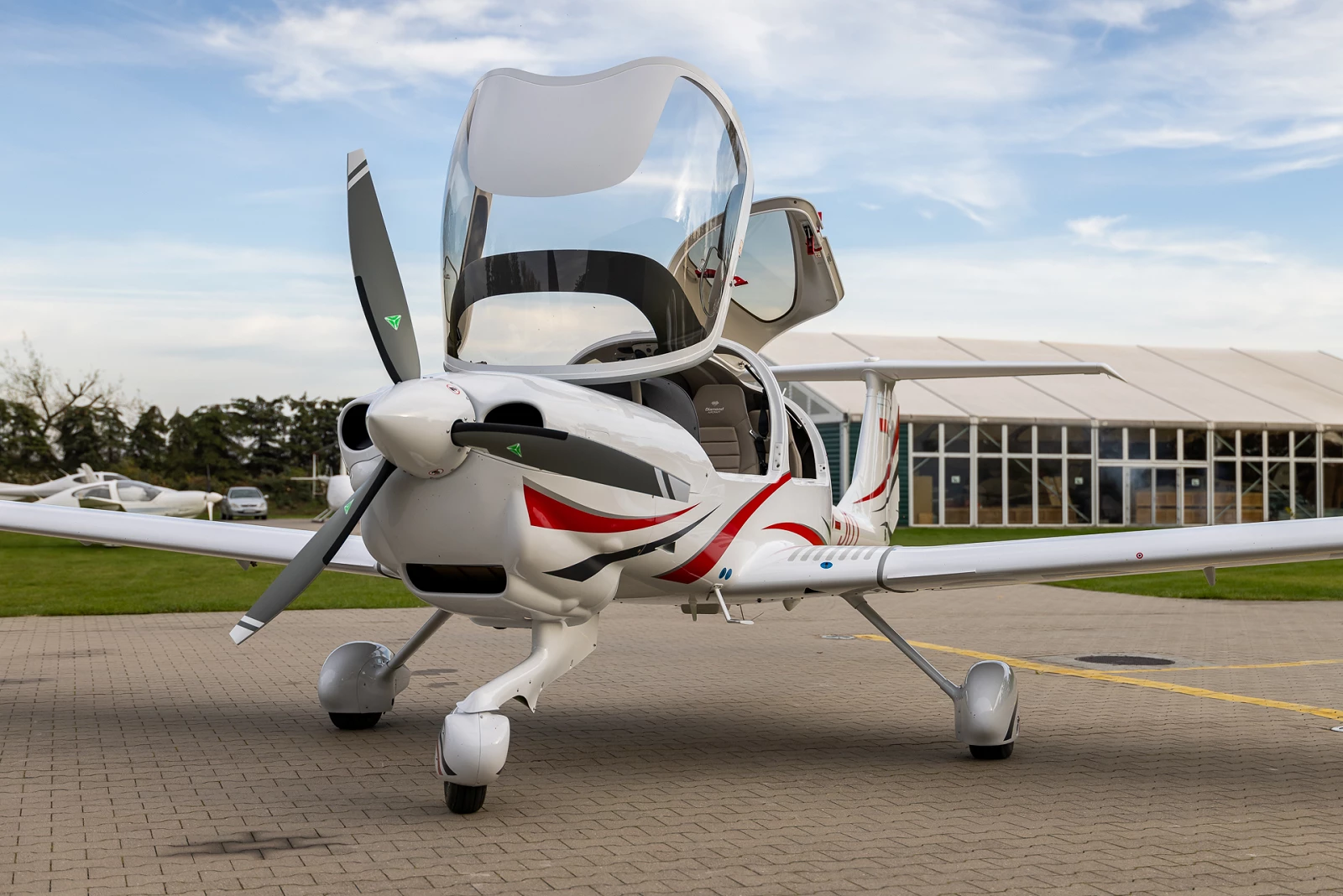
One thing worth noting—and something I still sometimes get confused about myself, despite having logged several dozen hours on the DA40—is boarding the cockpit. While in a Cessna or Piper you approach the aircraft from the rear (from the wing trailing edge), you board the DA40 from the front using an additional step in front of the wing. Additionally, the third door at the rear significantly improves passenger comfort—there’s no need to squeeze past the pilot’s seat.
The lack of a steerable nose wheel may seem like a nuisance, but I didn’t notice any problems controlling the plane on the ground. Whereas with other models I had to roll forward a bit before coming to a stop to straighten the wheel, with the DA40 there’s no need for that, and it takes off after an engine test without any problems. In addition, the large vertical stabilizer helps with taxiing, and the brakes are very well calibrated and operate in a pleasant, smooth manner.
Many versions and variants
I mentioned earlier that the DA40 has been produced in many versions—the latest is designated NG (Next Generation) and features a new 168 KM Austro Engine AE300, redesigned winglets, and modern avionics. While the engine may seem underpowered, it is more than sufficient to reach a maximum speed of 154 KTAS at an altitude of 8,000 ft and maintain a climb rate of 600–800 ft/min.
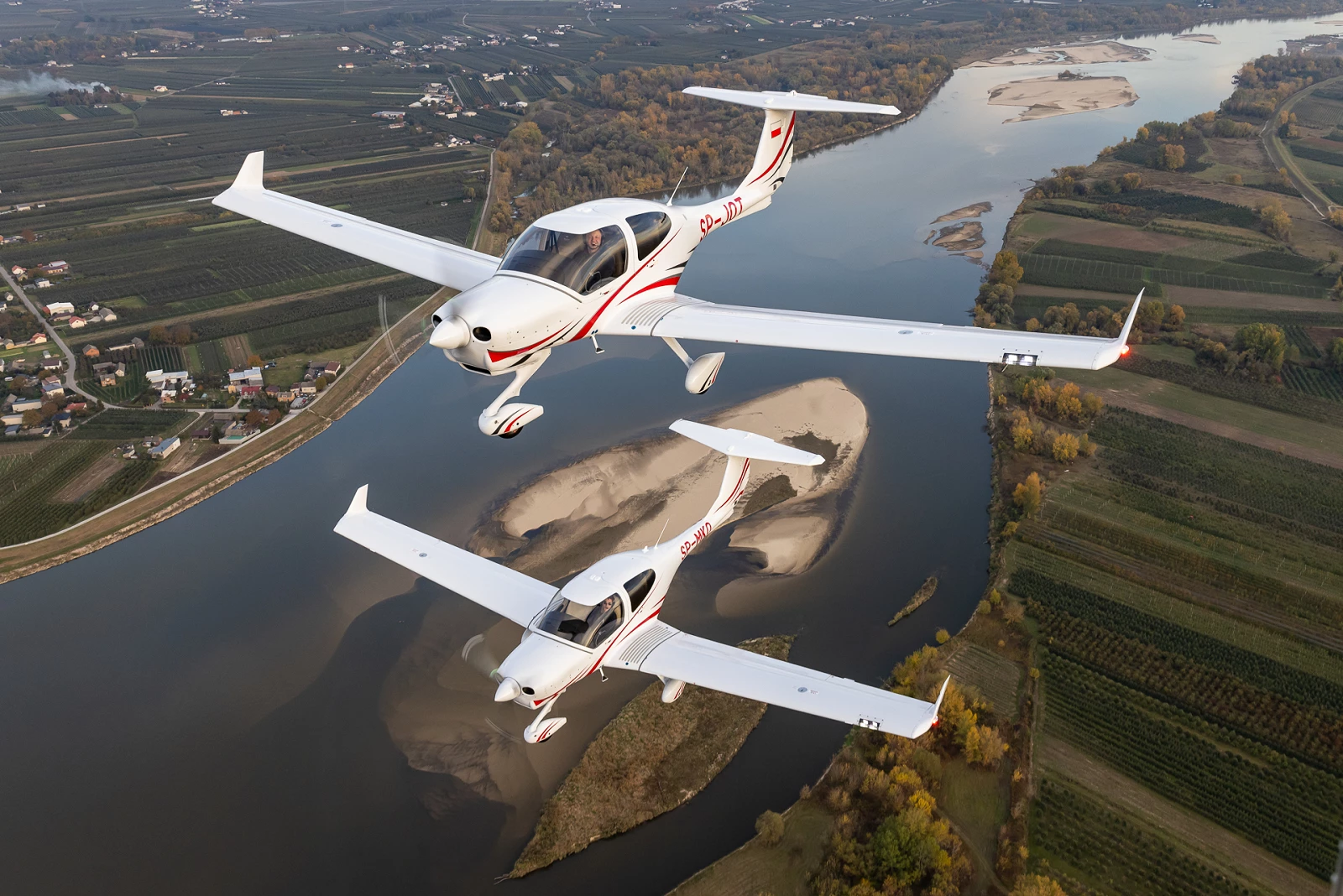
The NG is the most popular version, and owners can choose additional features such as LED lights or air conditioning—as is the case with the SP-JOT model shown here. Some models are also equipped with seats featuring an additional "bear" that aids breathing and provides better ventilation in both summer and winter.
In the past, Diamond has produced several versions powered by Avgas and equipped with various engines and standard features, but the two versions that are still available today deserve the most attention. The first is the Tundra Star version, which is designed for flying on unpaved surfaces and in harsh natural conditions. In addition to dedicated rear seats that are fully foldable and larger doors, the TS also features a reinforced landing gear and larger low-pressure tires.
Another version worth mentioning is the eDA40, or the electric “forty.” This aircraft made its first flight in 2023 and is currently undergoing certification for flights of up to 90 minutes on a single charge. This is a major step toward the electrification of aviation, especially since its range should now allow for longer flights, rather than just a few circuits.
![DA40_20241021_9017.jpg [1.23 MB]](https://www.jbi.com.pl/storage/image/core_files/2026/9/9/ac96aeda3287c230af3f82bc835b37dc/jpg/jbinvestments/preview/DA40_20241021_9017.webp)
Modern design
When flying Cessnas and Pipers, we’re used to metal/aluminum airframes. Diamond has opted for a composite airframe, where the fuselage is constructed as a single, integrated unit. This improves safety and stability, and also helps reduce the aircraft’s weight. Composite technologies are no longer a surprise to anyone, and this design has proven its reliability time and again, saving the lives of many pilots.
The cockpit features the latest Garmin G1000NXi avionics with Synthetic Vision and a state-of-the-art Garmin GFC700 autopilot, which assists the pilot. The cockpit itself is designed to be highly ergonomic, with light switches at the top, two Garmin screens occupying the main part of the cockpit, and avionics and electrical switches at the bottom. Between the pilot and the passenger are the temperature control sliders and the main throttle lever.
While talking with Kuba about his and my impressions of the flights and the service on this plane, we both came to the conclusion that “it’s designed almost like a car—you get in, start it up, and fly, while the onboard systems monitor many parameters for you, which simplifies the checklist.” It’s also worth mentioning the spacious luggage compartment, which can hold several suitcases.
![DA40_20241021_9355.jpg [1.60 MB]](https://www.jbi.com.pl/storage/image/core_files/2026/9/9/81e77e70a64fb0d3655f668d302d37a7/jpg/jbinvestments/preview/DA40_20241021_9355.webp)
Interesting solutions
Air conditioning is one of the features that pleasantly surprised me on this plane. While I’ve encountered general aviation (GA) aircraft with this feature (such as the Malibu Mirage or the Saratoga), 4-seat versions with air conditioning are a rarity. I have to admit that it comes in especially handy in the summer when the sun heats us up through the glass canopy and we want to cool down quickly and effectively. Of course, the air conditioning weighs about 30 kg, so it’s a trade-off with the amount of luggage we can take on board.
Compared to previous versions, the redesigned winglets not only improve the aircraft’s appearance on the ground but also its stability in the air. Having flown both the NG version and previous models, I must admit that the NG “sticks to the air” much better, and control of the aircraft during takeoff and landing using ground effect has been improved. Specially designed wheel fairings also help achieve better flight performance.
I mentioned at the beginning the FADEC system and the fact that the DA40NG is equipped with a JET-A1-powered engine. This offers nothing but benefits—lower fuel consumption, easy operation, simple startup... By the way, the DA40NG has a range of nearly 1,000 nm on a single tank of fuel! At first, I was a bit skeptical about operating with just a single throttle lever—how could it work without adjusting RPM or the air-fuel mixture? And what about takeoff? After a few flights, however, I really came to like this solution; I don’t have to remember various settings and can focus solely on setting the percentage of power I need. Additionally, there’s no longer a problem with failed engine starts due to too much or too little fuel—the FADEC system automatically regulates all parameters.
![DA40_20241021_9283.jpg [1.27 MB]](https://www.jbi.com.pl/storage/image/core_files/2026/9/9/0c9c7c4683053ec2ee8a40f64223a4d3/jpg/jbinvestments/preview/DA40_20241021_9283.webp)
In the air...
...the plane handles very well. I’d even say that sometimes it handles a little too well! You don’t need to apply much force to the controls or move the stick very far to achieve the desired effect, and yet it’s a very stable plane. The speeds are very similar to those of other models in the same class—rotation at about 60 KIAS, climb at about 80 KIAS, cruise at about 110–120 KIAS, and on approach we maintain about 70–80 KIAS.
One thing that initially surprises pilots about this aircraft is its very flat takeoff and landing. Because of the low position of the tail skid, you shouldn’t pull the control column back too hard during takeoff or landing to avoid scratching the rear of the fuselage. While this may seem unnatural at first, flat landings definitely help improve visibility from the cockpit without the need to lean out excessively.
A major plus is the aircraft’s noise level—or rather, the lack thereof. In other aircraft, we’re used to hearing changes in the engine’s operating parameters, and flying without headphones is out of the question. In the DA40, the cockpit is very well soundproofed, and the engine is quieter, so the flight is much more comfortable. However, you also need to keep this in mind when adjusting engine power—the parameters and percentages may change, but it’s hard to detect that change “by ear.”
Although the DA40NG has been on the market for over 10 years, it remains a solid and proven design. It’s great to see that more and more of these aircraft are appearing not only in Polish skies but also across Europe—here’s to more of the same!
Text and photos:Filip Modrzejewski