
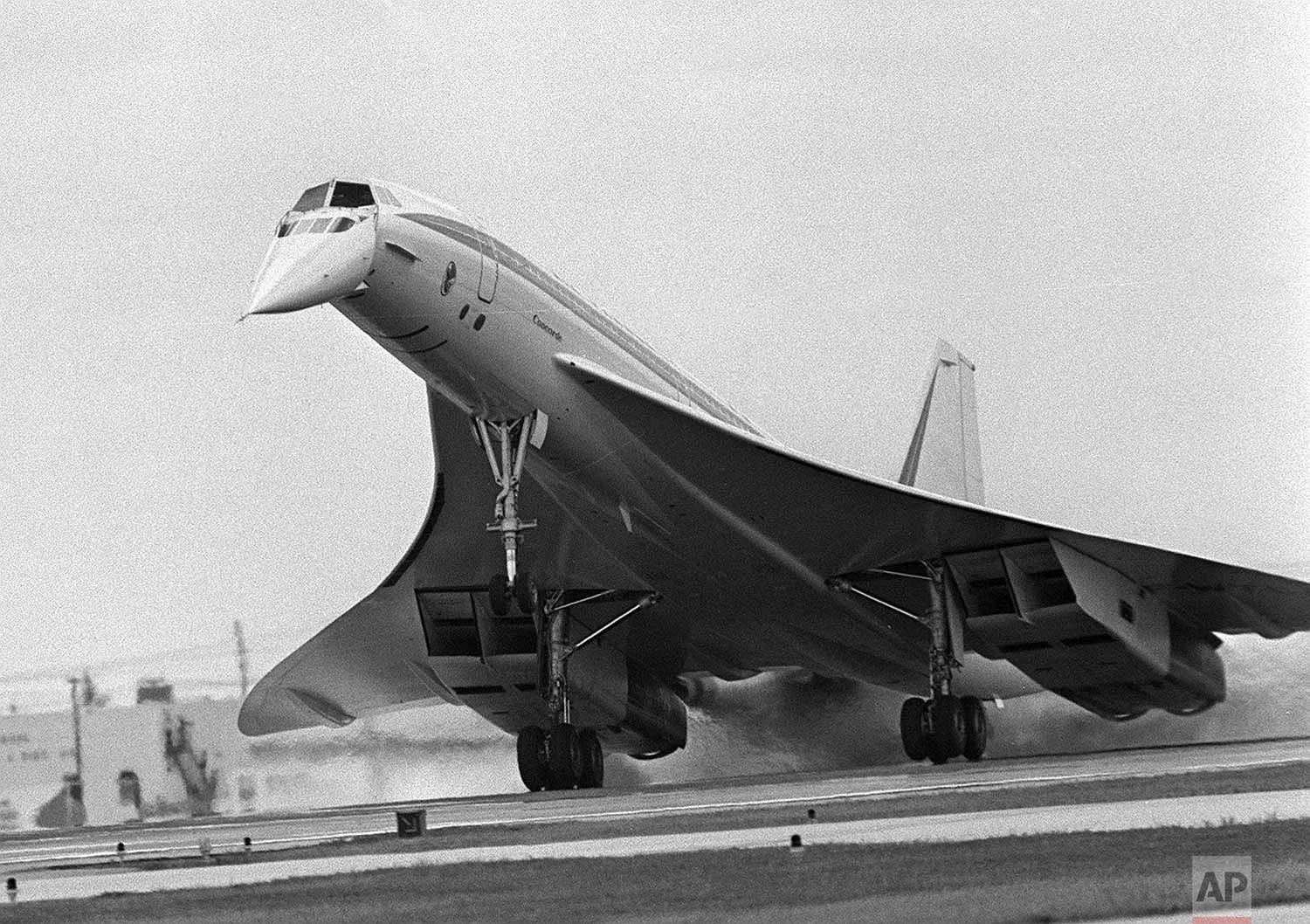
Concorde – a supersonic passenger aircraft that was ahead of its time
series - Machines that changed the sky
A speed that was ahead of its time
On July 13, 1985, Phil Collins performed an afternoon set at Live Aid at London’s Wembley Stadium; after the concert, he boarded a Concorde and took the stage in Philadelphia that very evening. A transatlantic flight compressed into three and a half hours—the same musician, the same day, two continents. No other passenger plane crossed the Atlantic at such a pace. Concorde flew like this for 27 years—from January 1976 to October 2003.
An agreement across the English Channel
The 1960s saw a race among three superpowers to develop the first supersonic passenger aircraft. The Americans were working on the Boeing 2707, the Soviets on the Tu-144, and the French and British decided to join forces. On November 29, 1962, the two countries signed an unprecedented intergovernmental agreement—a shared budget, shared risk, and profits split equally. The consortium of Aérospatiale in Toulouse and BAC in Bristol was tasked with building the first supersonic airliner.
The name itself was a political statement. The French word “concorde” means “agreement,” which was meant to symbolize a new era of European cooperation. The Soviets test-flew their prototype on December 31, 1968, beating the competition by two months. The Concorde took off for the first time on March 2, 1969, over Toulouse. The American Boeing 2707 never left the drawing board.
The Delta that breaks the sound barrier
The Concorde’s silhouette was unlike anything else flying under commercial colors at the time. The ogive delta wing had no horizontal stabilizers or conventional flaps. This shape minimized shock wave drag at supersonic speeds, but it came with a serious drawback—the need to land at a very high angle of attack, which completely blocked the pilot’s view of the runway.
Engineers addressed this issue with a droop nose capable of operating in three positions. During flight, it remained retracted to maintain aerodynamic efficiency; during takeoff, it lowered by 5°, and during landing, by 12.5°. The narrow cockpit windows had to withstand the extreme thermal stresses of flight at speeds exceeding 2,100 km/h. The fuselage itself was made of AU2GN aluminum alloy, operating practically at the limits of its capabilities.
Four Olympus aircraft with a bomber heritage
At the heart of the Concorde were four Rolls-Royce/Snecma Olympus 593 engines—units derived directly from the British Avro Vulcan strategic bomber. To this day, it remains the only passenger aircraft equipped with afterburners, a feature that has not returned to civil aviation since the Concorde was retired.
They were used during takeoff and when breaking the sound barrier, in the range of Mach 1 to 1.7. Above that speed, the Concorde continued to accelerate without them, which was a remarkable feat in itself. One of the least visible yet most critical structural elements were the variable-geometry air intakes. Movable flaps slowed the incoming airflow from Mach 2 to Mach 0.5 even before it entered the engine. Without this mechanism, no turbojet engine could operate in supersonic flight.
Three hours and twenty minutes
That’s how long the flight from Paris to New York took. A Boeing 747 covered the same route in 7–8 hours, offering passengers a view of the clouds from an altitude of 11 kilometers. The Concorde climbed twice as high, to an altitude of 18 km, from which one could see the distinct curvature of the Earth and the sky fading into the deep blackness of space.
The airspeed indicator mounted on the front bulkhead of the cockpit displayed the current airspeed and, halfway through the flight, stopped at 2.02. The fuselage skin heated up to about 127°C due to air friction—the windows were noticeably warm to the touch. The aircraft itself expanded by 25 centimeters in flight due to thermal expansion and returned to its original dimensions only after landing.
The in-flight service matched the technical excellence of the aircraft. Caviar and champagne were served by staff who maintained the standards of a Michelin-starred restaurant. Among the passengers were regularly members of the British royal family, CEOs of major corporations, heads of state, and Hollywood stars. A round-trip ticket cost $10,000–12,000 in the early 2000s, making this form of travel accessible only to a select few.
![Queen_Elizabeth_II_and_Prince_Philip_disembark_from_a_British_Airways_Concorde.jpg [2.97 MB]](https://www.jbi.com.pl/storage/image/core_files/2026/7/2/9cf4acf83ab852843f2adb8e0a9f0781/jpg/jbinvestments/preview/Queen_Elizabeth_II_and_Prince_Philip_disembark_from_a_British_Airways_Concorde.webp)
Photo by SRA JERRY WILSON - https://commons.wikimedia.org/w/index.php?curid=1685993
The end of an era
For the first 24 years of commercial service, the Concorde flew with an impeccable safety record. That changed with the crash of Air France Flight 4590 in July 2000, shortly after takeoff from Paris-Roissy. The fleet was grounded for over a year to implement structural modifications, including reinforcing the fuel tanks with Kevlar linings.
Its return to service coincided with the September 11, 2001, attacks and a severe downturn in the business travel market. Compounding these issues were economic realities—the Concorde consumed roughly the same amount of fuel as a Boeing 747, which had four times the passenger capacity, and the costs of maintaining the aging fleet were rising. Airbus, the consortium’s successor, withdrew its maintenance support. On October 24, 2003, a British Airways aircraft from New York landed at Heathrow, bringing to an end the 27-year era of supersonic passenger aviation.
For over two decades, no supersonic aircraft has returned to commercial service. The American company Boom Supersonic is working on the Overture, which is scheduled to debut in 2029. However, the Concorde remains the only aircraft to have regularly carried commercial passengers at speeds faster than the speed of sound.
Interesting facts about the Concorde that will surprise even aviation enthusiasts
1. Aluminum at the limits of its capabilities
The Concorde was built mainly from aluminum, even though titanium or steel might seem like a more obvious choice at such speeds. The problem? In the 1960s, the technology didn’t yet exist to machine titanium on such a large scale. Engineers deliberately limited the speed to Mach 2 so that the material… wouldn’t simply melt.
2. No traditional flaps or slots
The delta wing did not have the typical flaps found on other passenger aircraft. Instead, the Concorde relied on so-called vortex lift, which was generated at high angles of attack and “kept” the aircraft aloft.
3. Electrical systems instead of hydraulic systems in key locations
In many critical systems, electrical systems were used instead of hydraulic ones, which was rare at the time—the goal was to achieve greater control precision at extreme speeds.
4. Navigation that differs from that in conventional aircraft
The Concorde used an inertial navigation system (INS), which allowed it to determine its position without relying on external signals—a crucial feature for high-speed flights over the ocean.
5. Special carbon fiber brakes
It was one of the first passenger aircraft to use carbon brakes —a standard feature in aviation today, but an absolute novelty back then.
6. The air in front of the engine was "calmed" by shock waves
Instead of a single air shock, the intake system generated a series of controlled shock waves that gradually reduced the airspeed. It was one of the most advanced components of the entire design.
7. The plane was “naturally unstable”
Aerodynamically, the Concorde was designed in such a way that it would have been difficult to fly without constant adjustments. Stability was ensured by the control systems and the pilots’ skills—much like in modern fighter jets.
8. The takeoff was limited by the length of the runway
With a full fuel tank, it required very long runways. That is why it operated only from select airports around the world.
9. The fuel cooled… the air conditioning
Some cooling systems used fuel as a heat-absorbing medium— it acted as a heat sink before the heat reached the engines.
10. The tests involved the deformation of the entire aircraft
During ground tests, the structure was deliberately subjected to extreme temperatures and stresses to see how the entire fuselage “performs” as a single structure, rather than as a collection of parts.
Main photo by André Cros - This photograph is part of the André Cros Collection,
bottom photo by Henrysalome - Own work, CC BY 2.5
