
The Boeing 747 – The Jumbo Jet That Ushered in the Era of Mass Air Travel

series - Machines that changed the sky
The Largest Civilian Project in the History of Aviation
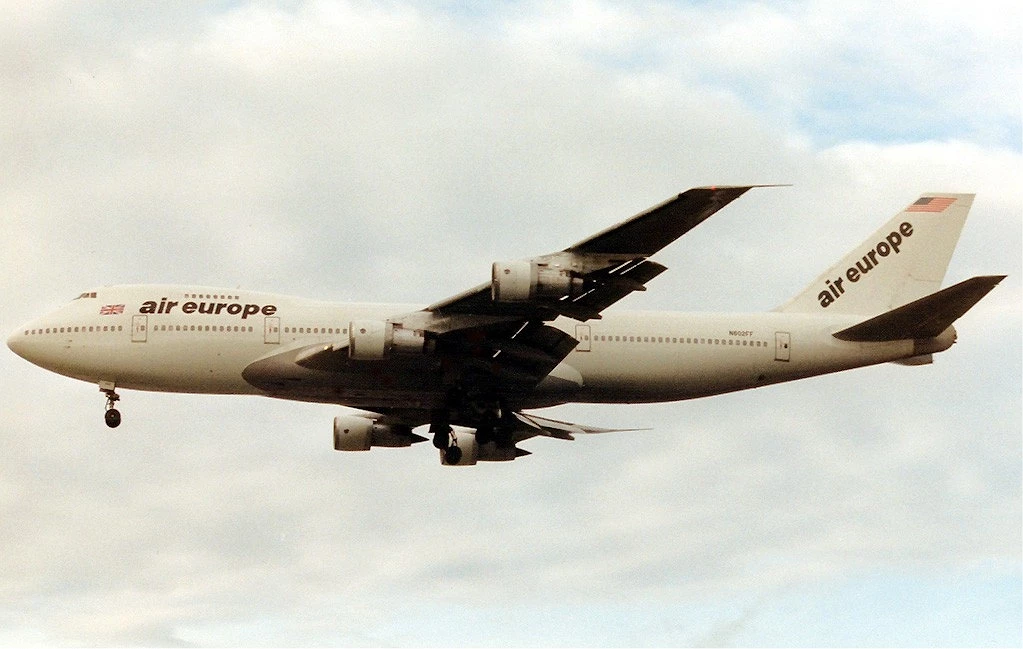
In 1965, the two most powerful men in civil aviation at the time—Boeing CEO Bill Allen and Pan Am founder Juan Trippe—set out on their annual salmon fishing trip. On a boat somewhere off the coast of Washington State, Trippe said, “If you build it, I’ll buy it.” Allen replied, “If you’ll buy it, I’ll build it.” A handshake, without an official contract. That’s how one of the greatest civilian projects in aviation history began—a passenger aircraft that, depending on the version and configuration, could carry several hundred people, and in high-density layouts, over 500 passengers, making air travel accessible to millions. The Boeing 747, dubbed the “Jumbo Jet” by the media, was in production for 54 years, with a total of 1,574 units built.
The Hump That Changed Everything
Boeing had expertise in large aircraft—its loss in the USAF competition for a heavy transport (won by Lockheed with the C-5 Galaxy) left the company with ready-made analyses and experience. The only thing missing was a civilian application. Juan Trippe provided it, dreaming of an aircraft 2.5 times larger than the Boeing 707, which carried only 189 passengers.
However, the shadow of the Concorde loomed over the project. Boeing feared that supersonic passenger aircraft would render subsonic planes obsolete. In the event of such a scenario, the 747 had to be convertible into a freighter. Hence one of the most important design decisions in aviation history: the cockpit was moved to the top of the fuselage so that the nose could open straight forward for cargo loading. This is how the Boeing 747’s distinctive hump was born—the most recognizable silhouette in civil aviation. Joe Sutter, later dubbed the “father of the 747,” was responsible for the design and led the team through a 28-month design sprint.
A Factory Fit for a Giant
No existing facility could accommodate the production of a machine of that size. Boeing purchased 315 hectares of swamp forest near Everett, Washington, and built a factory there that remains the world’s largest building by volume to this day. Construction of the hangar and the design of the aircraft proceeded in parallel—a pace that was unprecedented in the aviation industry.
The Boeing 747 was the first wide-body passenger aircraft—with two aisles instead of one. It was powered by four Pratt & Whitney JT9D turbofan engines, and later variants also featured General Electric CF6 and Rolls-Royce RB211 engines. The cost of the program consumed nearly all of the company’s capital—Boeing teetered on the brink of bankruptcy. The first flight took place on February 9, 1969, and the first commercial flight—on a Pan Am route from New York to London—took place on January 22, 1970.
A ticket that millions could afford
The crux of the 747 revolution lay in the economics of the seat. Its predecessor—the Boeing 707—could carry 189 passengers. Depending on the configuration, the Jumbo Jet could seat between 366 and 660 people. Despite higher operating costs on transatlantic routes, the ticket price per seat dropped dramatically. Flying across the Atlantic was no longer a privilege reserved for businesspeople—it became a realistic option for the middle class.
The effect was snowballing. The growth of mass tourism, the boom in travel agencies, and the greater and easier accessibility of Southeast Asia to Western travelers—none of this would have been possible on the scale we know today without the capacity and cost-effectiveness of the Jumbo Jet. The model in which the 747 transported hundreds of passengers between major hubs, where they would transfer to smaller aircraft, became the foundation of the modern air travel network.
![747-100-seat-chart-1970.jpg [58.61 KB]](https://www.jbi.com.pl/storage/image/core_files/2026/7/1/b1cec4b9b853f51240a19257724a18ab/jpg/jbinvestments/preview/747-100-seat-chart-1970.webp)
Queen of the Skies
The Jumbo Jet quickly earned a second nickname: Queen of the Skies. For 35 years, it remained the largest passenger aircraft in scheduled service—until the arrival of the Airbus A380 in 2007. Over the course of half a century of production, several variants were introduced: the -100, -200, -300, SP, SR, -400 (the most popular, with 694 units produced), and -8 (the latest generation).
One of the 747's most recognizable roles is its service in the U.S. presidential fleet. Modified 747 200B, designated as VC-25A since 1990 have been transporting U.S. presidents. When the sitting president is on board, the aircraft uses the call sign Air Force One.Joe Sutter’s vision for a cargo aircraft also proved prophetic:
cargo variants with a swing-up nose are still flying around the world, serving routes where cargo capacity matters.
1,574 copies and not a single one more
On January 31, 2023, a handover ceremony was held at the Everett plant for the final Boeing 747—a 747-8F freighter for Atlas Air. An image of Joe Sutter was painted on the fuselage. After 54 years of production and 1,574 aircraft, the production line has come to an end.
On January 31, 2023, a handover ceremony was held at the Everett plant for the final Boeing 747—a 747-8F freighter for Atlas Air. An image of Joe Sutter was painted on the fuselage. After 54 years of production and 1,574 aircraft, the production line has come to an end.
What led to the end of the 747 as a passenger aircraft? First and foremost, the economics of twin-engine long-range aircraft.. ETOPS regulations allowed twin-engine aircraft—the Boeing 777, 787 Dreamliner, and Airbus A350—to fly transoceanic routes. Two engines consume less fuel than four, and the math proved unforgiving even for the Queen of the Skies. The Boeing 747 lost out to fuel efficiency, but its legacy lives on: it proved that flying doesn’t have to be a luxury. Boeing historian Michael Lombardi is convinced that Jumbo Jets will still be flying in 2069—the 100th anniversary of the first flight.
10 Interesting Facts About the Boeing 747 That Might Surprise Even Aviation Enthusiasts
1. It was designed for a short service life as a passenger aircraft
The designers assumed that supersonic aircraft would eventually take over passenger traffic. That is why the 747 was designed from the outset to be easily converted into a cargo plane.
2. The hump wasn't the designers' idea
The distinctive “hump” was created because the cockpit was positioned above the main deck. This made it possible to install a nose that opened upward and to carry very large cargo loads.
3. The construction project required the creation of the world's largest building
To manufacture the 747, Boeing built a massive factory in Everett. At the time of its completion, it was the world's largest building by volume.
4. The first units had a problem with their own vibrations
During flight tests, aeroelastic phenomena were detected that caused excessive wing vibrations. Boeing had to reinforce the structure before commencing regular flights.
5. The upper deck was supposed to be... a living room
Originally, airlines set up bars, lounges, and relaxation areas on the upper deck. It was only later that the space began to be used for additional passenger seating.
6. It was capable of transporting a space shuttle
Specially modified 747s, known as Shuttle Carrier Aircraft, carried NASA's space shuttles on their backs.
7. One 747 serves as the White House in the sky
Modified Boeing 747-200B aircraft designated VC-25A are used to transport the U.S. president. When the sitting president is on board, they use the call sign Air Force One. They are equipped with a command center, secure communications, the president’s office, and the capability for in-flight refueling. Modified Boeing 747-8s, designated VC-25B, will soon enter service.
8. Record number of passengers: over 1,000 people
In 1991, during Operation Solomon, a single 747 carried more than 1,000 passengers. It was one of the most remarkable flights in aviation history.
9. The engines are larger than the fuselage of the first jet aircraft
The engines on modern versions of the 747 have a diameter greater than the fuselage of some early jet aircraft, such as the Boeing 707.
10. The Queen of the Skies outlived her own successors
Many people assumed that the double-deck Airbus A380 would completely replace the 747. However, production of the A380 ended earlier than expected, and the 747 remains highly valued as a cargo aircraft.
Bonus
The last 747 produced rolled off the assembly line in 2022 after more than 50 years of production, and was officially delivered to the customer in January 2023. During that time, more than 1,570 were built, making it one of the most recognizable aircraft in aviation history.
Images from WIKIPEDIA were used under theGFDL 1.2 license
Images from https://deltamuseum.org/ were used
Archival brochures


