
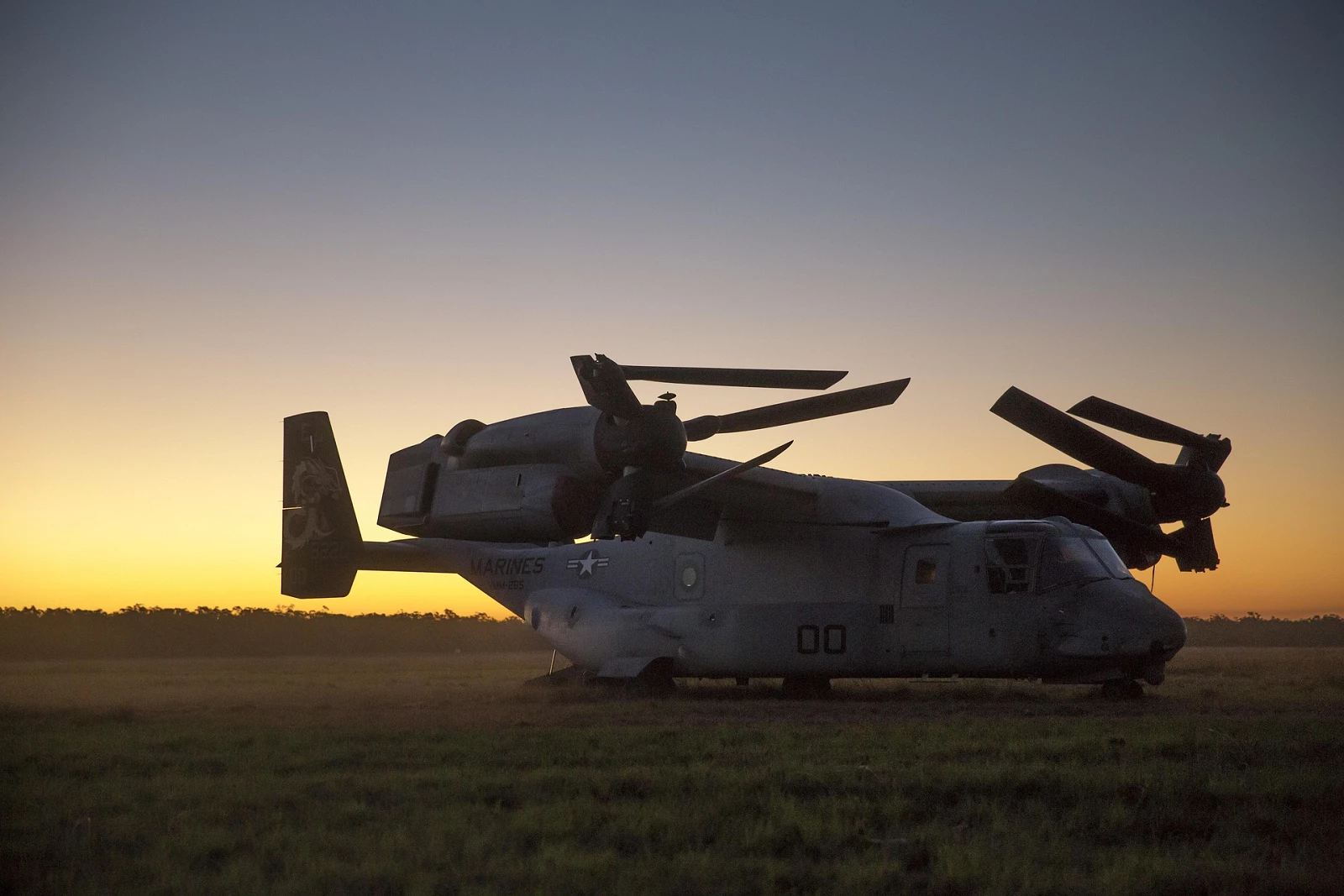
Bell-Boeing V-22 Osprey – a combination of an airplane and a helicopter
series - Machines that changed the sky
A successful combination
A helicopter takes off vertically but is slow. An airplane flies fast but needs a runway. For decades, the aviation industry tried to combine both sets of advantages into a single design—without success. It wasn’t until engineers at Bell and Boeing built the Bell-Boeing V-22 Osprey—the first tiltrotor aircraft in history to enter mass production and operational service—that they succeeded. The aircraft takes off vertically like a helicopter, and after rotating its engine nacelles, it flies at the speed of a turboprop.
A crushing defeat that sparked a revolution
On April 24, 1980, U.S. special forces attempted to rescue the hostages from the embassy in Tehran. Operation Eagle Claw ended in failure in the Iranian desert—the helicopters did not have sufficient range, and the transport planes could not land in the area. Eight soldiers were killed, and no one even reached the hostages.
This disaster made the Pentagon realize that a machine was needed that combined vertical takeoff capability with the speed and range of an airplane. In 1981, the JVX (Joint-service Vertical take-off/landing Experimental) program was launched, and two years later, a contract to build a prototype was awarded to a consortium of Bell Helicopter and Boeing Helicopters. Bell brought experience from the experimental XV-3 and XV-15 tiltrotors—machines that had already tested the concept of rotating rotors in the 1950s and 1970s. Boeing provided industrial capabilities and experience in the production of heavy transport helicopters. The V-22’s first flight took place on March 19, 1989.
The Anatomy of Change
The operating principle of the tiltrotor looks simple on a diagram, but is extremely difficult to implement. At the tips of the V-22’s wings are two nacelles, each housing a 4,586-kilowatt Rolls-Royce AE 1107C-Liberty turboshaft engine and a three-bladed rotor with a diameter of 11.6 meters.
During takeoff and landing, the nacelles are oriented vertically—the rotors operate as in a conventional helicopter. Once the appropriate altitude and speed are reached, the nacelles rotate to a horizontal position. The rotors then become propellers, and the wing takes over the lift. The entire transition process takes about 12 seconds. A tiltrotor can take off from a ship’s deck or an open field, and moments later fly at speeds unattainable by any helicopter.
An important safety feature is the drive shaft connecting the two nacelles. In the event of a failure in one engine, the other powers both rotors—the pilot retains full control of the aircraft. The maritime aspect has also been refined: the wings rotate 90° and fold along the fuselage, while the rotors fold along the nacelles. As a result, the V-22 fits into a hangar on the deck of an amphibious assault ship.
Twice as fast, twice as far
The numbers speak for themselves. The V-22’s top speed is 565 km/h—nearly twice that of the UH-60 Black Hawk (approx. 295 km/h). Its range on internal fuel is 1,627 km, compared to about 590 km for the Black Hawk. This is a huge difference that changes the logic of military operation planning. The V-22 can carry 24 fully equipped soldiers or over 9 tons of internal cargo. The aircraft is available in three variants: the MV-22B for the Marines (amphibious assault), the CV-22B for USAF special operations forces, and the CMV-22B for the Navy (aircraft carrier resupply).
![Bell Boeing V-22 Osprey3.JPG [563.15 KB]](https://www.jbi.com.pl/storage/image/core_files/2026/5/27/3d31e6488fe7fd033c7e14273b49bdc8/JPG/jbinvestments/preview/Bell%20Boeing%20V-22%20Osprey3.webp) Photo by Senior Airman Julianne Showalter
Photo by Senior Airman Julianne Showalter
26 years in the making
Twenty-six years passed between the launch of the JVX program in 1981 and the V-22’s entry into operational service in 2007. This is one of the longest development cycles in the history of military aviation—and certainly not because anyone was in no hurry.
The tiltrotor is a machine with no precedents in design. Entire engine nacelles rotate in flight, generating mechanical stresses and vibrations that earlier designs did not have to contend with. The powerful blast from the rotors during landing was strong enough to damage the landing pad. The program repeatedly teetered on the brink of cancellation—Defense Secretary Dick Cheney tried to cancel it in 1989, but Congress restored funding three times. The road from prototype to finished aircraft was bumpy and costly, but engineers at Bell and Boeing ultimately proved that the tiltrotor concept works.
The Variable-Rotor Aircraft in Action and in the Future
Since 2007, the V-22 has been deployed in Iraq, Afghanistan, and on dozens of humanitarian missions. The Marines used the MV-22B as an assault aircraft for amphibious operations—the Osprey replaced the aging Boeing CH-46 Sea Knight, which had been in service since the 1960s. USAF Special Operations Forces operate the CV-22B variant, capable of in-flight refueling. The only foreign operator is Japan, with 17 aircraft.
A total of over 460 aircraft have been ordered, and the production line is expected to remain in operation until around 2028. The most significant confirmation of the concept’s viability, however, is the U.S. Army’s 2022 decision: in the FLRAA (Future Long-Range Assault Aircraft) program, the Army selected the Bell V-280 Valor—a next-generation tiltrotor. The Bell-Boeing V-22 Osprey proved that a category that had been doubted for decades has a future.
10 Surprising Facts About the Bell Boeing V-22 Osprey
1. It is neither a helicopter nor an airplane—technically, it is a tiltrotor
Bell Boeing V-22 Osprey
The V-22 belongs to a very rare category of tiltrotor aircraft—its rotors rotate to allow for vertical takeoff, like a helicopter, and then transition to horizontal flight, like a turboprop aircraft. In practice, this results in a hybrid of both worlds.
2. If one motor fails, both rotors continue to operate
This is one of the most impressive features of the design. Both engines are connected by a drive shaft that runs through the wing, so if one engine fails, the other can power both rotors simultaneously. This design was specifically developed to ensure safety during hover.
3. The Osprey is incredibly fast for a VTOL aircraft
Its maximum speed is approximately 565 km/h (305 knots)—significantly faster than most conventional military helicopters. By comparison, the UH-60 Black Hawk typically flies at around 280–295 km/h.
4. The show was so controversial that it was almost canceled several times
The development of the V-22 spanned decades, cost billions, and was repeatedly criticized following a series of test crashes. At one point, the program was considered virtually a dead project, but it survived thanks to strong support from the Marines.
5. It has an unusual aerodynamic problem: vortex ring state + power settling
During certain vertical descent profiles, the Osprey can enter a dangerous state similar to that seen in helicopters, but its behavior is more complex due to its tiltrotor configuration. Pilots undergo specialized training specifically to address this risk.
6. Folding wings and rotating nacelles make it possible to “squeeze” it onto the ship
Despite its enormous size, the V-22 was designed to operate from amphibious assault ships. Its wings rotate and its rotors fold up so it can fit into naval hangars—it looks almost like a robot transforming in a sci-fi movie.
7. Osprey was intended to be a response to the Eagle Claw disaster
One of the factors that led to the development of this class of aircraft was the failure of Operation Eagle Claw (1980), the U.S. attempt to rescue hostages in Iran. The military concluded at the time that it needed an aircraft that combined the range of a conventional plane with the ability to land vertically.
8. The jet from the rotors is so powerful that it poses a real threat to the surrounding area
The V-22’s downwash is significantly stronger than that of many conventional helicopters. It can lift heavy objects, debris, and dust with tremendous force, which makes operations in urban and desert environments difficult.
9. There is a "luxury" version for VIPs
The CMV-22B variant is used by the U.S. Navy primarily for logistics transport, but configurations for VIP transport and special long-range missions have also been considered and tested. A tiltrotor as a high-speed flying limousine? Almost.
10. Pilots say it’s more about “system management” than traditional piloting
Making the switch from a helicopter or airplane to the V-22 requires a change in mindset. It is a machine with highly sophisticated automated systems for transitioning between flight modes, and the pilot oversees the aerodynamic transformation rather than manually “struggling” with it, as in older designs.
Bonus for geeks:
NASA has been exploring civilian applications of tiltrotor technology as a potential means of rapid regional transport—so the concepts behind the Osprey may make a comeback in civil aviation.
Photo: Source: Bell Flight
