
Antonov An-225 Mriya – the world's largest aircraft
series - Machines that changed the sky
The largest and heaviest
"Mriya" means "dream" in Ukrainian. That is the name given to the largest and heaviest transport aircraft in aviation history—a machine with a takeoff weight of 640 tons, capable of carrying cargo that other transport aircraft could not even dream of. The Antonov An-225 Mriya was the only one of its kind. It was built to carry the Soviet space shuttle on its back, and after the collapse of the USSR, it became a symbol of Ukrainian aviation and its most recognizable ambassador.
A shuttle needs wings
In the 1980s, the Soviet Energia-Buran space program faced a logistical challenge: how to transport the Buran space shuttle and components of the Energia launch vehicle from factories scattered across the USSR to the Baikonur Cosmodrome in Kazakhstan? Overland transport over thousands of kilometers was too slow and costly, and no existing aircraft had sufficient payload capacity.
The project was assigned to Antonov’s design bureau in Kyiv. The starting point was the An-124 Ruslan—at the time, the world’s largest production transport aircraft. The engineers lengthened the fuselage, added two engines, designed a new wing with a wingspan of nearly 90 meters, and incorporated a double vertical tail so that the upper surface of the fuselage could serve as a transport platform. The result was the An-225—a transport aircraft that took off for the first time on December 21, 1988, near Kyiv, with pilot Oleksandr Halunenko at the controls.
![Buran_on_An-225_(Le_Bourget_1989)_1.JPEG [339.65 KB]](https://www.jbi.com.pl/storage/image/core_files/2026/6/10/b90064d2f38194d677d1d6cac878459a/JPEG/jbinvestments/preview/Buran_on_An-225_(Le_Bourget_1989)_1.webp)
Photo by Master Sgt. Dave Casey
The Anatomy of a Giant
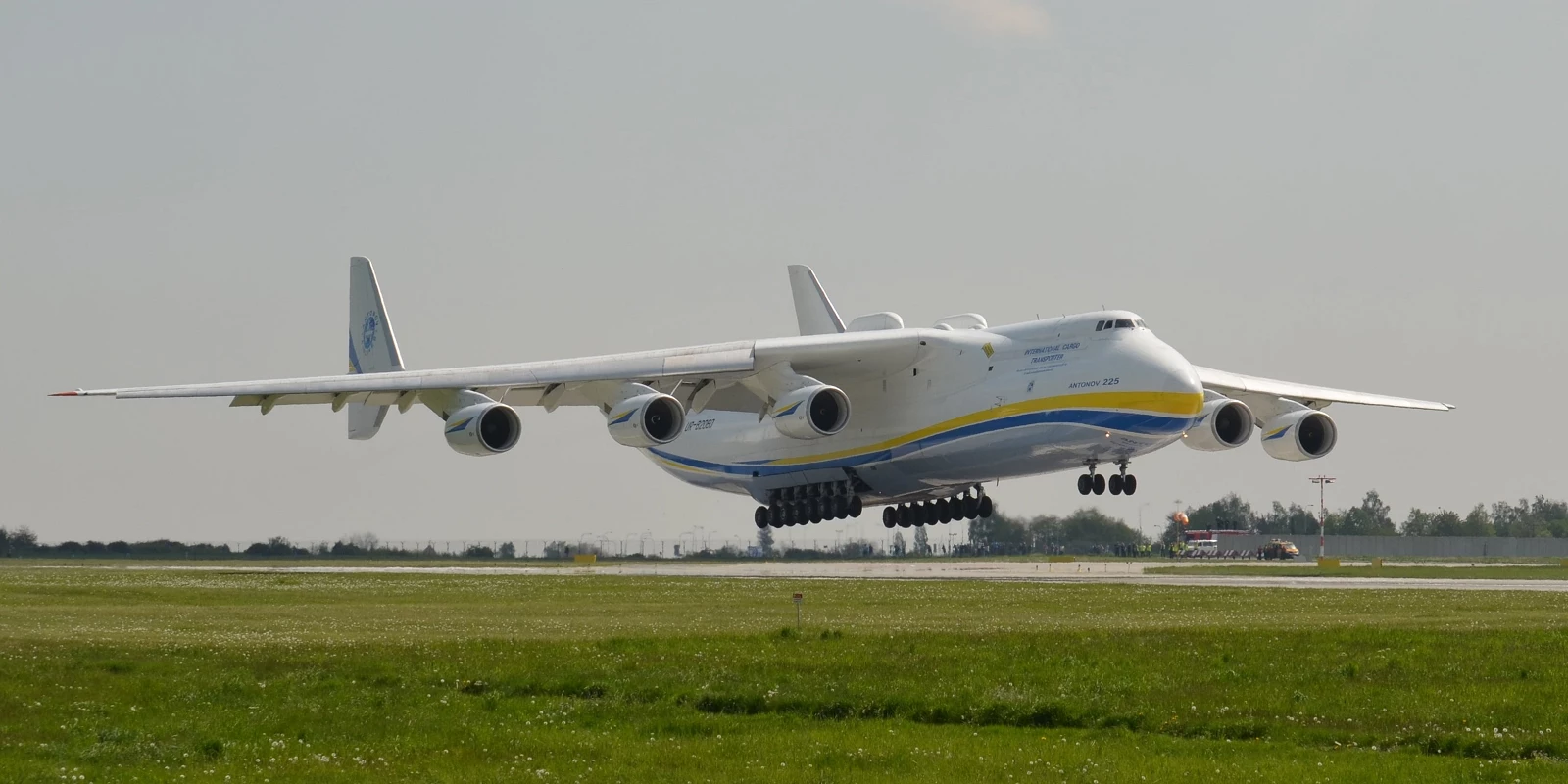
The sheer size of the An-225 was truly impressive. Its wingspan was 88.4 meters—longer than a football field. The fuselage measured 84 meters. The aircraft was powered by six Progress D-18T engines, each producing 229.5 kN of thrust.
The nose of the hull opened upward, revealing a 43-meter cargo hold measuring 6.4 by 4.4 meters. To illustrate the scale: the Mrija’s cargo hold was longer than the distance of the Wright brothers’ first flight in 1903. The landing gear consisted of 32 wheels arranged to distribute the immense weight across the surface and enable landing at airports with limited runway load-bearing capacity.
The twin vertical stabilizers—two separate stabilizers instead of a single central one—were not a whim of the designers. A classic, single stabilizer would have protruded high enough above the fuselage to block the transport of oversized cargo on the top of the aircraft. The two smaller stabilizers eliminated this problem.
![Antonov_An-225_Mriya,_Antonov_Design_Bureau_AN2191904.jpg [298.10 KB]](https://www.jbi.com.pl/storage/image/core_files/2026/6/10/f1981929a52e5ed62ad32c490a505e83/jpg/jbinvestments/preview/Antonov_An-225_Mriya,_Antonov_Design_Bureau_AN2191904.webp)
Photo by Alex Beltyukov - RuSpotters Team
Loads that other planes could only dream of
After the end of the Buran program and the collapse of the Soviet Union, the An-225 lost its original purpose. It sat grounded for several years at the Hostomel Airport near Kyiv, until a decision was made in the early 2000s to refurbish it and return it to commercial cargo service under Antonov Airlines.
Since 2001, the Mriya has flown around the world carrying cargo that no other transport aircraft could handle: 130-ton generators, diesel locomotives, wind turbine blades several dozen meters long, and power transformers. During the COVID-19 pandemic, the An-225 made flights from China to Europe carrying medical supplies—a single flight replaced more than a dozen flights by smaller aircraft. The Mriya held over 240 world records.
Wherever it landed, it drew crowds. Its landing at Warsaw Chopin Airport in April 2020, carrying a shipment of masks and protective equipment, became a story covered by national media. The Mrija was not just a logistical tool—it was a phenomenon that stirred emotions like no other transport aircraft in modern aviation.
The Ukrainian Dream
After Ukraine gained independence in 1991, the An-225 took on a significance that went far beyond mere technology. It became proof that Antonov’s design bureau in Kyiv was capable not only of designing but also of keeping a top-tier aircraft in service—without Soviet support or funding. The name “Mriya” ceased to be merely a factory designation. Vitali Klitschko called it an “ambassador with wings,” and its blue-and-yellow colors became one of the most recognizable symbols of Ukrainian industry.
Hostomel, February 2022
In late February 2022, when Russia launched a full-scale invasion of Ukraine, the An-225 was undergoing scheduled maintenance in Hostomel—one of its six engines had been removed. The aircraft was unable to take off. During the fighting for the airport, the hangar was hit, and a fire consumed the front section of the fuselage and the wings of the sole Mrija aircraft.
The loss caused a stir far beyond the aviation community. President Volodymyr Zelenskyy announced plans to complete a second An-225—its fuselage, about 30% complete, had been sitting at Antonov’s facilities since the 1980s. Antonov confirmed that design work on the reconstruction is underway, with an estimated cost of approximately $500 million. Full implementation is expected to take place after the war ends, as part of an international collaboration involving Western aviation companies. Whether the Mriya will take to the skies again remains an open question—but the very fact that Ukraine is not abandoning this plan speaks volumes about the An-225 more than any record ever could.
10 interesting facts about the Antonov An-225 Mriya that might surprise even aviation enthusiasts
1. It was created primarily for the space program
Most people know that it carried huge loads, but it was originally designed to transport the Buran space shuttle and components of the Energia rocket. It was the equivalent of the American Boeing 747 + Space Shuttle combination, only on a much larger scale.
2. The distinctive double vertical stabilizer wasn't just for looks
The two "tails" were created because a conventional single stabilizer would have been caught in the turbulence generated by the massive payload carried on the aircraft's fuselage. This design was an aerodynamic necessity.
3. It had as many as 32 wheels
The An-225's landing gear consisted of 32 wheels. Interestingly, some of them were steerable, allowing the giant aircraft to turn around at airports without the need for tow trucks.
4. He set over 100 records in a single flight
On March 22, 1989, the Mrija took off with a payload of 156.3 tons and set a total of 110 world records in a single flight. It is one of the most impressive record-breaking flights in aviation history.
5. It was so big that airports organized “hunts” for its arrivals
Mrija's arrival often drew thousands of plane spotters and aviation enthusiasts. In some countries, people traveled hundreds of kilometers just to see it land. It became a true aviation star.
6. A second copy exists… but it was never completed
Few people know that a second An-225 fuselage was also built. However, the program was suspended after the collapse of the Soviet Union, and the aircraft remained unfinished. After the first Mriya was destroyed, plans emerged to use that fuselage to rebuild the aircraft.
7. It was "taken apart" for a few years
After the Buran program ended, the aircraft was placed in storage. Its six engines were removed and used in other Antonov An-124 transport aircraft. It wasn't until the late 1990s that it was returned to service.
8. He transported items that had previously been considered unsuitable for air transport
Among the cargo it carried were generators weighing over 130 tons, locomotives, and giant wind turbine blades. In effect, it created an entirely new category of air transport.
9. An even larger version was planned
The Mrija served as the basis for the Antonov An-325 project, which was intended to serve as a flying platform for launching spacecraft. The project never progressed beyond the conceptual stage, but it demonstrates the scale of the designers’ ambitions.
10. The last mission was focused on combating COVID-19
It made its last commercial flight in February 2022, transporting nearly 90 tons of medical supplies related to the COVID-19 pandemic. A few weeks later, it was destroyed during the fighting for Hostomel Airport near Kyiv.
Bonus
The name “Mrija” means “Dream” in Ukrainian. After the plane was destroyed, it became a symbol not only of aviation, but also of Ukrainian determination and hope for reconstruction.
The photos were used underthePixabaycontent licenseand the CC BY-SA 4.0 license