
A New Development in Aerobatics and Training

Training aerobatic aircraft aren’t built every day—especially those designed primarily for training. In late 2024, the French manufacturer Aura Aero debuted its certified Integral R model, which is generating a great deal of (well-deserved) interest. Filip Modrzejewski and Jakub Śliwiński are taking this aircraft out for a test flight.
I’d had my eye on this aircraft for some time. Not only friends from Poland but also from the United Kingdom had mentioned it to me as a model they were considering to enhance their fleet of aerobatic and UPRT training aircraft, so it’s generating a lot of interest. The aircraft looks great both structurally and visually, and after my first aerobatic flight, I became even more convinced of its merits… but let’s take a look at everything step by step.
Integral R in Poland
By the end of 2024, the aircraft had received full EASA certification, and the first production model was delivered in April 2025 to an aerobatic club in France. At the same time, the aircraft began to gain increasing popularity, and thanks to a partnership with JB Investments & Aeroklub (which is the aircraft’s dealer in Poland), the Integral R also made its debut in Poland in late May. This was no coincidence; it was a dedicated presentation combined with numerous flights and the opportunity to experience the aircraft firsthand in Konstancin-Jeziorna near Warsaw.
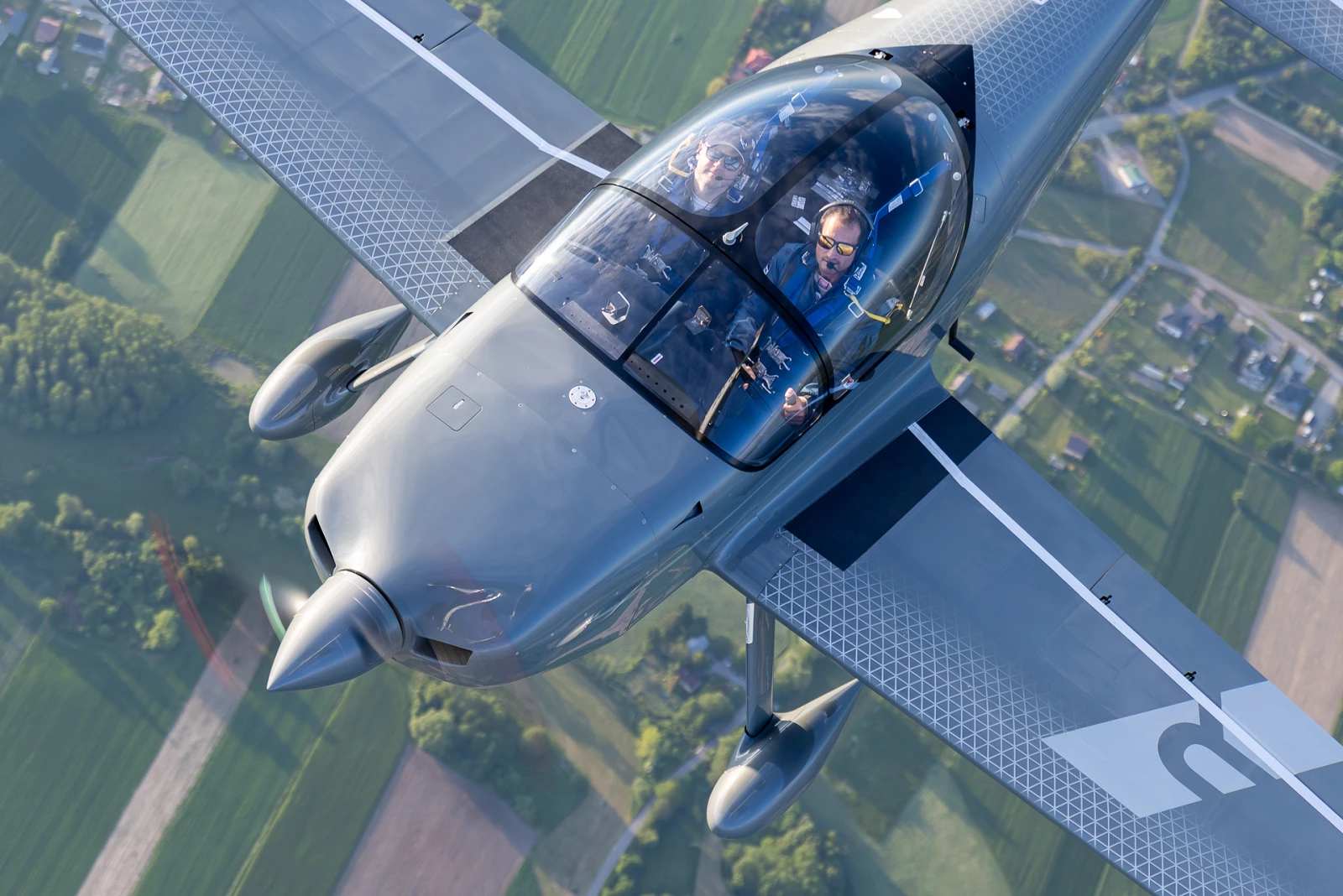
Once there, I meet up with Bastian and Romain—the Sales Director and Demonstration Pilot, respectively—with whom, as it turns out, I’ll spend a few days in a very pleasant, aviation-focused atmosphere. An Integral R is already waiting for us in front of the hangar, featuring a unique light-gray paint scheme and the registration F-WIAR. It’s a prototype also used for certification and various flight tests; the aircraft has already logged several hundred flight hours but still looks brand new. The fuselage has a sleek, streamlined shape, and on the wings, fuselage, and tailplane, we can see a paint pattern consisting of small triangles. “It took us about three weeks just to paint this pattern. We have several standard paint schemes for our customers, but we can also create custom paint jobs,” says Bastian.
![Aura_IntegralR_20250524_1886.jpg [2.33 MB]](https://www.jbi.com.pl/storage/image/core_files/2026/10/14/5687d5b561a6a72797dfa392576a5df5/jpg/jbinvestments/preview/Aura_IntegralR_20250524_1886.webp)
Wood and Carbon
The designers at Integral R opted for classic and robust designs, with a primary focus on a wooden structure reinforced with carbon fiber—the entire assembly is bonded with a special adhesive to make it even more durable. Both the fuselage and wings are made primarily of wood, while the control surfaces are mainly made of carbon fiber. It is worth noting that the ailerons do not have the typical weights underneath them, which improves left/right control with the control stick; nevertheless, controlling full deflection in this aircraft is not a problem at all.
As befits a rear-wheeled aerobatic aircraft, the Integral R has no flaps. The rear wheel has been further reinforced and features a sturdy steel structure to ensure safer operations from grass airfields. Another interesting feature is the bonded construction of the front section of the fairing with the engine cowling, designed to prevent potential detachment and ensure the integrity of the airflow around the aircraft—yet another improvement over other aircraft.
What does maintenance for this aircraft look like? That’s where Bastian comes in—it’s really no different from other aircraft and can be performed by qualified mechanics from a Part-145 organization who know how to work with wooden structures and composites. The engine is a classic Lycoming, and the avionics are Garmin and Trig, so these are also popular components. Additionally, we have a team of mechanics available who can quickly reach any location in Europe in the event of an emergency.”
![Aura_IntegralR_20250524_1702.jpg [1.43 MB]](https://www.jbi.com.pl/storage/image/core_files/2026/10/14/d8fb8fc40a3110613a3c26b6f0911395/jpg/jbinvestments/preview/Aura_IntegralR_20250524_1702.webp)
Safety and Comfort
Before we take a look inside the cockpit, my attention is drawn to the parachute installed on the plane. “This is the first aerobatic plane with a built-in parachute safety system. The system is really good and can save the plane even if it’s activated while flying upside down or in a spin,” says pilot Romain.
The cockpit is fairly basic but also well-equipped—the Garmin G3X avionics are located right in the center, with the radio and Trig transponder (very unobtrusive) and the circuit breakers to the right, and the analog airspeed indicator and altimeter to the left. Directly in front of the pilot, there is no classic “six-pack” (the avionics are centered), but rather a space to mount an iPad or an aerobatic harness, which is much more useful for this type of flight.
The seats are comfortable, although our legs are positioned straight out in front of us—there isn’t room to sit as you would in a typical chair. Despite this, there’s no problem accessing the (adjustable) rudder pedals, and we’re secured to the seat with a five-point Hooker Harness. The central panel with the throttle, propeller, and mixture levers clearly delineates the space for the pilot and passenger without feeling cramped. Incidentally, the Integral R’s cockpit is 20 cm wider than the Cap-10’s—that’s a significant difference.
I mentioned that the F-WIAR is a unit that also serves as a prototype and test aircraft—among other things. That’s why, in the cockpit, we can see additional instrumentation on top of the instrument panel for measuring structural vibrations, as well as, among other things… a brass knuckle. Test pilots use it in emergency situations to break out of the cockpit. Speaking of the cockpit, it’s worth noting that it opens backward using additional actuators and has a clearly visible handle in the center that indicates whether it is fully closed or open. Currently, the cockpit must be fully closed before the engine is started, but engineers at Aura Aero are working on a certified solution that would allow it to be partially opened during taxiing on the ground.
![Aura_IntegralR_20250524_1939.jpg [1.60 MB]](https://www.jbi.com.pl/storage/image/core_files/2026/10/14/7de1e563907d16cd2dcdb1ae8c6e70ba/jpg/jbinvestments/preview/Aura_IntegralR_20250524_1939.webp)
Let's go
Talk is cheap, but everyone is waiting for the afternoon flight to put this plane “through its paces” and see how the Integral R handles in the air. I put on my parachute, and Romain and I take our seats in the cockpit. Getting in and out of the plane isn’t difficult thanks to the wide step and the platform on the wing where you can stand, along with an additional dedicated handle behind the cockpit.
We close the cowl, pump fuel into the engine, and start it smoothly. “A cold start is very easy and pleasant in this aircraft, but with a warm engine, it can sometimes catch the pilot off guard.” We taxi to the runway, noting the engine’s very quiet and somewhat “artificial” sound—all thanks to the engine’s electronic ignition system, which replaces traditional spark plugs. This is a relatively new technology, but it significantly reduces engine noise.
After a engine test, we take off, accelerating the plane to about 120 km/h before lifting off the ground. Sharp turns during the circuit are no problem for this aircraft, and the rate of climb remains above 1,000 fpm almost the entire time. We wave to the observers in Konstancin and head southeast. I have the opportunity to fly the plane in a straight line and get a feel for its characteristics—it’s very stable in flight, and when I release the controls, the plane continues flying in the exact same orientation as when I left it. On the other hand, when making turns or performing other maneuvers, the aircraft responds very easily to the controls, without requiring a great deal of force—I must admit that I’ve been missing a good combination of stability and agility in my recent flights.
During the flight, we maintain a constant speed of about 270 km/h, which is the typical cruise speed for this aircraft. It’s worth noting that the speed indicators are calibrated in km/h—“the main reason is that this unit offers much greater precision than knots, which is especially useful for aerobatic flights.” Of course, every owner can set their own units on the Garmin G3X.
![Aura_IntegralR_20250524_2508.jpg [2.16 MB]](https://www.jbi.com.pl/storage/image/core_files/2026/10/14/b3d5ac952b9741586fb0af979c8c6773/jpg/jbinvestments/preview/Aura_IntegralR_20250524_2508.webp)
Time for some stunts
On a cross-country flight or while flying in circles, the Integral R handles very, very pleasantly—it’s been a long time since I’ve enjoyed manual flying this much. So it’s time to put an even bigger smile on my face by performing a few aerobatic maneuvers—especially since I’ve recently been brushing up on my skills in this area on a German Grob Aircraft.
We start with a barrel roll, followed by an inverted flight, during which Romain shows me the correct angle of the aircraft—which is much steeper than in a normal straight-line flight. We also perform a few loops and Cuban eights, and with each maneuver, I like this plane more and more. The 210 KM engine provides plenty of speed to spare, and we can perform loops at speeds ranging from 210 to 300 km/h without having to “dive” to build speed.
Flying these maneuvers in the Integral is pure pleasure; the plane responds very well to the pilot’s inputs, and all maneuvers are executed very smoothly. At the same time, they don’t happen as quickly as in other planes, so both we and our potential student have the opportunity to understand what’s happening and what the correct flying technique is. The Integral R has a roll rate of 180 degrees per second, meaning a full roll around its axis in 2 seconds. It’s also worth mentioning that you can turn off the electric trimmer (using the switch in front of the pilot) so it doesn’t interfere with your maneuvers. Before returning, we perform two more spins to see how the aircraft behaves in such situations—once again, it passes with flying colors, recovering very quickly and easily, even after several turns.
We’re heading back to Konstancin, flying along the Vistula River, and the landing approach procedure is very simple—slow down to approach speed (145 km/h), turn on the lights and fuel pump, then descend in a gentle glide to see the runway and touch down on three points. This flight proved to me just how well-thought-out and well-designed this aircraft is—I’m certain it will perform excellently at many airports throughout Europe and the U.S.
Text and photos:Filip Modrzejewski


