
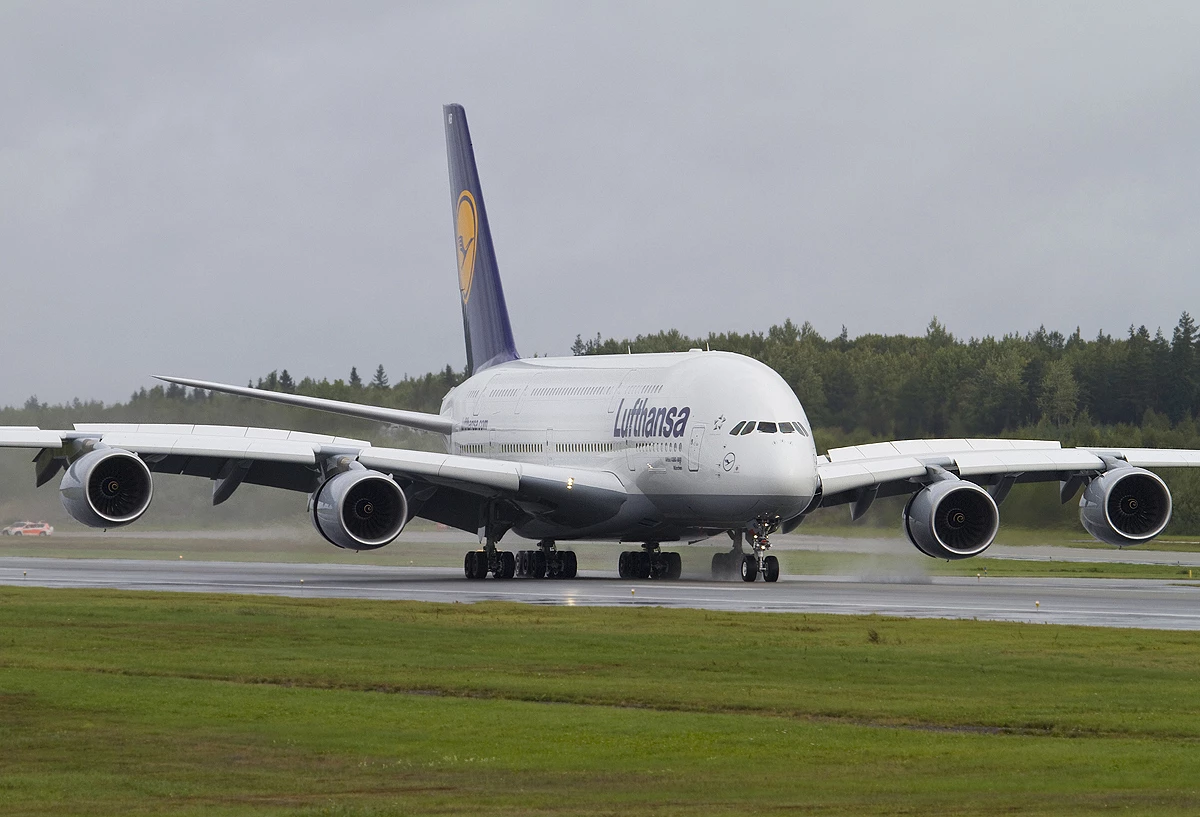
Airbus A380 – the world's largest passenger aircraft
series - Machines that changed the sky
Size isn't everything
In December 2000, the Airbus board of directors made a decision worth 9.5 billion euros: to build a passenger aircraft capable of carrying more than 800 people on two full decks. The goal was to break the Boeing 747’s long-standing monopoly on the category of the largest long-range aircraft. The Airbus A380 achieved that goal—it became the largest passenger aircraft in aviation history. However, after 251 units were delivered, the production line was shut down. The story of the Superjumbo is a lesson that, in aviation, size alone is not enough.
Europe's Response to the Jumbo Jet
Since the 1970s, the Boeing 747 had no competitor in the category of passenger aircraft with more than 400 seats. Airbus intended to change that. The A3XX project—a double-decker giant with two full decks running the entire length of the fuselage—took shape throughout the 1990s. Unlike the 747, which had an upper deck only in the front section of the fuselage, the A380 offered two full decks from nose to tail.
The designation A380 was not based on a sequential numbering system. The number 8 resembles the cross-section of a double-deck fuselage, and in Far Eastern culture it is considered a symbol of good luck—an important detail for an aircraft that Airbus marketed primarily to Asian carriers. Six airlines placed 50 orders. The actual cost of the program—including delays and modifications—rose from the planned 9.5 to approximately 25 billion euros.
Over 500 km of wiring in a single fuselage
The A380’s size was impressive even compared to the 747. Wingspan: 79.75 m. Length: 72.72 m. Takeoff weight: 575 metric tons. Four engines—Rolls-Royce Trent 900s or Engine Alliance GP7200s—powered the aircraft, which could carry 555 passengers in a three-class configuration.
Each aircraft required the installation of approximately 560 km of wiring—and it was the wiring harnesses that proved to be the program’s Achilles’ heel. Different standards used at the factories in Hamburg and Toulouse led to delays that cost Airbus an additional 5 billion euros and more than a year of downtime. The maiden flight took place on April 27, 2005, from Toulouse, and the first commercial flight was on October 25, 2007, when Singapore Airlines launched flight SQ380 from Singapore to Sydney.
Silence on Both Decks
No technical specification can capture what an A380 passenger feels once seated. The double-layered floor and ceiling structure between decks dampens vibrations and noise so effectively that the Superjumbo’s cabin is the quietest in commercial aviation. Wide aisles, higher ceilings than on any other aircraft, and no sense of claustrophobia—even in economy class.
Airlines use this space to create products not found on any other type of aircraft. Emirates offers onboard showers and cocktail bars. Singapore Airlines offers suites with double beds. Etihad has introduced “The Residence”—a three-room suite with a bathroom and an onboard butler on a passenger aircraft. For years, passengers have cited the A380 as their preferred aircraft type for long-haul routes—satisfaction surveys leave no doubt on this matter.
Hub lost by one point
The problem is that airlines do not share passengers’ enthusiasm to a sufficient degree. The Airbus A380 was designed for the “hub-and-spoke” model—hundreds of passengers traveling between hubs (Dubai, London, Singapore), where they would transfer to smaller aircraft. However, the market has shifted toward direct “point-to-point” flights, operated by smaller, twin-engine aircraft.
The A380’s four engines consume more fuel than the two engines on a Boeing 787 or an Airbus A350, while offering comparable range. Seat-mile efficiency works in the Superjumbo’s favor only when the aircraft is full—and very few airlines are able to fill more than 500 seats daily on many routes. Emirates, with its fleet of 123 aircraft, has proven that the model works, but the rest of the market has not followed suit. The irony is that it was Airbus itself that built the A350—an aircraft that took orders away from its own flagship product.
A Renaissance Despite the End of Production
On December 16, 2021, Emirates took delivery of its last A380. Production lasted just 14 years—compared to the Boeing 747’s 54 years. The pandemic accelerated the phase-out of these aircraft, and five airlines completely phased out their A380 fleets. Paradoxically, a partial resurgence followed the pandemic. Emirates, Singapore Airlines, British Airways, and Qantas have returned the Superjumbo to regular service on their busiest routes. As of May 2025, approximately 180 aircraft remained in active service.
The Airbus A380 did not revolutionize aviation as its creators had planned, but it still made its mark on history. It did not replace the Boeing 747 nor usher in a new era of mass transportation, but it demonstrated that it was possible to build an aircraft capable of carrying more than 800 passengers. In addition, it proved that it is possible to provide passengers with the quietest and most spacious cabin in commercial aviation, despite its enormous size.
![Emirates A380 - MSN272.jpg [1.90 MB]](https://www.jbi.com.pl/storage/image/core_files/2026/6/25/1e54baa2f8e69fcb856fd4cfaa8a2236/jpg/jbinvestments/preview/A380%20Emirates%20-%20MSN272.webp)
1. The wings were designed with an even larger version in mind
The A380's wings are larger and stronger than required for the aircraft's basic version. They were designed to accommodate planned variants with a higher takeoff weight, which ultimately never went into production.
2. Every tire carries a tremendous load
The A380 has as many as 22 wheels. Despite the aircraft's enormous weight, the pressure it exerts on the runway is comparable to that of many smaller wide-body aircraft, thanks to its optimal weight distribution.
3. The cockpit is more similar to that of the A320 than to that of the Boeing 747
Pilots flying the Airbus A320 family can transition to the A380 relatively easily thanks to Airbus's cockpit commonality philosophy.
4. It is one of the quietest large aircraft in the world
Despite having four engines, the A380 generates less noise during takeoff and landing than many older, much smaller passenger aircraft.
5. Cockpit windows weigh more than some cars
The cockpit windshields are multilayered, heated, and extremely durable. The set of windshields weighs hundreds of kilograms.
6. Transporting the parts was a logistical nightmare
A380 components were manufactured in various European countries. Some sections of the fuselage were transported overnight by special ships, barges, and road convoys because they were too large for standard transport.
7. Stairs between decks are not necessary
Although most shipyards install elegant staircases, the design allowed shipbuilders to design the interiors in many different ways, including alternative layouts for moving between decks.
8. It could carry more than 850 passengers
In a single-class configuration for high-density flights, the A380 was certified to carry more than 850 passengers. In practice, airlines typically carried between 450 and 600 passengers.
9. It consumes less fuel per passenger than many smaller aircraft
With high passenger load factors, the A380 was extremely fuel-efficient per passenger, which was one of the main arguments in favor of its development.
10. Production has ended, but the plane hasn't disappeared
Although Airbus ceased production of the A380 in 2021, many of these aircraft are still in service with airlines such as Emirates, and some experts believe the aircraft will remain in service for another dozen or so years—or even several decades.
Bonus
Emirates is the largest operator of the A380. The airline has ordered more than 120 of them, which is nearly half of all A380s ever produced. As a result, on some routes you can see several of these giants a day.
Photos were used from the Airbus Media Center © Airbus and under theCC BY-SA 3.0 license


