
AERO 2026

AERO Friedrichshafen 2026 — Our Team on Site
The AERO Friedrichshafen Air Show is the largest event of its kind in Europe, and this year it once again attracted a large number of visitors from both the General Aviation and Business Aviation sectors. Filip Modrzejewski reports on what was on display this year.
In mid-spring—more specifically, from April 22–25—there was one topic on the lips of nearly every pilot and aviation enthusiast: the Aero 2026 air show, which took place in Friedrichshafen, Germany, on Lake Constance. It was here that nearly 150 aircraft and over 850 exhibitors from around the world gathered, and even more pilots flew in with their own planes. In total, nearly 40,000 people visited the show over the course of four days.
Many improvements
Upon entering one of the halls, it’s impossible not to notice the Diamond Aircraft booth from Austria, which showcased a number of improvements to its aircraft—not only new paint schemes for the DA42, DA50RG, and DA62, but also the resumption of production of the popular DA20 Katana trainer. “The flagship models feature refreshed paint schemes and interior trim, new landing lights, an ergonomically redesigned control stick (now leather-wrapped and with a new shape), as well as tablet mounts for passengers, backlit USB-C charging ports, and additional straps to make closing the doors easier,” says Konrad Pawłowski of JB Aviation. Pilots were also able to relax in the company of other aviators in the Diamond Pilot Lounge.
Moving on, attendees at AERO 2026 were also able to admire the improvements and changes made to the aircraft produced by the American manufacturer Piper Aircraft. While the M700 Fury has been on the market for over a year, this was the first time we were able to see it in a version with a 7-blade propeller. Its smaller sibling, the M500—featuring a refreshed interior and a new paint scheme—also drew a lot of interest. Also worth noting is the diesel engine for the twin-engine Seminole DX—those who have trained on multi-engine aircraft may recall having to operate six control levers. In the DX (diesel) version, engine control is simplified to a single lever, so you only need to operate two levers—this is a major improvement and makes things much easier for pilots.
When discussing training aircraft, we must not forget the French company Aura Aero, which has made a name for itself with its new aerobatic training aircraft, the Integral R. EASA certification for the Integral S model—designed for basic training and also showcased at the Friedrichshafen airshow—is scheduled to be completed this year. Aura also presented updates to its ERA model, a 19-seat hybrid aircraft designed for domestic travel—available in passenger, VIP, and cargo versions. The first flights are already scheduled for 2027.
Staying on the topic of new releases, visitors to the Pilatus booth could see both a simulator and the actual PRO version of the aircraft, where the biggest changes are the Garmin G3000 PRIME avionics suite and a new control yoke inspired by the PC-24. Pilot-aircraft interaction has improved, and nearly every pilot who has had the opportunity to fly the PC-12 PRO version speaks highly of it. In addition, new interior elements, additional lighting, and more storage compartments and amenities in the cabin will also please passengers.
![AERO26_20260421_8800.jpg [1.02 MB]](https://www.jbi.com.pl/storage/image/core_files/2026/7/3/801554ad166f6e5b7514d88e021bb24e/jpg/jbinvestments/preview/AERO26_20260421_8800.webp)
The World of Ultralights
Another very prominent part of the trade show was the halls featuring ultralight aircraft, which have been on the market for some time now. This is a sector with many players, each offering their own unique solutions and technological innovations from various countries.
The Evocopter, with its Classic model, is a very interesting alternative to the Robinson R22—it has a range of up to 450 km, and carbon fiber components dominate both the cockpit and the airframe. The cockpit also deserves a lot of attention—not only because of the glass cockpit, but also because of the very large windshield, which allows for even better visibility and precise takeoffs and landings. The entire aircraft is powered by a Lycoming YO-360 J2A engine.
Risen Aircraft has unveiled its Risen SV916 aircraft, which reaches a cruising speed of up to 225 KTAS and was designed in Italy. The aircraft has a highly aerodynamic shape, which allows it to achieve a glide ratio of 23:1—a feature that can be a definite advantage in emergency situations. Also worthy of note is… the canopy for the remote pilot, which can be opened remotely, and, of course, the onboard parachute.
Blackwing Aircraft from Sweden also attracted a great deal of attention, showcasing not only its new demonstration model with a gradient paint scheme but also a second model in a champagne color. The aircraft’s robust and safe design, combined with a comfortable cockpit and a powerful 160-horsepower engine, drew many visitors who wanted to learn more about this aircraft.
It’s impossible to list all the exhibitors in this section, and the market seems very saturated—we have plenty of options to choose from. Trade shows like AERO allow us to gain an even better understanding of the latest trends and find the right machine for our needs.
![AERO26_20260421_8771.jpg [1.69 MB]](https://www.jbi.com.pl/storage/image/core_files/2026/7/3/741cf22a9bde08542f08bb767674e4f9/jpg/jbinvestments/preview/AERO26_20260421_8771.webp)
Helicopters with a strong showing
Though somewhat overshadowed by airplanes, helicopters are also taking up more and more space at AERO each year. Hall B5 once again served as a meeting place for manufacturers, operators, flight schools, and companies providing services to the rotorcraft market. In addition to the aircraft themselves, the Heli Forum hosted panels and conferences focused on training, safety, and the future of the helicopter market.
At the Bell Textron booth, the Bell 505 Jet Ranger X drew the most attention; it has been gaining popularity for several years as a modern training and private helicopter. The manufacturer also showcased the larger Bell 407, which is used in business, rescue, and utility operations. Both models were also on display at the static exhibition, where visitors could get a close-up look at the differences between the American manufacturer’s light and medium-sized aircraft.
The Guimbal Cabri G2, well known throughout Europe, was also on display. For many years, this French design has been regarded as one of the safest training helicopters thanks to its composite construction and the rotor’s resistance to certain operational errors. More and more schools are choosing this model as an alternative to Robinsons, and its presence at the show consistently drew instructors and future helicopter pilots.
The Italian company Alpi Aviation also presented an interesting offering, showcasing the SYTON AH-180 ultralight helicopter. This design is aimed primarily at private owners and recreational aviation enthusiasts, and is part of the increasingly noticeable trend toward the development of light helicopters.
![AERO26_20260422_8928.jpg [1.41 MB]](https://www.jbi.com.pl/storage/image/core_files/2026/7/3/be239b207565b074ea2103b9eebf9706/jpg/jbinvestments/preview/AERO26_20260422_8928.webp)
Business Aviation
Year after year, we are seeing more and more business jets and business aviation-related services. Many manufacturers are beginning to view AERO as an increasingly large and important event, and some of them have even moved here entirely from the EBACE trade show.
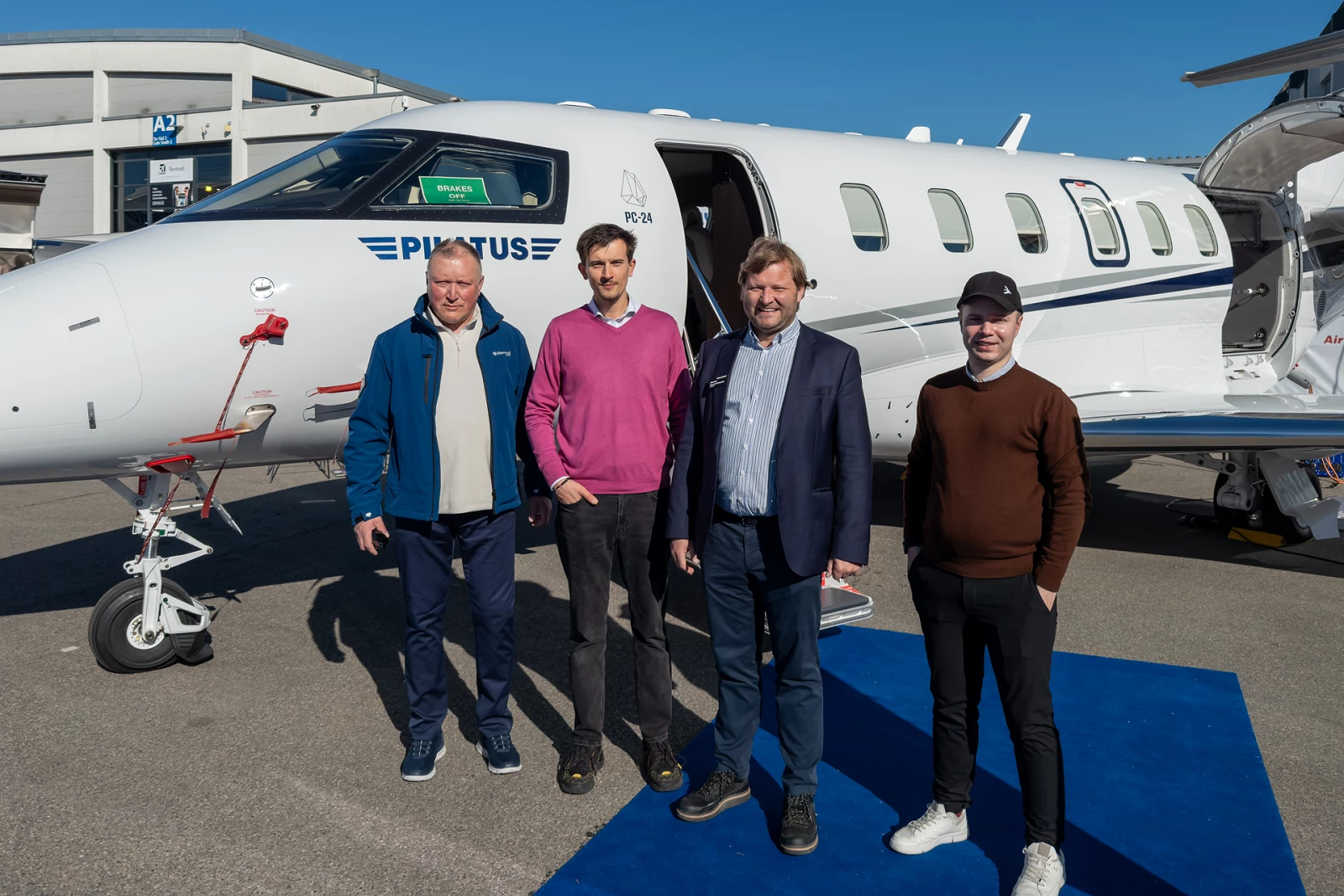
Undoubtedly, the Pilatus PC-24 was a popular model at the static display, which this year took up almost the entire outdoor area. Stepping on board, you feel as if you’re in a larger and even more advanced PC-12, with similar interior finishes but completely different performance specifications. A ceiling of FL410 and speeds of Mach 0.75 are possible only in jet aircraft, and passenger comfort is even greater. It is the only mid-size jet equipped with a fold-out sofa on board.
Among other jet aircraft, it’s also worth mentioning the other planes that visitors could see up close—Dassault showcased its flagship Falcon 6X model, Cessna presented business jets from the Cessna Citation family, and the largest aircraft on static display was the Bombardier Global, which drew a lot of interest from every aviator in the vicinity.
The topic of business aviation also encompasses ground support, as well as the organization and support of flight operations. This year, there was an even greater presence of many companies organizing charter flights, as well as ground handling and fueling companies, and representatives from numerous airports. Aircraft and business clients require support not only in the air but also on the ground, and this market continues to grow rapidly, as was evident at this year’s trade show.
![AERO26_20260423_8991.jpg [1.15 MB]](https://www.jbi.com.pl/storage/image/core_files/2026/7/3/711577839da0d3a86e777769a72ba124/jpg/jbinvestments/preview/AERO26_20260423_8991.webp)
Air Shows
The final day of AERO (Saturday) is dedicated to the general public and air shows. This year, the main attraction was the BO-105 helicopter from the Flying Bulls, as well as several other solo and formation aerobatic displays. There was also a nice Polish-German touch with a dynamic display by the Grob 120 TP turboprop aircraft, piloted by Dariusz Stachurski—the former leader of the Orlik Aerobatic Team.
On both Friday and Saturday, the AERO Career Days job fair was also held for visitors. Both young people and those with experience were able to broaden their horizons here and not only apply for various positions but also learn about a variety of career paths in aviation. This is especially important for young people, so that everyone is aware of just how many different fields are connected to aviation.
There is no doubt that the AERO Friedrichshafen trade show continues to grow and expand. This is a good sign that the world of General and Business Aviation is moving forward. And now all we can do is look forward to the next, even bigger edition in April 2027.
Text and photos:Filip Modrzejewski


